Case
Study
Overview
ZCroot
Web App
I led the end-to-end design of a six-week MVP for an AI-powered career readiness platform built for engineering students. The product combined resume optimization, ATS scoring, mock interviews, and job discovery into a personalized dashboard experience designed to support both free and premium users.
Operating as both designer and product partner, I restructured the information architecture, clarified the freemium strategy, and designed a scalable visual system aligned with a future white-label university model. The result is a launch-ready platform that balances user trust, engagement, and monetization under tight time and funding constraints.
Lead Designer
Role
Eng Lead, Founder
Squad
7 weeks
Duration
The Problem
This product required solving three interconnected challenges: monetization, readiness, and access.
1. Designing a Freemium Model That Builds Trust
The platform needed both free and premium tiers. The initial proposal limited free users to 10 job views per month — a restriction that risked limiting engagement and perceived value.
The challenge was balancing accessibility with clear upgrade incentives. I recommended shifting to five job views per day, encouraging habitual usage while reserving AI tools, mock interviews, and referral access for premium users. The trade-off: protect revenue potential without undermining adoption.
2. Closing the Employability Gap
Engineering students often struggle not with technical skill, but with presentation and hiring systems. Resumes fail ATS filters, LinkedIn profiles lack optimization, and interview readiness varies widely.
The product needed to move beyond job listings and provide structured preparation — positioning AI resume tools and mock interviews as confidence-building systems rather than surface-level features.
3. Access to Opportunity
Referrals significantly influence hiring outcomes. The platform aimed to bridge the access gap by integrating referral pathways and professional consultations, aligning with a long-term white-label vision for universities.
The core challenge was designing a scalable career-readiness ecosystem under tight time and funding constraints — prioritizing features that delivered immediate value while supporting future institutional growth.
The Solution
The solution focused on designing a cohesive, personalized dashboard that balanced user value with monetization strategy.
1. A Personalized Career Command Center
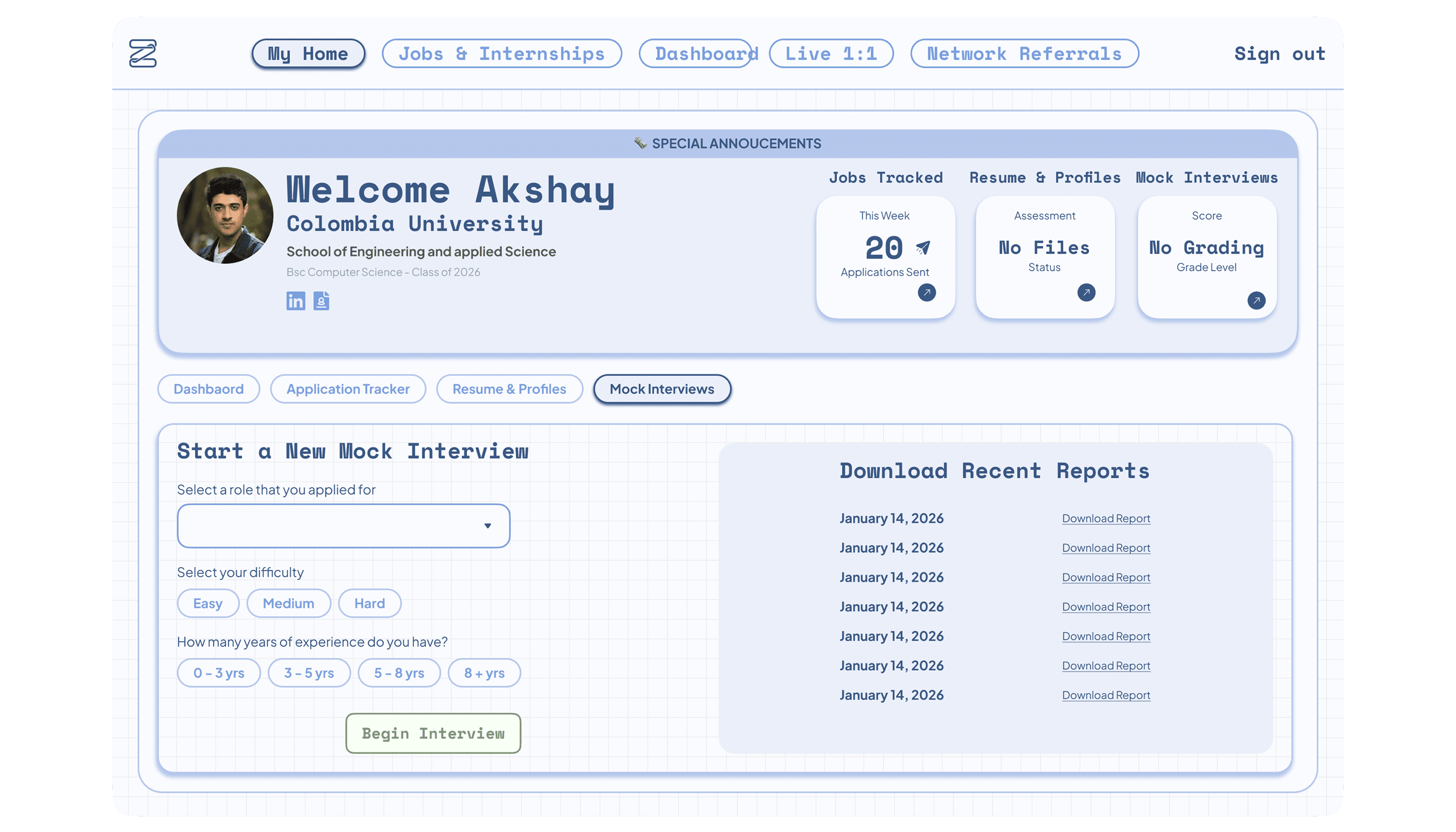
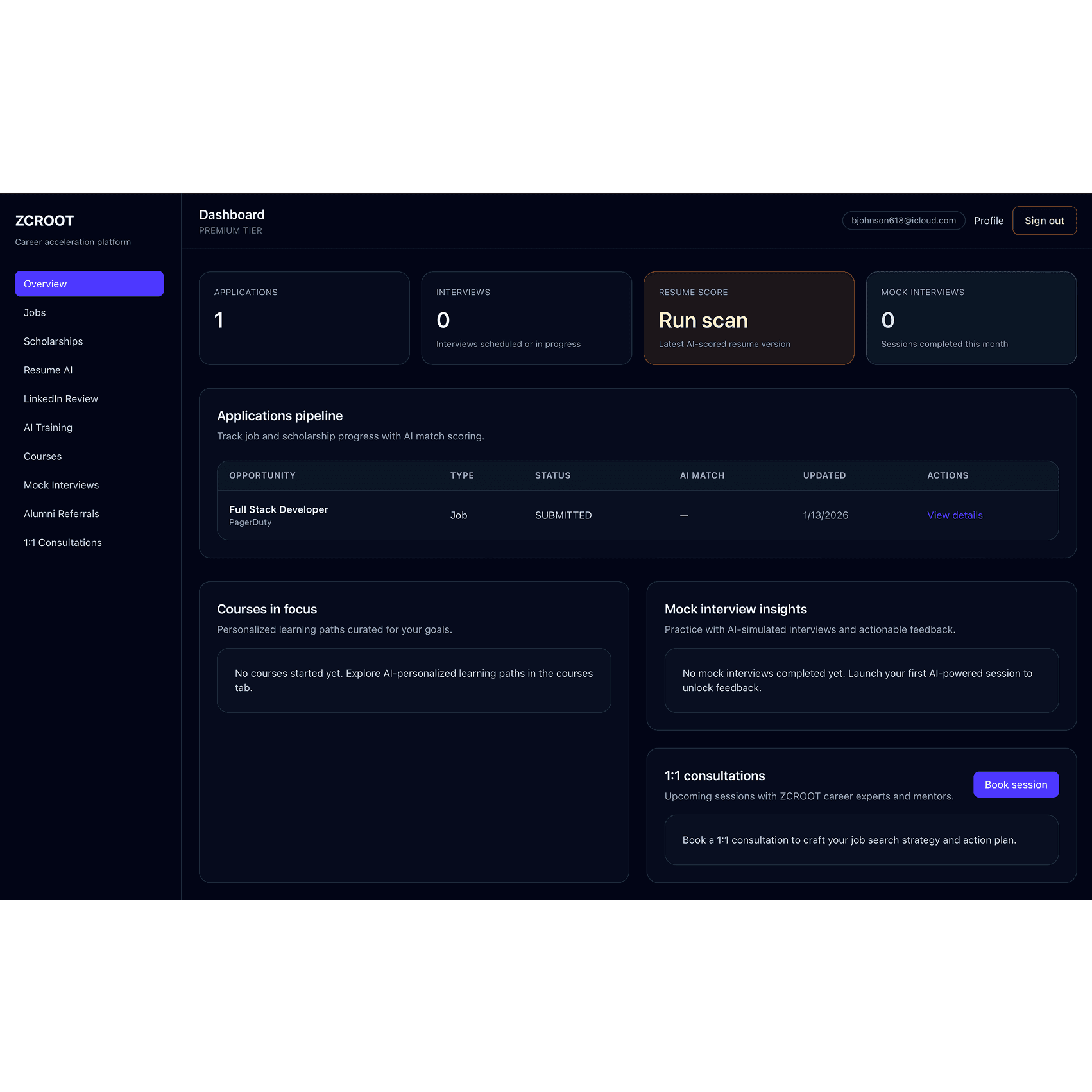
I designed the homepage as a dynamic dashboard that welcomed users by name, highlighted their major and institution, and surfaced career progress indicators. The goal was to create ownership and position the platform as an ongoing development hub — not just a job board.
2. Monetization Integrated, Not Hidden
Free and premium features were intentionally distributed across the interface. Locked tools remained visible but contextualized, allowing users to understand their value without feeling blocked. I audited early wireframes to ensure the experience didn’t feel overly gated.
3. A Structured Job-Readiness Path
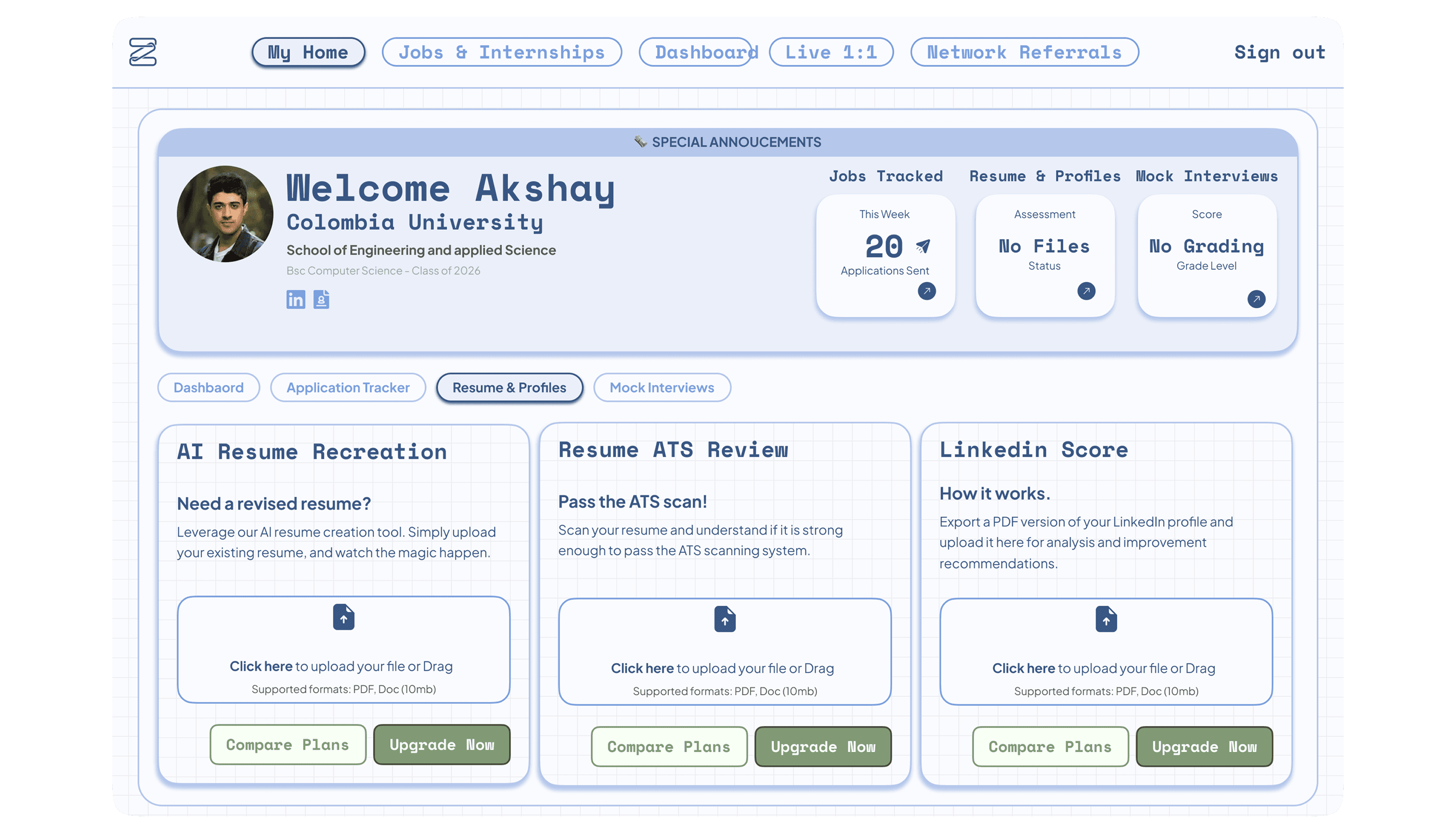
Instead of presenting isolated tools, I organized resume optimization, ATS scanning, LinkedIn improvements, and mock interviews into a guided progression. This reduced cognitive load and clarified “what to do next.”
4. Designing for Habit Formation
I challenged the initial limit of 10 job views per month and proposed five per day. This supported daily re-engagement and retention while preserving premium differentiation.
Each decision balanced engagement, trust, and long-term revenue strategy within a six-week MVP timeline.
The Results
1. MVP Delivered in Six Weeks
Designed and finalized the end-to-end product experience within a constrained six-week timeline, enabling engineering to move directly into build without major UX rework.
2. Monetization Strategy Clarified
Refined the freemium structure to better support engagement and upgrade visibility, aligning user experience with long-term revenue goals.
3. Scalable Design Foundation
Established a cohesive visual system and brand identity to support future white-label opportunities for universities and institutional partners.
4. Investor & Institutional Readiness
Delivered a polished, demo-ready product that supports early conversations with universities and potential investors ahead of launch.
The MVP is currently preparing for launch, with validation focused on user engagement, upgrade conversion, and institutional interest.
Discovery
The Process of Learning and finding a path forward
Because I joined after the initial concept phase, my discovery focused on market evaluation, competitive analysis, and structural assessment.
1. Competitive & Adjacent Market Analysis
I evaluated existing job boards, ATS scanners, resume tools, and educational platforms to understand feature parity, differentiation opportunities, and UX patterns. This helped clarify where we needed to match expectations (e.g., ATS scoring) versus where we could create a more cohesive ecosystem.
2. Brand & Aesthetic Direction
Brand perception was a priority for the founders. I analyzed products they admired — such as Gumroad, Figma Store, and Phantom — to understand their visual clarity, hierarchy, and tonal positioning. This informed early explorations of typography, color systems, and interface density appropriate for engineering students.
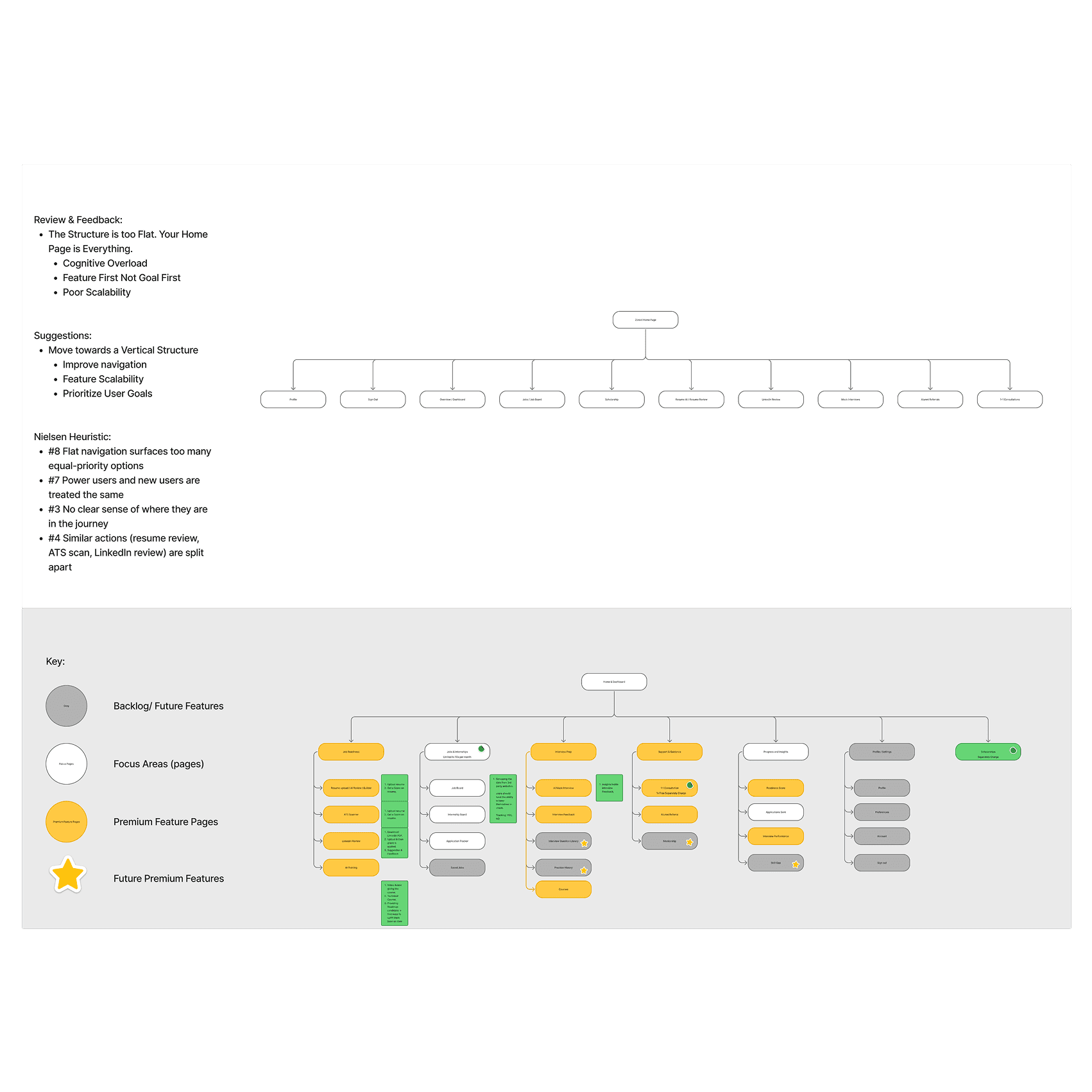
3. Information Architecture Audit
The initial engineered MVP had a flat architecture, with most functionality housed on a single homepage. I conducted a structural review and identified scalability and clarity risks.
I restructured the platform into clearer domains:
Job Readiness
Jobs & Internships
Courses
Premium Services
I also removed the scholarship feature, as it diluted the core value proposition and complicated the architecture.
4. Audience Alignment
I defined the primary user profile (junior and senior engineering students) and aligned visual tone, hierarchy, and feature emphasis to their goals: preparation, credibility, and opportunity access.
This discovery phase ensured the product moved from a feature collection to a structured, scalable experience before visual design began.
Define
The Process of figuring out "What are we actually Solving?"
The define phase focused on clarifying audience, prioritization, and product positioning before committing to design direction.
1. Target Audience & Personas
I defined the primary user as junior and senior engineering students — particularly those in computer science and technical disciplines. This alignment was critical, as the AI mock interview and skills-based preparation tools were strongest when tailored to technical roles.
This focus helped narrow scope and prevented the product from becoming overly generalized.
2. MVP Feature Prioritization
Given the six-week timeline, I prioritized features that delivered immediate, differentiated value:
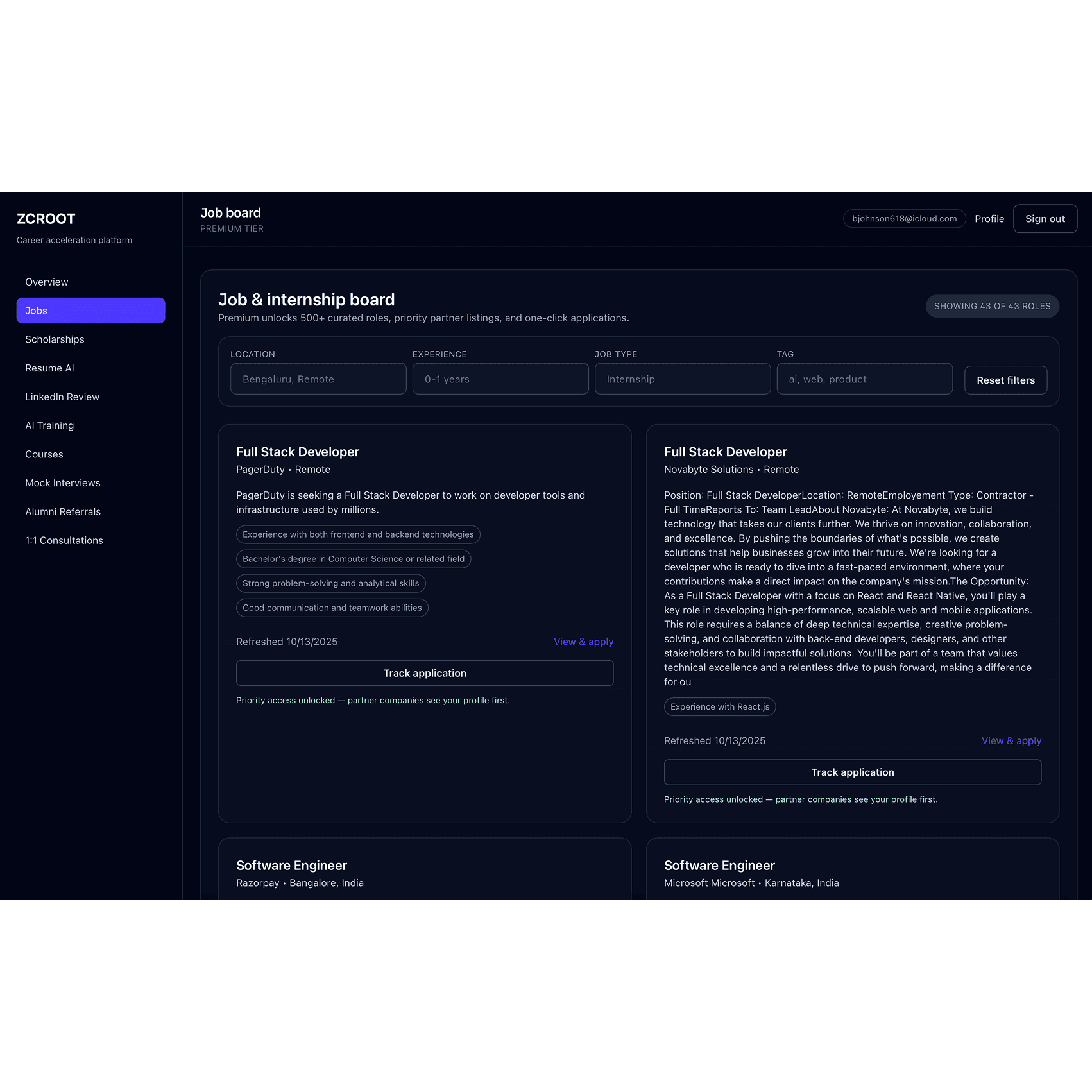
Job & internship board
AI mock interviews
ATS resume scanning
School-integrated newsfeed
Features were evaluated based on two criteria: user impact and institutional appeal. The goal was to demonstrate enough utility to validate product-market fit while supporting future university partnerships.
3. Key User Journeys
I mapped core user flows around a student’s natural rhythm: preparing materials, practicing interviews, discovering opportunities, and applying. The platform needed to integrate into their academic workflow — not compete with it.
4. Product Positioning Principle
One guiding question shaped the experience:
How do we ensure this is not just another job board?
This led to positioning the product as a career readiness ecosystem — combining preparation, application, and access — rather than a listing platform.
Explore
Exploring all the ways in which we can solve this problem.
The explore phase focused on iteration, alignment, and balancing business goals with user value.
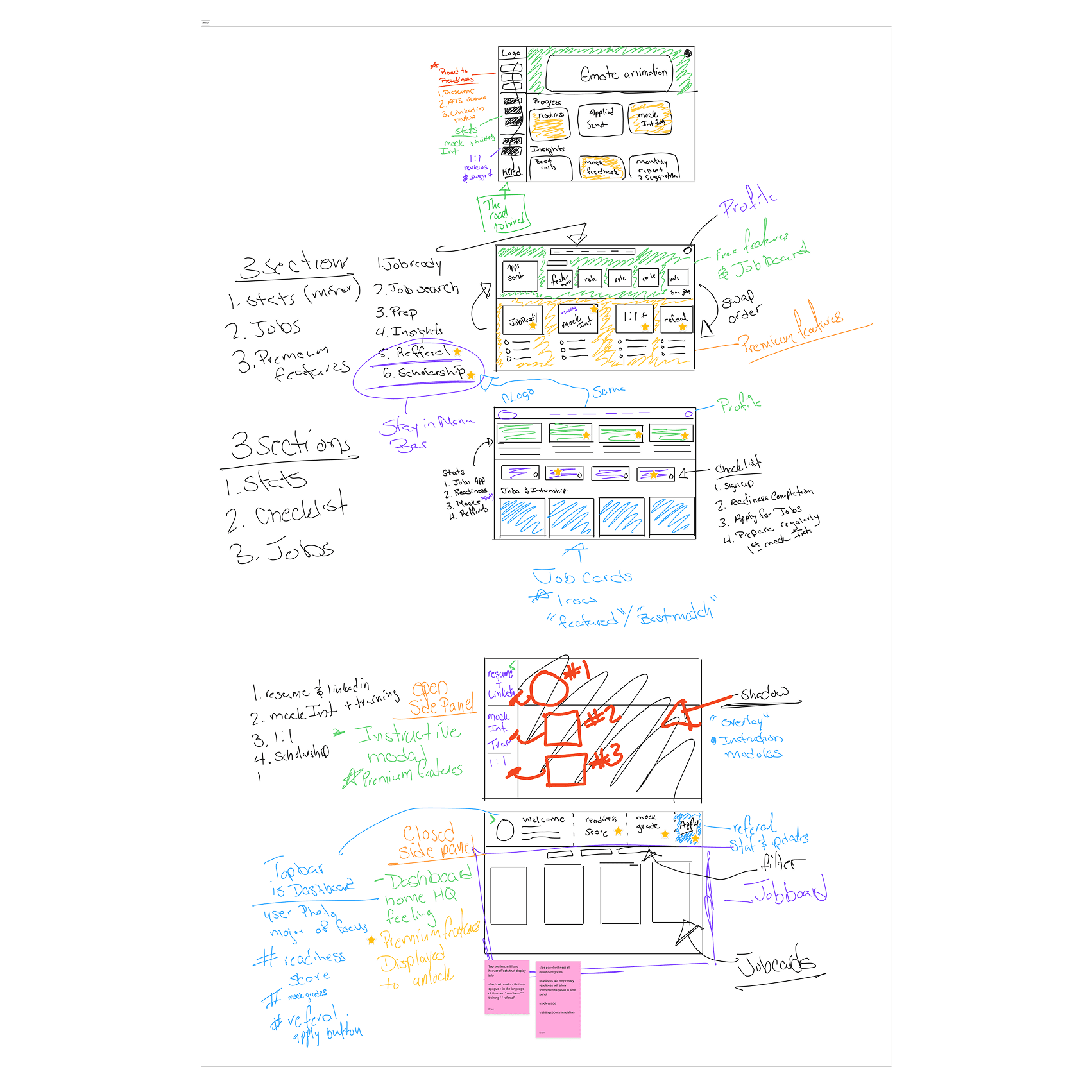
1. Dashboard Iteration
I sketched four distinct dashboard variations, each testing different layouts, hierarchy models, and distributions of free vs. premium features. A key consideration was ensuring both tiers felt valuable without overwhelming the experience with gated content.
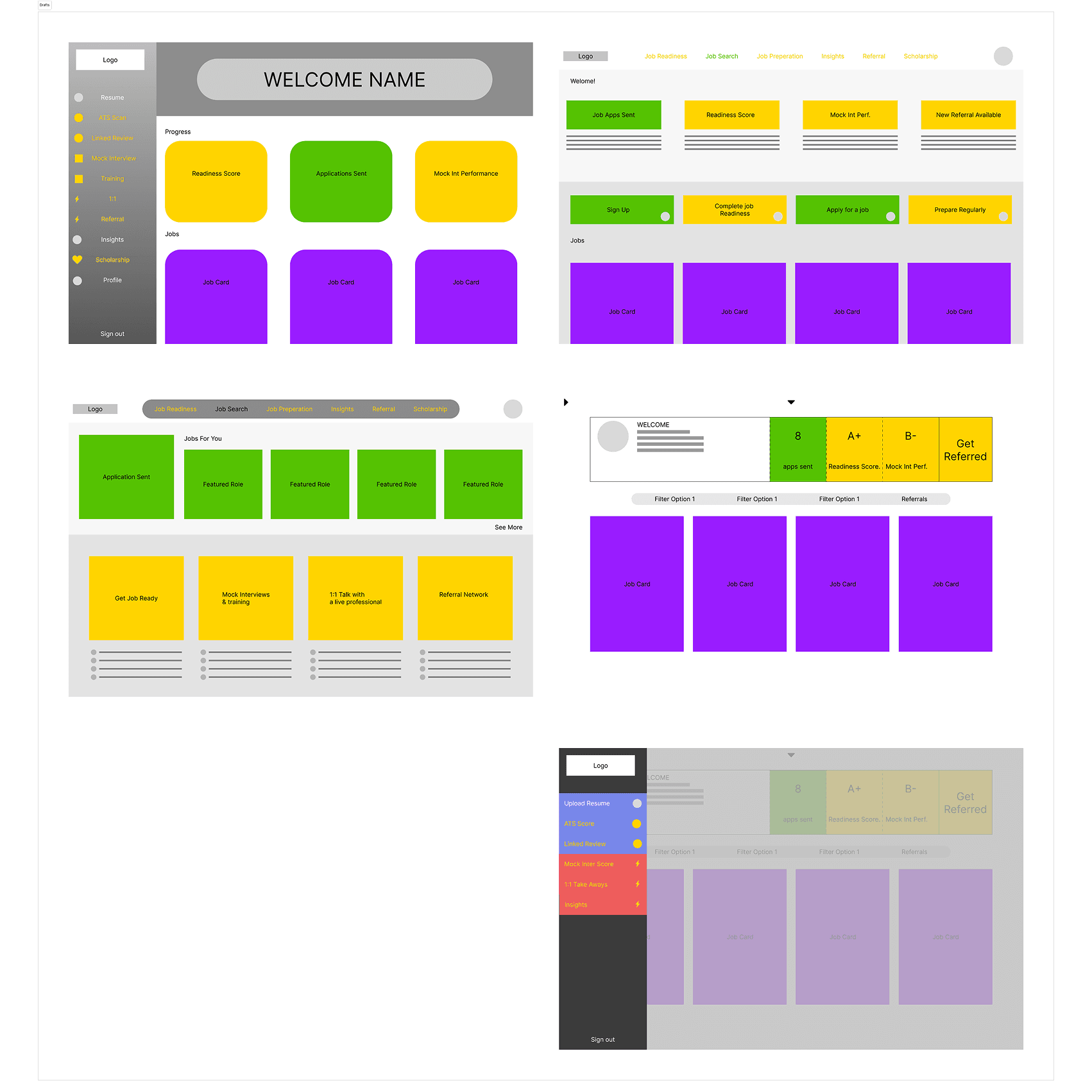
These concepts were translated into low-fidelity wireframes and reviewed collaboratively with the founder and tech lead to align on direction.
2. Navigation & Information Architecture
I explored multiple navigation structures to support the newly defined content domains (Job Readiness, Jobs & Internships, Courses, Services). This ensured the architecture scaled beyond a single homepage and reduced cognitive overload.
3. Strategic Feature Decisions
Several features were challenged during this phase:
Scholarships were removed as a standalone category and absorbed into the news feed to preserve architectural clarity.
Job cards were removed from the homepage to avoid positioning the product as just another job board.
The school newsfeed, initially considered for removal, was retained to strengthen institutional alignment and provide consistent value to free users.
These decisions reinforced the product’s positioning as a career ecosystem rather than a listing platform.
4. Partnership & Alignment
Throughout exploration, I positioned myself as a strategic partner to the founder and engineering lead — advocating for decisions that supported long-term differentiation while staying within MVP constraints.
Design
Flows, IA and Wire Frames. Taking Lofi to HiFI Designs
The design phase focused on translating validated structure into a cohesive visual system while balancing speed, clarity, and scalability.
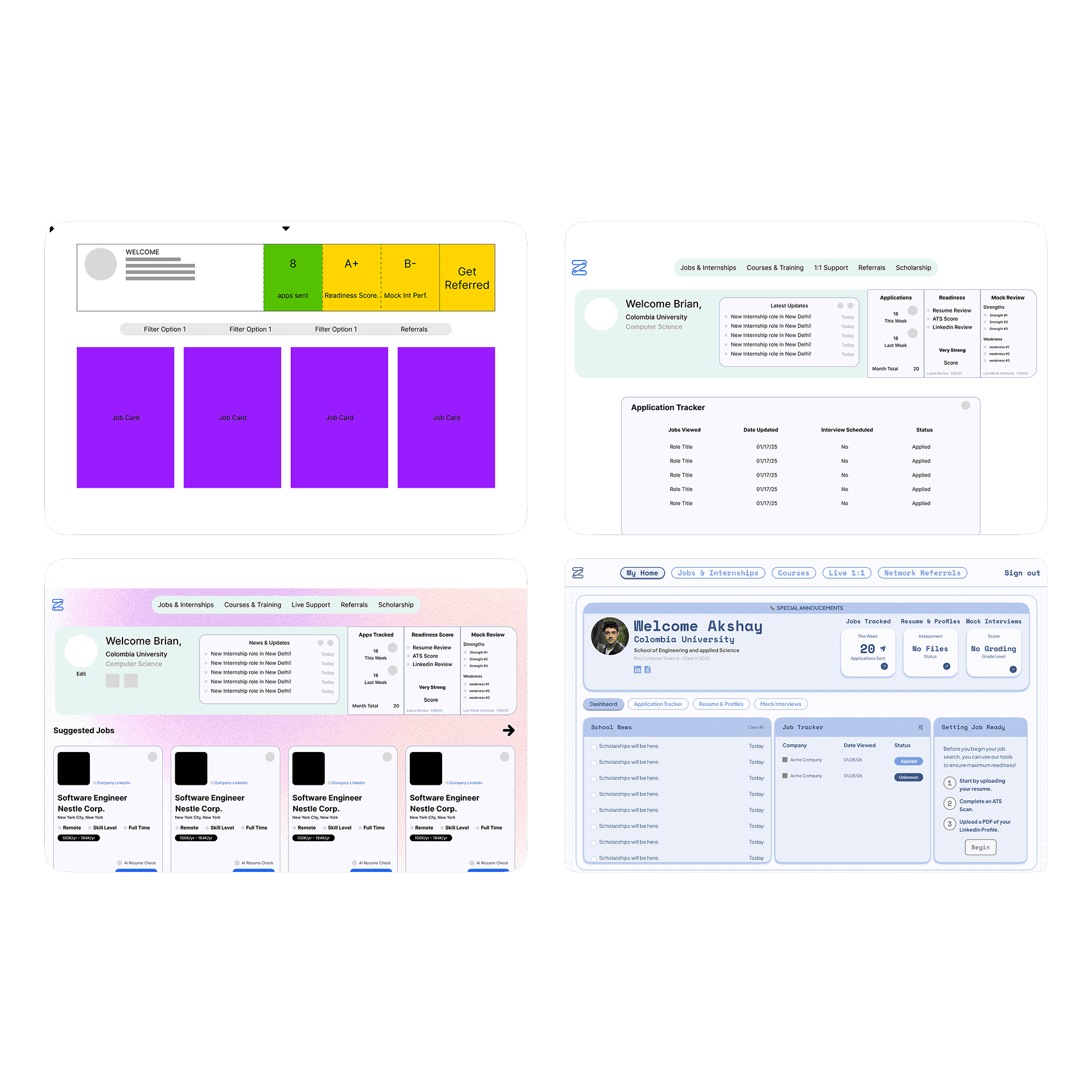
1. Mid-Fidelity Exploration Before Commitment
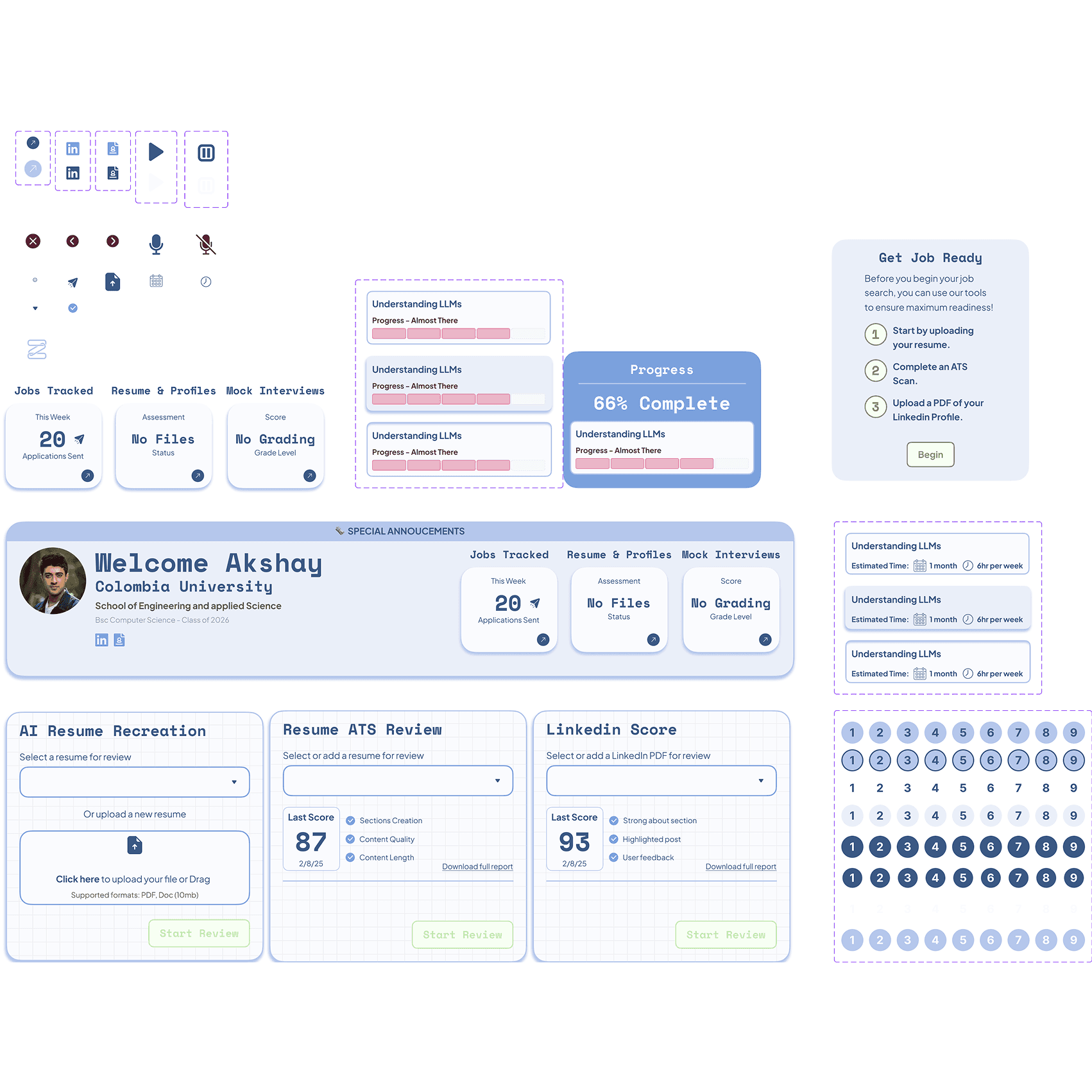
Before locking into a design system, I moved wireframes into a mid-fidelity exploration phase. This allowed me to test layout density, card treatments, shadow usage, spacing systems, and visual hierarchy without prematurely committing to components.
This “design sandbox” phase helped refine the interface direction before formalizing the system.
2. Visual Identity & Color Strategy
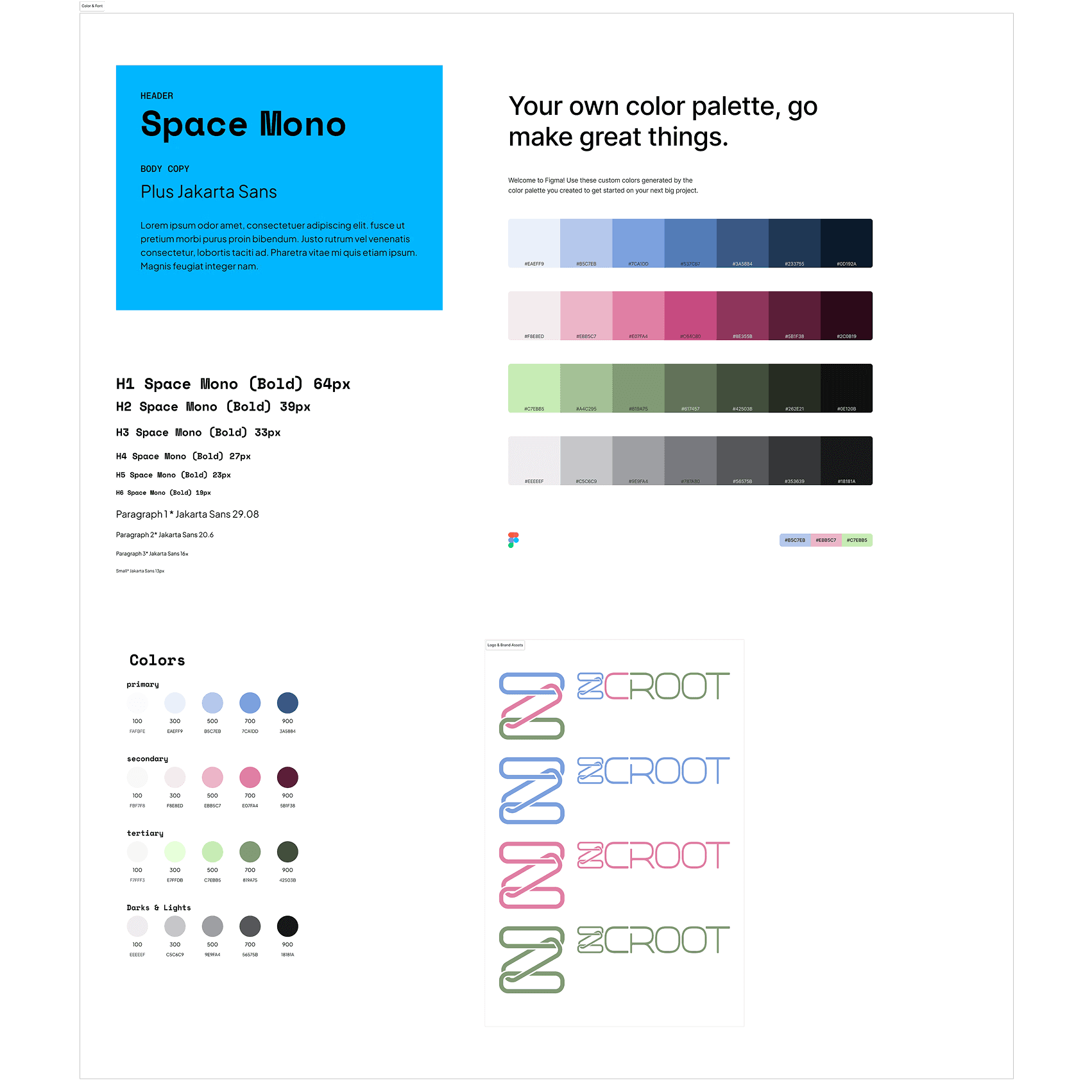
I developed a soft, modern visual language centered around a powder pastel blue as the primary color, supported by pastel pink and lime green accents.
The goal was to create an interface that felt:
Technical, yet approachable
Easy on the eyes for long sessions
Sophisticated without feeling corporate
Ultimately, the blue became dominant to preserve clarity and reduce visual fatigue.
3. Typography for Technical Credibility
I paired Space Mono for headers with Plus Jakarta Sans for body text.
Space Mono introduced a subtle technical tone aligned with engineering students, while Jakarta Sans ensured readability and accessibility across dense content areas.
This pairing reinforced brand personality without compromising usability.
4. Component System & Consistency
The interface leaned on rounded corners, clean card layouts, bold outlines, and subtle shadows to create softness within a structured grid. Components were designed for reuse across dashboard modules, job listings, readiness tools, and service pages.
5. Designing for MVP Constraints & Scalability
To preserve engineering bandwidth and accelerate launch, certain outputs — such as resume reviews and LinkedIn reports — were delivered as downloadable PDFs rather than fully interactive in-platform experiences.
Similarly, job applications were completed externally on company sites.
These decisions reduced development complexity while still delivering core value. The system was designed to scale later if validation supported deeper integration.
Test
COnducting rounds of testing before hand offs
Testing during this phase focused primarily on stakeholder validation and technical QA.
1. Founder Review & Alignment
I conducted iterative reviews with the founder to ensure the product direction aligned with both the long-term institutional vision and short-term MVP goals. Feedback was largely positive, with strong alignment on structure, positioning, and visual execution.
2. Engineering QA
As development progressed, the engineering team conducted QA reviews to validate feasibility, implementation accuracy, and system behavior. This ensured the design translated effectively into build.
3. Identified Next Steps
While the core experience was validated for MVP, several areas were identified for future iteration:
User account management
Onboarding flow
Marketing / landing page
Deeper feature maturity
The current scope successfully delivered the primary career-readiness experience, with additional refinements planned as the product evolves post-launch.
Reflection
No project is DONe. Reflect and plan what could be better and whats next.
This project strengthened my ability to operate not only as a designer, but as a product thinker. With limited research and a compressed timeline, I had to continuously weigh user value against scalability, monetization, and long-term positioning.
1. Designing Monetization With Intention
I learned that monetization works best when it is integrated into the experience — not bolted on. Upgrade moments should feel contextual and value-driven, not restrictive.
Creating multiple, intentional entry points for upgrade — while preserving meaningful utility in the free tier — is critical to building trust and encouraging conversion.
2. Designing for Growth & Habit Formation
This project reinforced the importance of designing for repeat engagement. Decisions like daily job view limits and structured readiness flows were less about restriction and more about encouraging ongoing interaction.
Growth is often shaped by small behavioral nudges embedded in the interface.
3. What I Would Test Post-Launch
Post-launch, I would prioritize validating:
Where users enter resume and LinkedIn uploads — and which entry points convert best
At what stage users upgrade (early exploration vs. post-application)
Engagement and skill progression within AI mock interviews
The real-world value of one-on-one consultations
Whether users improve measurable outcomes over time
These insights would inform both product refinement and monetization strategy.
4. Collaboration & Leadership
Working closely with the tech lead reinforced the value of strong design–engineering partnership. Aligning on feasibility early helped prevent overdesign and accelerated delivery.
Partnering with the founder also required balancing vision with practical execution — advocating for user clarity while supporting the broader institutional strategy.
Case Study
Overview
ZCroot
Web App
I led the end-to-end design of a six-week MVP for an AI-powered career readiness platform built for engineering students. The product combined resume optimization, ATS scoring, mock interviews, and job discovery into a personalized dashboard experience designed to support both free and premium users.
Operating as both designer and product partner, I restructured the information architecture, clarified the freemium strategy, and designed a scalable visual system aligned with a future white-label university model. The result is a launch-ready platform that balances user trust, engagement, and monetization under tight time and funding constraints.
Lead Designer
Role
Eng Lead, Founder
Squad
7 weeks
Duration
The Problem
This product required solving three interconnected challenges: monetization, readiness, and access.
1. Designing a Freemium Model That Builds Trust
The platform needed both free and premium tiers. The initial proposal limited free users to 10 job views per month — a restriction that risked limiting engagement and perceived value.
The challenge was balancing accessibility with clear upgrade incentives. I recommended shifting to five job views per day, encouraging habitual usage while reserving AI tools, mock interviews, and referral access for premium users. The trade-off: protect revenue potential without undermining adoption.
2. Closing the Employability Gap
Engineering students often struggle not with technical skill, but with presentation and hiring systems. Resumes fail ATS filters, LinkedIn profiles lack optimization, and interview readiness varies widely.
The product needed to move beyond job listings and provide structured preparation — positioning AI resume tools and mock interviews as confidence-building systems rather than surface-level features.
3. Access to Opportunity
Referrals significantly influence hiring outcomes. The platform aimed to bridge the access gap by integrating referral pathways and professional consultations, aligning with a long-term white-label vision for universities.
The core challenge was designing a scalable career-readiness ecosystem under tight time and funding constraints — prioritizing features that delivered immediate value while supporting future institutional growth.
The Solution
The solution focused on designing a cohesive, personalized dashboard that balanced user value with monetization strategy.
1. A Personalized Career Command Center
I designed the homepage as a dynamic dashboard that welcomed users by name, highlighted their major and institution, and surfaced career progress indicators. The goal was to create ownership and position the platform as an ongoing development hub — not just a job board.
2. Monetization Integrated, Not Hidden
Free and premium features were intentionally distributed across the interface. Locked tools remained visible but contextualized, allowing users to understand their value without feeling blocked. I audited early wireframes to ensure the experience didn’t feel overly gated.
3. A Structured Job-Readiness Path
Instead of presenting isolated tools, I organized resume optimization, ATS scanning, LinkedIn improvements, and mock interviews into a guided progression. This reduced cognitive load and clarified “what to do next.”
4. Designing for Habit Formation
I challenged the initial limit of 10 job views per month and proposed five per day. This supported daily re-engagement and retention while preserving premium differentiation.
Each decision balanced engagement, trust, and long-term revenue strategy within a six-week MVP timeline.
The Results
1. MVP Delivered in Six Weeks
Designed and finalized the end-to-end product experience within a constrained six-week timeline, enabling engineering to move directly into build without major UX rework.
2. Monetization Strategy Clarified
Refined the freemium structure to better support engagement and upgrade visibility, aligning user experience with long-term revenue goals.
3. Scalable Design Foundation
Established a cohesive visual system and brand identity to support future white-label opportunities for universities and institutional partners.
4. Investor & Institutional Readiness
Delivered a polished, demo-ready product that supports early conversations with universities and potential investors ahead of launch.
The MVP is currently preparing for launch, with validation focused on user engagement, upgrade conversion, and institutional interest.
Discovery
The Process of Learning and finding a path forward
Because I joined after the initial concept phase, my discovery focused on market evaluation, competitive analysis, and structural assessment.
1. Competitive & Adjacent Market Analysis
I evaluated existing job boards, ATS scanners, resume tools, and educational platforms to understand feature parity, differentiation opportunities, and UX patterns. This helped clarify where we needed to match expectations (e.g., ATS scoring) versus where we could create a more cohesive ecosystem.
2. Brand & Aesthetic Direction
Brand perception was a priority for the founders. I analyzed products they admired — such as Gumroad, Figma Store, and Phantom — to understand their visual clarity, hierarchy, and tonal positioning. This informed early explorations of typography, color systems, and interface density appropriate for engineering students.
3. Information Architecture Audit
The initial engineered MVP had a flat architecture, with most functionality housed on a single homepage. I conducted a structural review and identified scalability and clarity risks.
I restructured the platform into clearer domains:
Job Readiness
Jobs & Internships
Courses
Premium Services
I also removed the scholarship feature, as it diluted the core value proposition and complicated the architecture.
4. Audience Alignment
I defined the primary user profile (junior and senior engineering students) and aligned visual tone, hierarchy, and feature emphasis to their goals: preparation, credibility, and opportunity access.
This discovery phase ensured the product moved from a feature collection to a structured, scalable experience before visual design began.
Define
The Process of figuring out "What are we actually Solving?"
The define phase focused on clarifying audience, prioritization, and product positioning before committing to design direction.
1. Target Audience & Personas
I defined the primary user as junior and senior engineering students — particularly those in computer science and technical disciplines. This alignment was critical, as the AI mock interview and skills-based preparation tools were strongest when tailored to technical roles.
This focus helped narrow scope and prevented the product from becoming overly generalized.
2. MVP Feature Prioritization
Given the six-week timeline, I prioritized features that delivered immediate, differentiated value:
Job & internship board
AI mock interviews
ATS resume scanning
School-integrated newsfeed
Features were evaluated based on two criteria: user impact and institutional appeal. The goal was to demonstrate enough utility to validate product-market fit while supporting future university partnerships.
3. Key User Journeys
I mapped core user flows around a student’s natural rhythm: preparing materials, practicing interviews, discovering opportunities, and applying. The platform needed to integrate into their academic workflow — not compete with it.
4. Product Positioning Principle
One guiding question shaped the experience:
How do we ensure this is not just another job board?
This led to positioning the product as a career readiness ecosystem — combining preparation, application, and access — rather than a listing platform.
Explore
Exploring all the ways in which we can solve this problem.
The explore phase focused on iteration, alignment, and balancing business goals with user value.
1. Dashboard Iteration
I sketched four distinct dashboard variations, each testing different layouts, hierarchy models, and distributions of free vs. premium features. A key consideration was ensuring both tiers felt valuable without overwhelming the experience with gated content.
These concepts were translated into low-fidelity wireframes and reviewed collaboratively with the founder and tech lead to align on direction.
2. Navigation & Information Architecture
I explored multiple navigation structures to support the newly defined content domains (Job Readiness, Jobs & Internships, Courses, Services). This ensured the architecture scaled beyond a single homepage and reduced cognitive overload.
3. Strategic Feature Decisions
Several features were challenged during this phase:
Scholarships were removed as a standalone category and absorbed into the news feed to preserve architectural clarity.
Job cards were removed from the homepage to avoid positioning the product as just another job board.
The school newsfeed, initially considered for removal, was retained to strengthen institutional alignment and provide consistent value to free users.
These decisions reinforced the product’s positioning as a career ecosystem rather than a listing platform.
4. Partnership & Alignment
Throughout exploration, I positioned myself as a strategic partner to the founder and engineering lead — advocating for decisions that supported long-term differentiation while staying within MVP constraints.
Design
Flows, IA and Wire Frames. Taking Lofi to HiFI Designs
The design phase focused on translating validated structure into a cohesive visual system while balancing speed, clarity, and scalability.
1. Mid-Fidelity Exploration Before Commitment
Before locking into a design system, I moved wireframes into a mid-fidelity exploration phase. This allowed me to test layout density, card treatments, shadow usage, spacing systems, and visual hierarchy without prematurely committing to components.
This “design sandbox” phase helped refine the interface direction before formalizing the system.
2. Visual Identity & Color Strategy
I developed a soft, modern visual language centered around a powder pastel blue as the primary color, supported by pastel pink and lime green accents.
The goal was to create an interface that felt:
Technical, yet approachable
Easy on the eyes for long sessions
Sophisticated without feeling corporate
Ultimately, the blue became dominant to preserve clarity and reduce visual fatigue.
3. Typography for Technical Credibility
I paired Space Mono for headers with Plus Jakarta Sans for body text.
Space Mono introduced a subtle technical tone aligned with engineering students, while Jakarta Sans ensured readability and accessibility across dense content areas.
This pairing reinforced brand personality without compromising usability.
4. Component System & Consistency
The interface leaned on rounded corners, clean card layouts, bold outlines, and subtle shadows to create softness within a structured grid. Components were designed for reuse across dashboard modules, job listings, readiness tools, and service pages.
5. Designing for MVP Constraints & Scalability
To preserve engineering bandwidth and accelerate launch, certain outputs — such as resume reviews and LinkedIn reports — were delivered as downloadable PDFs rather than fully interactive in-platform experiences.
Similarly, job applications were completed externally on company sites.
These decisions reduced development complexity while still delivering core value. The system was designed to scale later if validation supported deeper integration.
Test
COnducting rounds of testing before hand offs
Testing during this phase focused primarily on stakeholder validation and technical QA.
1. Founder Review & Alignment
I conducted iterative reviews with the founder to ensure the product direction aligned with both the long-term institutional vision and short-term MVP goals. Feedback was largely positive, with strong alignment on structure, positioning, and visual execution.
2. Engineering QA
As development progressed, the engineering team conducted QA reviews to validate feasibility, implementation accuracy, and system behavior. This ensured the design translated effectively into build.
3. Identified Next Steps
While the core experience was validated for MVP, several areas were identified for future iteration:
User account management
Onboarding flow
Marketing / landing page
Deeper feature maturity
The current scope successfully delivered the primary career-readiness experience, with additional refinements planned as the product evolves post-launch.
Reflection
No project is DONe. Reflect and plan what could be better and whats next.
This project strengthened my ability to operate not only as a designer, but as a product thinker. With limited research and a compressed timeline, I had to continuously weigh user value against scalability, monetization, and long-term positioning.
1. Designing Monetization With Intention
I learned that monetization works best when it is integrated into the experience — not bolted on. Upgrade moments should feel contextual and value-driven, not restrictive.
Creating multiple, intentional entry points for upgrade — while preserving meaningful utility in the free tier — is critical to building trust and encouraging conversion.
2. Designing for Growth & Habit Formation
This project reinforced the importance of designing for repeat engagement. Decisions like daily job view limits and structured readiness flows were less about restriction and more about encouraging ongoing interaction.
Growth is often shaped by small behavioral nudges embedded in the interface.
3. What I Would Test Post-Launch
Post-launch, I would prioritize validating:
Where users enter resume and LinkedIn uploads — and which entry points convert best
At what stage users upgrade (early exploration vs. post-application)
Engagement and skill progression within AI mock interviews
The real-world value of one-on-one consultations
Whether users improve measurable outcomes over time
These insights would inform both product refinement and monetization strategy.
4. Collaboration & Leadership
Working closely with the tech lead reinforced the value of strong design–engineering partnership. Aligning on feasibility early helped prevent overdesign and accelerated delivery.
Partnering with the founder also required balancing vision with practical execution — advocating for user clarity while supporting the broader institutional strategy.
Case
Study
Overview
ZCroot
Web App
I led the end-to-end design of a six-week MVP for an AI-powered career readiness platform built for engineering students. The product combined resume optimization, ATS scoring, mock interviews, and job discovery into a personalized dashboard experience designed to support both free and premium users.
Operating as both designer and product partner, I restructured the information architecture, clarified the freemium strategy, and designed a scalable visual system aligned with a future white-label university model. The result is a launch-ready platform that balances user trust, engagement, and monetization under tight time and funding constraints.
Lead Designer
R0le
Eng Lead, Founder
Squad
7 weeks
Duration
The Problem
This product required solving three interconnected challenges: monetization, readiness, and access.
1. Designing a Freemium Model That Builds Trust
The platform needed both free and premium tiers. The initial proposal limited free users to 10 job views per month — a restriction that risked limiting engagement and perceived value.
The challenge was balancing accessibility with clear upgrade incentives. I recommended shifting to five job views per day, encouraging habitual usage while reserving AI tools, mock interviews, and referral access for premium users. The trade-off: protect revenue potential without undermining adoption.
2. Closing the Employability Gap
Engineering students often struggle not with technical skill, but with presentation and hiring systems. Resumes fail ATS filters, LinkedIn profiles lack optimization, and interview readiness varies widely.
The product needed to move beyond job listings and provide structured preparation — positioning AI resume tools and mock interviews as confidence-building systems rather than surface-level features.
3. Access to Opportunity
Referrals significantly influence hiring outcomes. The platform aimed to bridge the access gap by integrating referral pathways and professional consultations, aligning with a long-term white-label vision for universities.
The core challenge was designing a scalable career-readiness ecosystem under tight time and funding constraints — prioritizing features that delivered immediate value while supporting future institutional growth.
The Solution
The solution focused on designing a cohesive, personalized dashboard that balanced user value with monetization strategy.
1. A Personalized Career Command Center
I designed the homepage as a dynamic dashboard that welcomed users by name, highlighted their major and institution, and surfaced career progress indicators. The goal was to create ownership and position the platform as an ongoing development hub — not just a job board.
2. Monetization Integrated, Not Hidden
Free and premium features were intentionally distributed across the interface. Locked tools remained visible but contextualized, allowing users to understand their value without feeling blocked. I audited early wireframes to ensure the experience didn’t feel overly gated.
3. A Structured Job-Readiness Path
Instead of presenting isolated tools, I organized resume optimization, ATS scanning, LinkedIn improvements, and mock interviews into a guided progression. This reduced cognitive load and clarified “what to do next.”
4. Designing for Habit Formation
I challenged the initial limit of 10 job views per month and proposed five per day. This supported daily re-engagement and retention while preserving premium differentiation.
Each decision balanced engagement, trust, and long-term revenue strategy within a six-week MVP timeline.
The Results
1. MVP Delivered in Six Weeks
Designed and finalized the end-to-end product experience within a constrained six-week timeline, enabling engineering to move directly into build without major UX rework.
2. Monetization Strategy Clarified
Refined the freemium structure to better support engagement and upgrade visibility, aligning user experience with long-term revenue goals.
3. Scalable Design Foundation
Established a cohesive visual system and brand identity to support future white-label opportunities for universities and institutional partners.
4. Investor & Institutional Readiness
Delivered a polished, demo-ready product that supports early conversations with universities and potential investors ahead of launch.
The MVP is currently preparing for launch, with validation focused on user engagement, upgrade conversion, and institutional interest.
Discovery
The Process of Learning and finding a path forward
Because I joined after the initial concept phase, my discovery focused on market evaluation, competitive analysis, and structural assessment.
1. Competitive & Adjacent Market Analysis
I evaluated existing job boards, ATS scanners, resume tools, and educational platforms to understand feature parity, differentiation opportunities, and UX patterns. This helped clarify where we needed to match expectations (e.g., ATS scoring) versus where we could create a more cohesive ecosystem.
2. Brand & Aesthetic Direction
Brand perception was a priority for the founders. I analyzed products they admired — such as Gumroad, Figma Store, and Phantom — to understand their visual clarity, hierarchy, and tonal positioning. This informed early explorations of typography, color systems, and interface density appropriate for engineering students.
3. Information Architecture Audit
The initial engineered MVP had a flat architecture, with most functionality housed on a single homepage. I conducted a structural review and identified scalability and clarity risks.
I restructured the platform into clearer domains:
Job Readiness
Jobs & Internships
Courses
Premium Services
I also removed the scholarship feature, as it diluted the core value proposition and complicated the architecture.
4. Audience Alignment
I defined the primary user profile (junior and senior engineering students) and aligned visual tone, hierarchy, and feature emphasis to their goals: preparation, credibility, and opportunity access.
This discovery phase ensured the product moved from a feature collection to a structured, scalable experience before visual design began.
Define
The Process of figuring out "What are we actually Solving?"
The define phase focused on clarifying audience, prioritization, and product positioning before committing to design direction.
1. Target Audience & Personas
I defined the primary user as junior and senior engineering students — particularly those in computer science and technical disciplines. This alignment was critical, as the AI mock interview and skills-based preparation tools were strongest when tailored to technical roles.
This focus helped narrow scope and prevented the product from becoming overly generalized.
2. MVP Feature Prioritization
Given the six-week timeline, I prioritized features that delivered immediate, differentiated value:
Job & internship board
AI mock interviews
ATS resume scanning
School-integrated newsfeed
Features were evaluated based on two criteria: user impact and institutional appeal. The goal was to demonstrate enough utility to validate product-market fit while supporting future university partnerships.
3. Key User Journeys
I mapped core user flows around a student’s natural rhythm: preparing materials, practicing interviews, discovering opportunities, and applying. The platform needed to integrate into their academic workflow — not compete with it.
4. Product Positioning Principle
One guiding question shaped the experience:
How do we ensure this is not just another job board?
This led to positioning the product as a career readiness ecosystem — combining preparation, application, and access — rather than a listing platform.
Explore
Exploring all the ways in which we can solve this problem.
The explore phase focused on iteration, alignment, and balancing business goals with user value.
1. Dashboard Iteration
I sketched four distinct dashboard variations, each testing different layouts, hierarchy models, and distributions of free vs. premium features. A key consideration was ensuring both tiers felt valuable without overwhelming the experience with gated content.
These concepts were translated into low-fidelity wireframes and reviewed collaboratively with the founder and tech lead to align on direction.
2. Navigation & Information Architecture
I explored multiple navigation structures to support the newly defined content domains (Job Readiness, Jobs & Internships, Courses, Services). This ensured the architecture scaled beyond a single homepage and reduced cognitive overload.
3. Strategic Feature Decisions
Several features were challenged during this phase:
Scholarships were removed as a standalone category and absorbed into the news feed to preserve architectural clarity.
Job cards were removed from the homepage to avoid positioning the product as just another job board.
The school newsfeed, initially considered for removal, was retained to strengthen institutional alignment and provide consistent value to free users.
These decisions reinforced the product’s positioning as a career ecosystem rather than a listing platform.
4. Partnership & Alignment
Throughout exploration, I positioned myself as a strategic partner to the founder and engineering lead — advocating for decisions that supported long-term differentiation while staying within MVP constraints.
Design
Flows, IA and Wire Frames. Taking Lofi to HiFI Designs
The design phase focused on translating validated structure into a cohesive visual system while balancing speed, clarity, and scalability.
1. Mid-Fidelity Exploration Before Commitment
Before locking into a design system, I moved wireframes into a mid-fidelity exploration phase. This allowed me to test layout density, card treatments, shadow usage, spacing systems, and visual hierarchy without prematurely committing to components.
This “design sandbox” phase helped refine the interface direction before formalizing the system.
2. Visual Identity & Color Strategy
I developed a soft, modern visual language centered around a powder pastel blue as the primary color, supported by pastel pink and lime green accents.
The goal was to create an interface that felt:
Technical, yet approachable
Easy on the eyes for long sessions
Sophisticated without feeling corporate
Ultimately, the blue became dominant to preserve clarity and reduce visual fatigue.
3. Typography for Technical Credibility
I paired Space Mono for headers with Plus Jakarta Sans for body text.
Space Mono introduced a subtle technical tone aligned with engineering students, while Jakarta Sans ensured readability and accessibility across dense content areas.
This pairing reinforced brand personality without compromising usability.
4. Component System & Consistency
The interface leaned on rounded corners, clean card layouts, bold outlines, and subtle shadows to create softness within a structured grid. Components were designed for reuse across dashboard modules, job listings, readiness tools, and service pages.
5. Designing for MVP Constraints & Scalability
To preserve engineering bandwidth and accelerate launch, certain outputs — such as resume reviews and LinkedIn reports — were delivered as downloadable PDFs rather than fully interactive in-platform experiences.
Similarly, job applications were completed externally on company sites.
These decisions reduced development complexity while still delivering core value. The system was designed to scale later if validation supported deeper integration.
Test
COnducting rounds of testing before hand offs
Testing during this phase focused primarily on stakeholder validation and technical QA.
1. Founder Review & Alignment
I conducted iterative reviews with the founder to ensure the product direction aligned with both the long-term institutional vision and short-term MVP goals. Feedback was largely positive, with strong alignment on structure, positioning, and visual execution.
2. Engineering QA
As development progressed, the engineering team conducted QA reviews to validate feasibility, implementation accuracy, and system behavior. This ensured the design translated effectively into build.
3. Identified Next Steps
While the core experience was validated for MVP, several areas were identified for future iteration:
User account management
Onboarding flow
Marketing / landing page
Deeper feature maturity
The current scope successfully delivered the primary career-readiness experience, with additional refinements planned as the product evolves post-launch.
Reflection
No project is DONe. Reflect and plan what could be better and whats next.
This project strengthened my ability to operate not only as a designer, but as a product thinker. With limited research and a compressed timeline, I had to continuously weigh user value against scalability, monetization, and long-term positioning.
1. Designing Monetization With Intention
I learned that monetization works best when it is integrated into the experience — not bolted on. Upgrade moments should feel contextual and value-driven, not restrictive.
Creating multiple, intentional entry points for upgrade — while preserving meaningful utility in the free tier — is critical to building trust and encouraging conversion.
2. Designing for Growth & Habit Formation
This project reinforced the importance of designing for repeat engagement. Decisions like daily job view limits and structured readiness flows were less about restriction and more about encouraging ongoing interaction.
Growth is often shaped by small behavioral nudges embedded in the interface.
3. What I Would Test Post-Launch
Post-launch, I would prioritize validating:
Where users enter resume and LinkedIn uploads — and which entry points convert best
At what stage users upgrade (early exploration vs. post-application)
Engagement and skill progression within AI mock interviews
The real-world value of one-on-one consultations
Whether users improve measurable outcomes over time
These insights would inform both product refinement and monetization strategy.
4. Collaboration & Leadership
Working closely with the tech lead reinforced the value of strong design–engineering partnership. Aligning on feasibility early helped prevent overdesign and accelerated delivery.
Partnering with the founder also required balancing vision with practical execution — advocating for user clarity while supporting the broader institutional strategy.