Case
Study
Overview
CAD. Online
App MVP
I led the design of a mobile tutoring platform that modernized a traditionally manual booking model into a scalable, revenue-driven digital experience. By supporting parents, students, and tutors within a single system, the product centralized scheduling, communication, payments, and discovery while preserving the company’s existing tutoring philosophy. A credit-based purchasing model unlocked recurring revenue and flexible pricing, aligning business goals with user needs. This project highlights my strength in designing within real operational constraints, collaborating with executive stakeholders, and translating complex service workflows into intuitive, conversion-focused mobile experiences.
Lead Designer
Role
Eric, Designer - Edward, CEO Head of Eng
Squad
7 weeks
Duration
The Problem
When a Proven Service Model Stops Scaling
The company had built a successful tutoring business across core academic subjects, but its operating model hadn’t evolved with user expectations or market competition.
User Impact
Students and parents experienced friction when booking, rescheduling, or canceling sessions
Communication and payment details were fragmented across emails and phone calls, creating confusion and mistrust
Users lacked a single place to manage sessions, progress, and tutor relationships
Business Impact
A manual, offline-first workflow limited scalability and operational efficiency
The company lacked visibility into user behavior, engagement, and retention
In a crowded education market shaped by mobile-first experiences, the platform risked falling behind faster, more seamless competitors
Core Tension
The business needed to modernize its experience without breaking what already worked — preserving its trusted tutoring model while expanding into a scalable, mobile-first platform that could support growth, insight, and new revenue opportunities.
The Solution
Evolving a Proven Model Into a Scalable Platform
I designed a mobile-first tutoring platform that modernized the experience without disrupting the company’s trusted service model — focusing on clarity, flexibility, and long-term scalability.
Experience Strategy
Rather than creating a one-size-fits-all app, the solution centered on role-aware experiences that respected the distinct needs of parents, students, and teachers while sharing a common platform foundation.
Key Design Decisions
Role-based onboarding to quickly understand user intent and tailor the experience for parents, students, or teachers
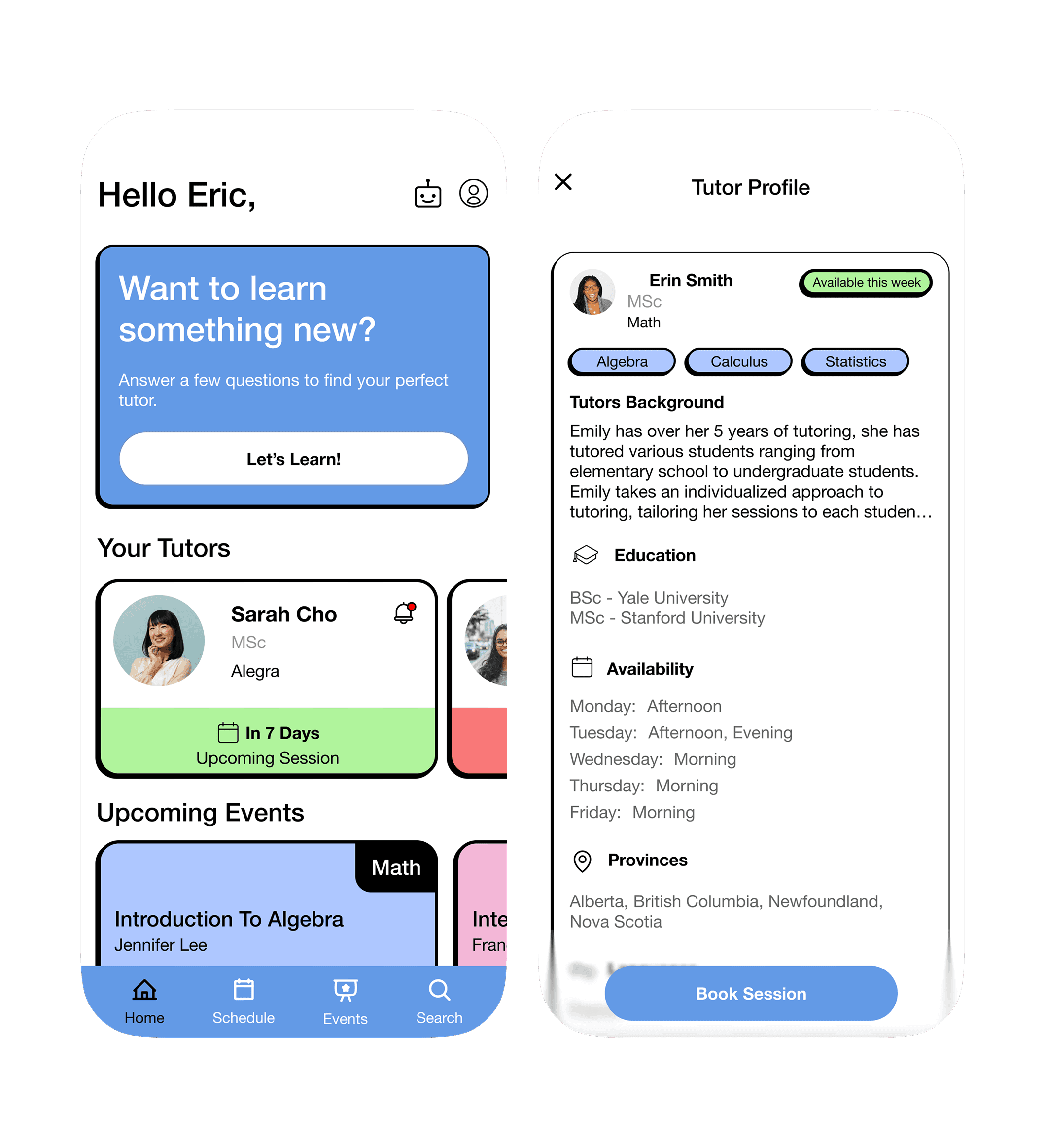
A centralized home experience that surfaced what mattered most: upcoming sessions, tutor communication, and next actions
Integrated discovery and booking, allowing users to find and schedule tutors without leaving the platform
A credit-based system that simplified payments, supported rescheduling, and enabled scalable pricing models through bundled credits and promotions
Platform Alignment
The solution intentionally extended the company’s existing educational philosophy rather than replacing it — preserving trust while enabling:
Operational efficiency
Better user visibility and engagement tracking
New, flexible revenue opportunities
The Results
User & Platform Impact
Centralized booking, communication, and discovery into a single mobile experience
Reduced friction around scheduling, rescheduling, and payments
Supported parents, students, and tutors within one cohesive, role-aware system
Business Impact
Delivered a high-fidelity MVP ready for development and launch
Introduced a scalable, credit-based model that enabled recurring revenue
Created flexibility for promotions, bundles, and seasonal pricing
Gave the business visibility into user behavior, engagement, and demand patterns
Outcome
The platform transformed a manual, offline-heavy tutoring operation into a mobile-first system designed to scale — without compromising the company’s existing educational model or user trust.
Discovery
The Process of Learning and finding a path forward
From Assumptions to Role-Specific Needs
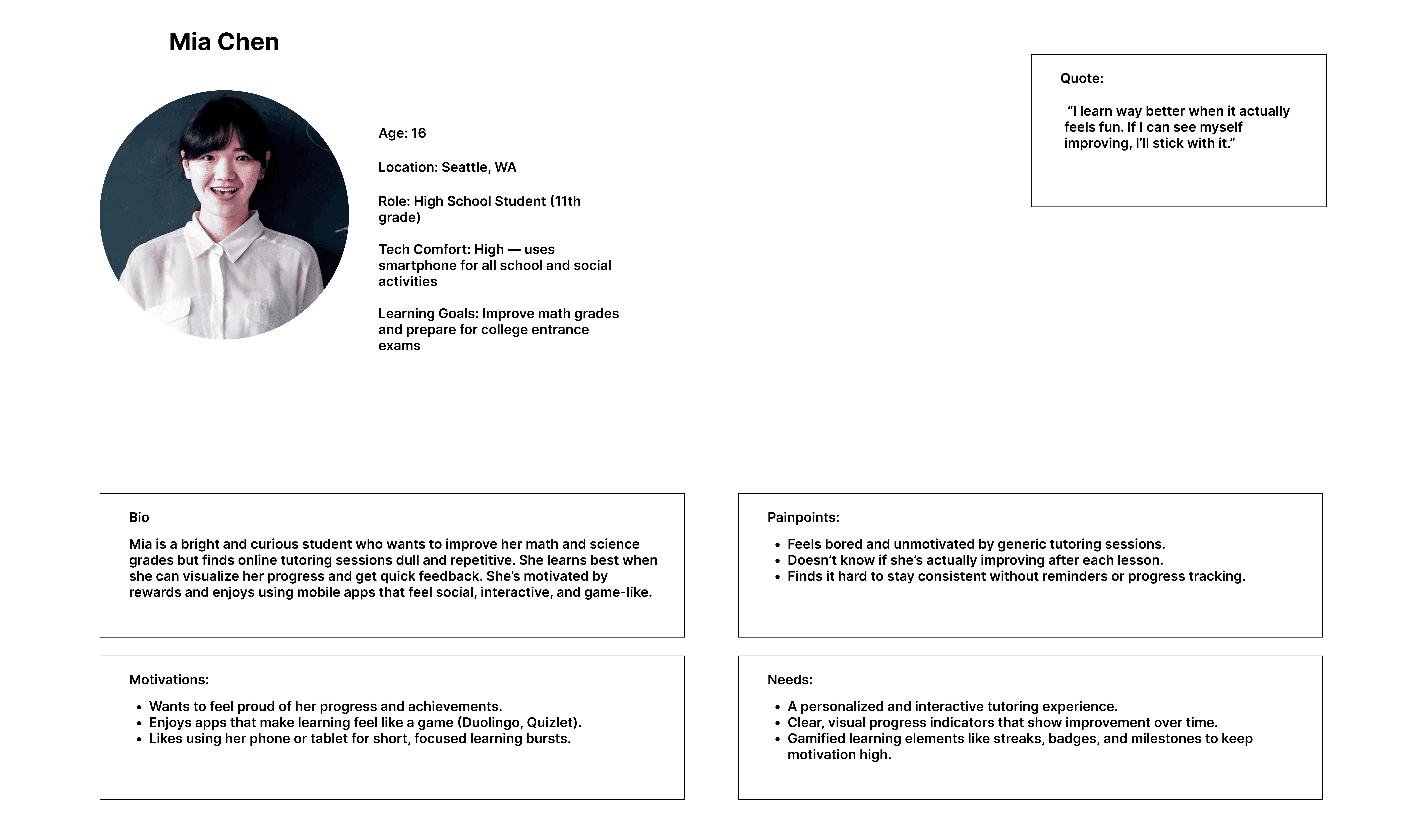
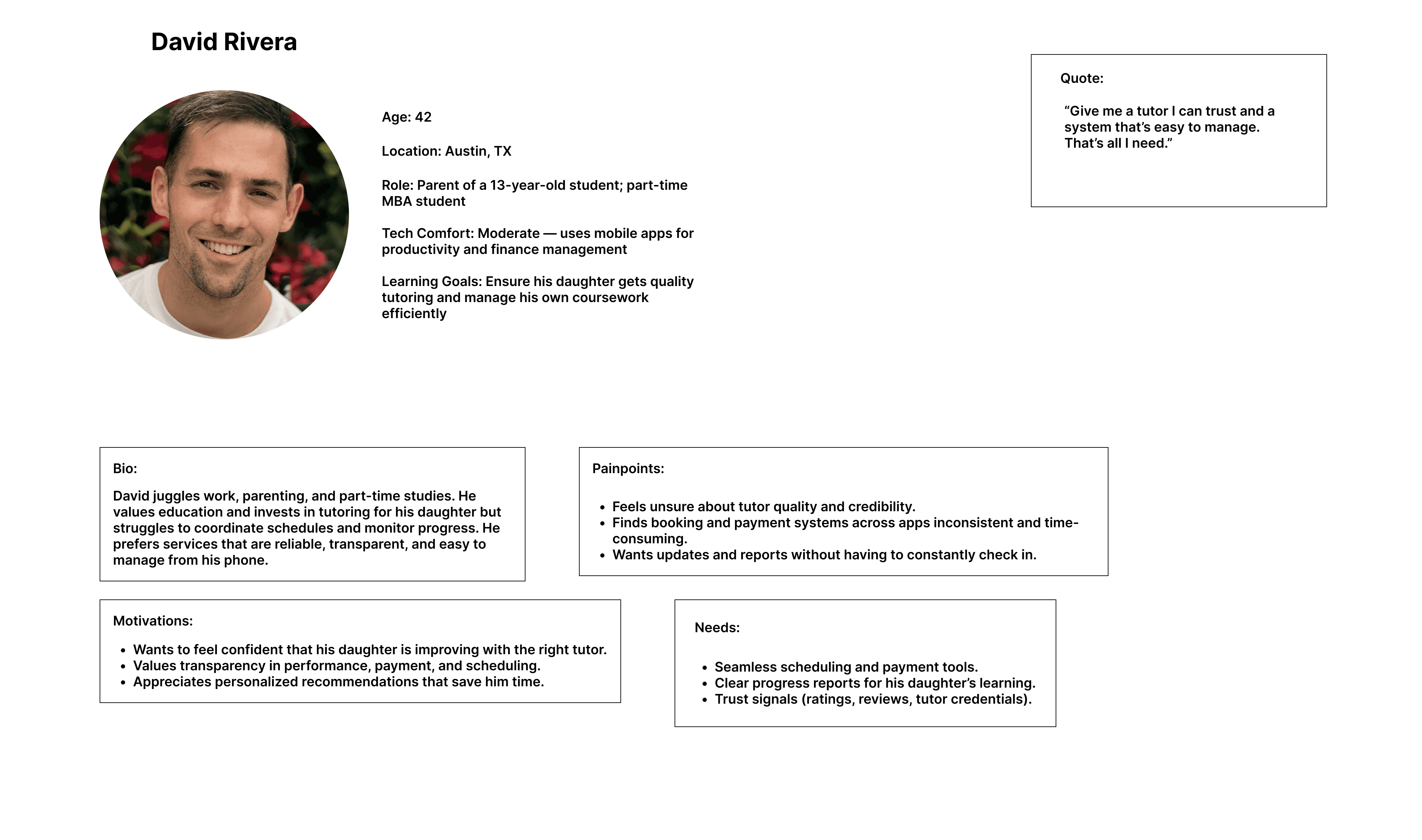
Early on, it was clear that “building a tutoring app” wasn’t the real challenge. The real complexity came from serving three distinct user types — parents, students, and tutors — each with different goals, anxieties, and constraints inside the same system.
What Discovery Uncovered
Parents prioritized reliability, scheduling flexibility, and payment clarity
Students cared about ease of access, reminders, and continuity with tutors
Tutors needed predictable scheduling, clear communication, and reduced administrative overhead
Despite these differences, all groups shared one frustration: managing tutoring through emails and phone calls created unnecessary friction and confusion.
Turning Insight Into Direction
Using POV statements, I translated these insights into a focused set of “How Might We” questions to bridge user needs with operational goals. These questions helped:
Clarify where experiences needed to diverge by role
Identify shared system foundations that could scale
Frame ideation around reducing friction rather than adding features
Key Insight
The opportunity wasn’t to create three separate products — it was to design one platform that adapts to user intent while maintaining a consistent core experience.


Define
The Process of figuring out "What are we actually Solving?"
Framing the Right Problem to Solve
Synthesizing research revealed that user frustration wasn’t caused by a single interaction — it stemmed from systemic inefficiencies across scheduling, communication, and continuity of learning.
Rather than optimizing isolated moments, the opportunity was to redesign the end-to-end tutoring experience around speed, transparency, and flexibility — without increasing operational complexity for the business.
Core Experience Priorities
Speed & efficiency — reducing friction around booking, rescheduling, and session management
Transparency — making tutor matching, availability, and payments easy to understand
Flexibility — supporting real-life schedule changes without breaking trust
Continuity — helping students maintain consistent learning relationships over time
What We Chose to Focus On
Using POV statements and “How Might We” questions, I narrowed the scope to opportunities that:
Solved problems shared across parents, students, and tutors
Reduced operational overhead instead of adding manual work
Created a foundation for scalable growth and monetization
Defining Principle
A tutoring platform should feel reliable and effortless — even when schedules change.
This framing guided ideation toward system-level solutions (role-based experiences, centralized scheduling, and flexible payments) rather than one-off feature additions.
Explore
Exploring all the ways in which we can solve this problem.
Feature Ideation & MVP Prioritization
Guided by the “How Might We” questions, we explored a wide range of solution concepts aimed at addressing both user pain points and core business needs. Through structured ideation sessions, we generated 20+ feature ideas, spanning areas such as automated tutor matching, flexible scheduling, pricing transparency, and tools to support long-term learning continuity.
To avoid overbuilding, each concept was evaluated using three criteria:
User impact — How meaningfully does this solve a real user problem?
Business value — Does this support growth, retention, or revenue?
Technical feasibility — Can this be realistically delivered within MVP constraints?
This prioritization framework helped us shift from a feature-heavy mindset to a focused, outcome-driven MVP.
We collaborated closely with the client throughout this process, validating assumptions and aligning on tradeoffs to ensure the solution supported their operational model and long-term strategy. Together, we narrowed the scope to a core feature set centered on:
Efficient user onboarding
Accurate tutor matching
Seamless scheduling
A clear and intuitive path to purchase
This approach ensured the MVP delivered immediate value to users while remaining scalable for future iterations.
Design
Flows, IA and Wire Frames. Taking Lofi to HiFI Designs
From Low-Fidelity Concepts to High-Fidelity Prototype
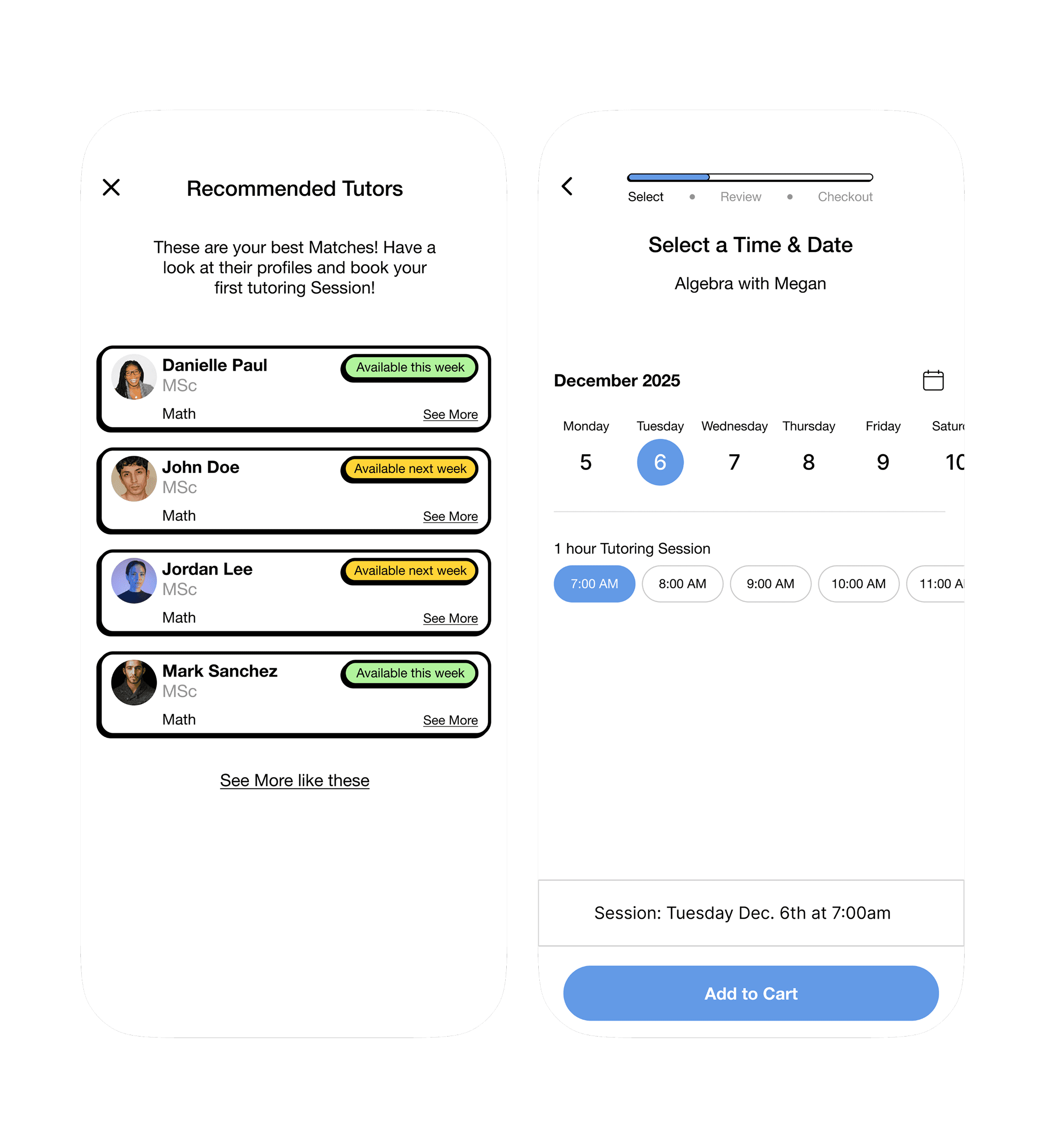
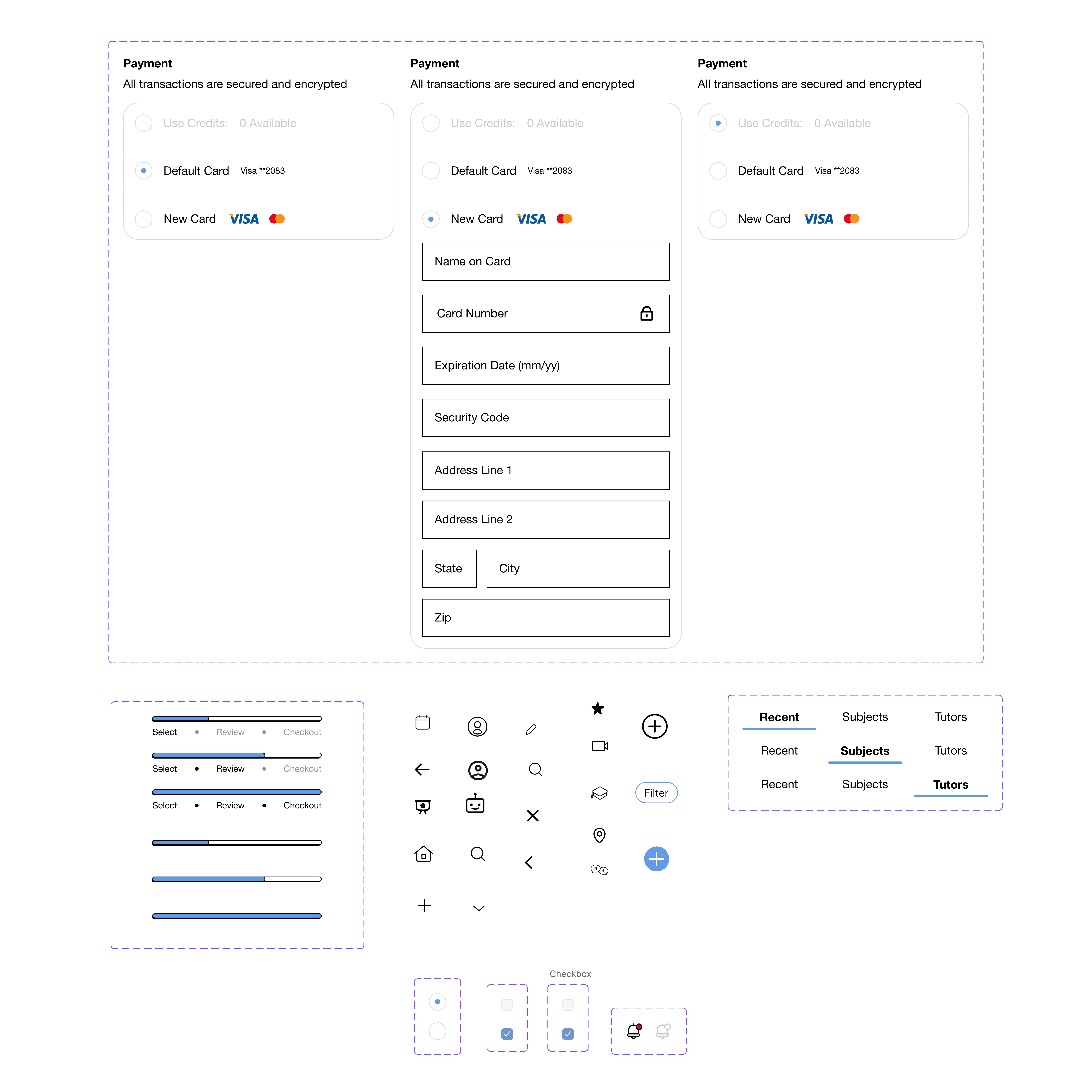
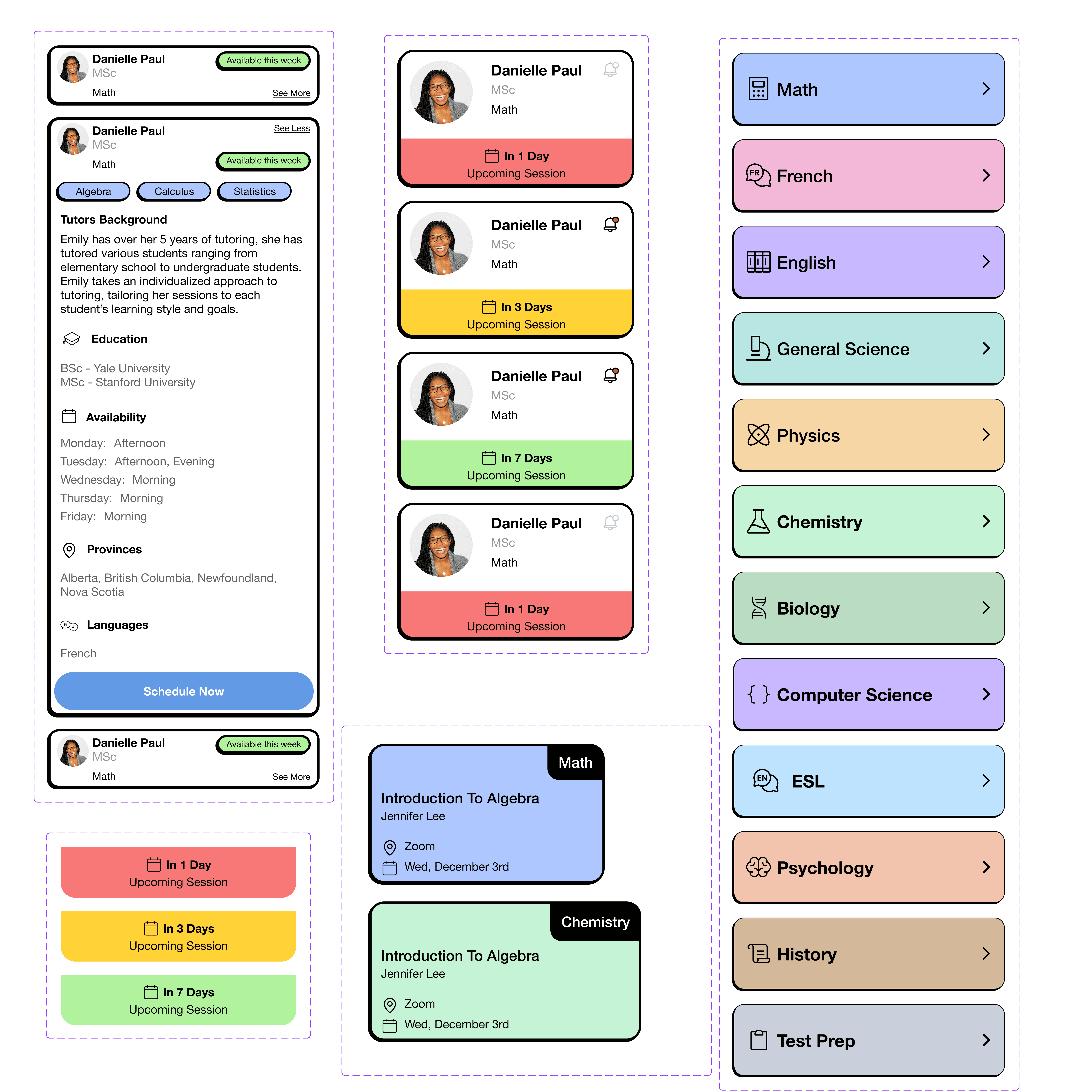
We translated early concepts into wireframes and high-fidelity designs with a clear focus on creating a seamless end-to-end booking and checkout experience. The primary goal was to reduce friction and cognitive load, allowing users to move confidently from tutor discovery to session confirmation.
To achieve this, we intentionally reduced the number of steps required to schedule and pay for a session. Each screen was designed to guide users forward with clear actions, minimizing decision fatigue and abandonment during critical conversion moments.
Designing for Conversion & Long-Term Engagement
Beyond a single booking, we designed the experience to support repeat usage and sustained learning. The checkout flow allows users to:
Add additional sessions at the point of purchase
Buy discounted credit bundles for future bookings
This flexibility balanced business goals with user value—offering cost savings while encouraging continued engagement without forcing commitment.
Throughout the flow, we prioritized transparency and trust by clearly communicating:
Pricing and discounts
Session details and expectations
Flexibility around scheduling and future use
These design decisions were directly informed by research insights highlighting user hesitation around pricing clarity and long-term commitment. By addressing these concerns upfront, the final design reduces anxiety, builds confidence, and supports both conversion and retention.
Test
COnducting rounds of testing before hand offs
Test, Test, Test—Then Refine
Before handoff, we conducted usability testing on the high-fidelity mobile prototype to validate clarity, usability, and task completion across critical user flows. Testing focused on:
Account sign-up
Tutor matching
Session scheduling
Checkout and confirmation
The goal was to ensure users could move confidently from discovery to booking with minimal friction and without needing external guidance.
Iteration & Refinement
Testing surfaced several opportunities to improve the experience, particularly within the checkout flow. Users expressed moments of hesitation around pricing, next steps, and session confirmation, highlighting the need for clearer UI hierarchy and additional navigational context at key decision points.
Based on these insights, we made targeted refinements to:
Improve checkout layout and visual emphasis
Add contextual guidance where users paused or questioned next steps
Reduce cognitive load by simplifying interactions and copy
These iterations strengthened flow cohesion and improved overall confidence during the most conversion-critical moments.
Final Deliverable & Handoff
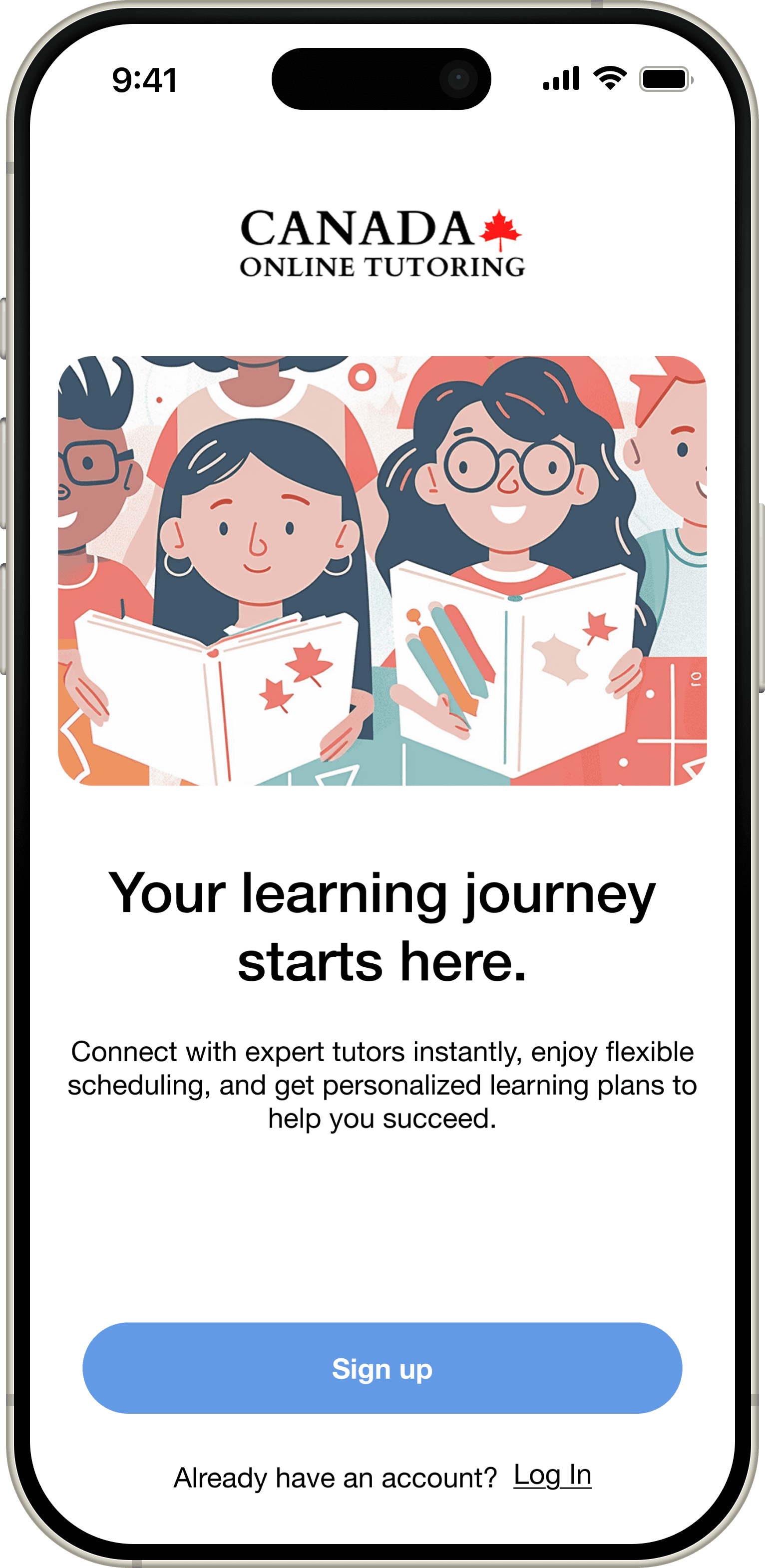

The final deliverable was a five-flow, high-fidelity mobile prototype covering:
Sign-up
Tutor matching
Scheduling
Checkout
Confirmation
Together, these flows function as a single, intuitive end-to-end experience. To support implementation, we provided detailed design annotations and interaction notes outlining behaviors, edge cases, and system feedback states.
The completed prototype was delivered to the client’s engineering team as a scalable foundation for development and future iteration—aligned with both user needs and business objectives.
Reflection
No project is DONe. Reflect and plan what could be better and whats next.
This project challenged me to think beyond interface design and focus on building a scalable product system that served both users and the business. Designing for multiple personas—parents, students, and teachers—required thoughtful trade-offs to maintain clarity while supporting distinct needs within a shared platform.
One of my biggest takeaways was learning how deeply monetization decisions impact user trust and long-term engagement. By designing a credit-based model as part of the core experience, not a bolt-on, we enabled recurring revenue while preserving transparency and flexibility for users. This strengthened my ability to design with financial and operational realities in mind.
Working closely with executive stakeholders and iterating through usability testing sharpened my product judgment—particularly around prioritization, flow simplification, and decision-point clarity. This project reinforced my growth as a product designer who connects research, business strategy, and execution to deliver outcomes that scale.
Case Study
Overview
CAD. Online
App MVP
I led the design of a mobile tutoring platform that modernized a traditionally manual booking model into a scalable, revenue-driven digital experience. By supporting parents, students, and tutors within a single system, the product centralized scheduling, communication, payments, and discovery while preserving the company’s existing tutoring philosophy. A credit-based purchasing model unlocked recurring revenue and flexible pricing, aligning business goals with user needs. This project highlights my strength in designing within real operational constraints, collaborating with executive stakeholders, and translating complex service workflows into intuitive, conversion-focused mobile experiences.
Lead Designer
Role
Eric, Designer - Edward, CEO Head of Eng
Squad
7 weeks
Duration
The Problem
When a Proven Service Model Stops Scaling
The company had built a successful tutoring business across core academic subjects, but its operating model hadn’t evolved with user expectations or market competition.
User Impact
Students and parents experienced friction when booking, rescheduling, or canceling sessions
Communication and payment details were fragmented across emails and phone calls, creating confusion and mistrust
Users lacked a single place to manage sessions, progress, and tutor relationships
Business Impact
A manual, offline-first workflow limited scalability and operational efficiency
The company lacked visibility into user behavior, engagement, and retention
In a crowded education market shaped by mobile-first experiences, the platform risked falling behind faster, more seamless competitors
Core Tension
The business needed to modernize its experience without breaking what already worked — preserving its trusted tutoring model while expanding into a scalable, mobile-first platform that could support growth, insight, and new revenue opportunities.
The Solution
Evolving a Proven Model Into a Scalable Platform
I designed a mobile-first tutoring platform that modernized the experience without disrupting the company’s trusted service model — focusing on clarity, flexibility, and long-term scalability.
Experience Strategy
Rather than creating a one-size-fits-all app, the solution centered on role-aware experiences that respected the distinct needs of parents, students, and teachers while sharing a common platform foundation.
Key Design Decisions
Role-based onboarding to quickly understand user intent and tailor the experience for parents, students, or teachers
A centralized home experience that surfaced what mattered most: upcoming sessions, tutor communication, and next actions
Integrated discovery and booking, allowing users to find and schedule tutors without leaving the platform
A credit-based system that simplified payments, supported rescheduling, and enabled scalable pricing models through bundled credits and promotions
Platform Alignment
The solution intentionally extended the company’s existing educational philosophy rather than replacing it — preserving trust while enabling:
Operational efficiency
Better user visibility and engagement tracking
New, flexible revenue opportunities
The Results
User & Platform Impact
Centralized booking, communication, and discovery into a single mobile experience
Reduced friction around scheduling, rescheduling, and payments
Supported parents, students, and tutors within one cohesive, role-aware system
Business Impact
Delivered a high-fidelity MVP ready for development and launch
Introduced a scalable, credit-based model that enabled recurring revenue
Created flexibility for promotions, bundles, and seasonal pricing
Gave the business visibility into user behavior, engagement, and demand patterns
Outcome
The platform transformed a manual, offline-heavy tutoring operation into a mobile-first system designed to scale — without compromising the company’s existing educational model or user trust.
Discovery
The Process of Learning and finding a path forward
From Assumptions to Role-Specific Needs
Early on, it was clear that “building a tutoring app” wasn’t the real challenge. The real complexity came from serving three distinct user types — parents, students, and tutors — each with different goals, anxieties, and constraints inside the same system.
What Discovery Uncovered
Parents prioritized reliability, scheduling flexibility, and payment clarity
Students cared about ease of access, reminders, and continuity with tutors
Tutors needed predictable scheduling, clear communication, and reduced administrative overhead
Despite these differences, all groups shared one frustration: managing tutoring through emails and phone calls created unnecessary friction and confusion.
Turning Insight Into Direction
Using POV statements, I translated these insights into a focused set of “How Might We” questions to bridge user needs with operational goals. These questions helped:
Clarify where experiences needed to diverge by role
Identify shared system foundations that could scale
Frame ideation around reducing friction rather than adding features
Key Insight
The opportunity wasn’t to create three separate products — it was to design one platform that adapts to user intent while maintaining a consistent core experience.
Define
The Process of figuring out "What are we actually Solving?"
Framing the Right Problem to Solve
Synthesizing research revealed that user frustration wasn’t caused by a single interaction — it stemmed from systemic inefficiencies across scheduling, communication, and continuity of learning.
Rather than optimizing isolated moments, the opportunity was to redesign the end-to-end tutoring experience around speed, transparency, and flexibility — without increasing operational complexity for the business.
Core Experience Priorities
Speed & efficiency — reducing friction around booking, rescheduling, and session management
Transparency — making tutor matching, availability, and payments easy to understand
Flexibility — supporting real-life schedule changes without breaking trust
Continuity — helping students maintain consistent learning relationships over time
What We Chose to Focus On
Using POV statements and “How Might We” questions, I narrowed the scope to opportunities that:
Solved problems shared across parents, students, and tutors
Reduced operational overhead instead of adding manual work
Created a foundation for scalable growth and monetization
Defining Principle
A tutoring platform should feel reliable and effortless — even when schedules change.
This framing guided ideation toward system-level solutions (role-based experiences, centralized scheduling, and flexible payments) rather than one-off feature additions.
Explore
Exploring all the ways in which we can solve this problem.
Feature Ideation & MVP Prioritization
Guided by the “How Might We” questions, we explored a wide range of solution concepts aimed at addressing both user pain points and core business needs. Through structured ideation sessions, we generated 20+ feature ideas, spanning areas such as automated tutor matching, flexible scheduling, pricing transparency, and tools to support long-term learning continuity.
To avoid overbuilding, each concept was evaluated using three criteria:
User impact — How meaningfully does this solve a real user problem?
Business value — Does this support growth, retention, or revenue?
Technical feasibility — Can this be realistically delivered within MVP constraints?
This prioritization framework helped us shift from a feature-heavy mindset to a focused, outcome-driven MVP.
We collaborated closely with the client throughout this process, validating assumptions and aligning on tradeoffs to ensure the solution supported their operational model and long-term strategy. Together, we narrowed the scope to a core feature set centered on:
Efficient user onboarding
Accurate tutor matching
Seamless scheduling
A clear and intuitive path to purchase
This approach ensured the MVP delivered immediate value to users while remaining scalable for future iterations.
Design
Flows, IA and Wire Frames. Taking Lofi to HiFI Designs
From Low-Fidelity Concepts to High-Fidelity Prototype
We translated early concepts into wireframes and high-fidelity designs with a clear focus on creating a seamless end-to-end booking and checkout experience. The primary goal was to reduce friction and cognitive load, allowing users to move confidently from tutor discovery to session confirmation.
To achieve this, we intentionally reduced the number of steps required to schedule and pay for a session. Each screen was designed to guide users forward with clear actions, minimizing decision fatigue and abandonment during critical conversion moments.
Designing for Conversion & Long-Term Engagement
Beyond a single booking, we designed the experience to support repeat usage and sustained learning. The checkout flow allows users to:
Add additional sessions at the point of purchase
Buy discounted credit bundles for future bookings
This flexibility balanced business goals with user value—offering cost savings while encouraging continued engagement without forcing commitment.
Throughout the flow, we prioritized transparency and trust by clearly communicating:
Pricing and discounts
Session details and expectations
Flexibility around scheduling and future use
These design decisions were directly informed by research insights highlighting user hesitation around pricing clarity and long-term commitment. By addressing these concerns upfront, the final design reduces anxiety, builds confidence, and supports both conversion and retention.
Test
COnducting rounds of testing before hand offs
Test, Test, Test—Then Refine
Before handoff, we conducted usability testing on the high-fidelity mobile prototype to validate clarity, usability, and task completion across critical user flows. Testing focused on:
Account sign-up
Tutor matching
Session scheduling
Checkout and confirmation
The goal was to ensure users could move confidently from discovery to booking with minimal friction and without needing external guidance.
Iteration & Refinement
Testing surfaced several opportunities to improve the experience, particularly within the checkout flow. Users expressed moments of hesitation around pricing, next steps, and session confirmation, highlighting the need for clearer UI hierarchy and additional navigational context at key decision points.
Based on these insights, we made targeted refinements to:
Improve checkout layout and visual emphasis
Add contextual guidance where users paused or questioned next steps
Reduce cognitive load by simplifying interactions and copy
These iterations strengthened flow cohesion and improved overall confidence during the most conversion-critical moments.
Final Deliverable & Handoff
The final deliverable was a five-flow, high-fidelity mobile prototype covering:
Sign-up
Tutor matching
Scheduling
Checkout
Confirmation
Together, these flows function as a single, intuitive end-to-end experience. To support implementation, we provided detailed design annotations and interaction notes outlining behaviors, edge cases, and system feedback states.
The completed prototype was delivered to the client’s engineering team as a scalable foundation for development and future iteration—aligned with both user needs and business objectives.
Reflection
No project is DONe. Reflect and plan what could be better and whats next.
This project challenged me to think beyond interface design and focus on building a scalable product system that served both users and the business. Designing for multiple personas—parents, students, and teachers—required thoughtful trade-offs to maintain clarity while supporting distinct needs within a shared platform.
One of my biggest takeaways was learning how deeply monetization decisions impact user trust and long-term engagement. By designing a credit-based model as part of the core experience, not a bolt-on, we enabled recurring revenue while preserving transparency and flexibility for users. This strengthened my ability to design with financial and operational realities in mind.
Working closely with executive stakeholders and iterating through usability testing sharpened my product judgment—particularly around prioritization, flow simplification, and decision-point clarity. This project reinforced my growth as a product designer who connects research, business strategy, and execution to deliver outcomes that scale.
Case
Study
Overview
CAD. Online
App MVP
I led the design of a mobile tutoring platform that modernized a traditionally manual booking model into a scalable, revenue-driven digital experience. By supporting parents, students, and tutors within a single system, the product centralized scheduling, communication, payments, and discovery while preserving the company’s existing tutoring philosophy. A credit-based purchasing model unlocked recurring revenue and flexible pricing, aligning business goals with user needs. This project highlights my strength in designing within real operational constraints, collaborating with executive stakeholders, and translating complex service workflows into intuitive, conversion-focused mobile experiences.
Lead Designer
R0le
Eric, Designer - Edward, CEO Head of Eng
Squad
7 weeks
Duration
The Problem
When a Proven Service Model Stops Scaling
The company had built a successful tutoring business across core academic subjects, but its operating model hadn’t evolved with user expectations or market competition.
User Impact
Students and parents experienced friction when booking, rescheduling, or canceling sessions
Communication and payment details were fragmented across emails and phone calls, creating confusion and mistrust
Users lacked a single place to manage sessions, progress, and tutor relationships
Business Impact
A manual, offline-first workflow limited scalability and operational efficiency
The company lacked visibility into user behavior, engagement, and retention
In a crowded education market shaped by mobile-first experiences, the platform risked falling behind faster, more seamless competitors
Core Tension
The business needed to modernize its experience without breaking what already worked — preserving its trusted tutoring model while expanding into a scalable, mobile-first platform that could support growth, insight, and new revenue opportunities.
The Solution
Evolving a Proven Model Into a Scalable Platform
I designed a mobile-first tutoring platform that modernized the experience without disrupting the company’s trusted service model — focusing on clarity, flexibility, and long-term scalability.
Experience Strategy
Rather than creating a one-size-fits-all app, the solution centered on role-aware experiences that respected the distinct needs of parents, students, and teachers while sharing a common platform foundation.
Key Design Decisions
Role-based onboarding to quickly understand user intent and tailor the experience for parents, students, or teachers
A centralized home experience that surfaced what mattered most: upcoming sessions, tutor communication, and next actions
Integrated discovery and booking, allowing users to find and schedule tutors without leaving the platform
A credit-based system that simplified payments, supported rescheduling, and enabled scalable pricing models through bundled credits and promotions
Platform Alignment
The solution intentionally extended the company’s existing educational philosophy rather than replacing it — preserving trust while enabling:
Operational efficiency
Better user visibility and engagement tracking
New, flexible revenue opportunities
The Results
User & Platform Impact
Centralized booking, communication, and discovery into a single mobile experience
Reduced friction around scheduling, rescheduling, and payments
Supported parents, students, and tutors within one cohesive, role-aware system
Business Impact
Delivered a high-fidelity MVP ready for development and launch
Introduced a scalable, credit-based model that enabled recurring revenue
Created flexibility for promotions, bundles, and seasonal pricing
Gave the business visibility into user behavior, engagement, and demand patterns
Outcome
The platform transformed a manual, offline-heavy tutoring operation into a mobile-first system designed to scale — without compromising the company’s existing educational model or user trust.
Discovery
The Process of Learning and finding a path forward
From Assumptions to Role-Specific Needs
Early on, it was clear that “building a tutoring app” wasn’t the real challenge. The real complexity came from serving three distinct user types — parents, students, and tutors — each with different goals, anxieties, and constraints inside the same system.
What Discovery Uncovered
Parents prioritized reliability, scheduling flexibility, and payment clarity
Students cared about ease of access, reminders, and continuity with tutors
Tutors needed predictable scheduling, clear communication, and reduced administrative overhead
Despite these differences, all groups shared one frustration: managing tutoring through emails and phone calls created unnecessary friction and confusion.
Turning Insight Into Direction
Using POV statements, I translated these insights into a focused set of “How Might We” questions to bridge user needs with operational goals. These questions helped:
Clarify where experiences needed to diverge by role
Identify shared system foundations that could scale
Frame ideation around reducing friction rather than adding features
Key Insight
The opportunity wasn’t to create three separate products — it was to design one platform that adapts to user intent while maintaining a consistent core experience.
Define
The Process of figuring out "What are we actually Solving?"
Framing the Right Problem to Solve
Synthesizing research revealed that user frustration wasn’t caused by a single interaction — it stemmed from systemic inefficiencies across scheduling, communication, and continuity of learning.
Rather than optimizing isolated moments, the opportunity was to redesign the end-to-end tutoring experience around speed, transparency, and flexibility — without increasing operational complexity for the business.
Core Experience Priorities
Speed & efficiency — reducing friction around booking, rescheduling, and session management
Transparency — making tutor matching, availability, and payments easy to understand
Flexibility — supporting real-life schedule changes without breaking trust
Continuity — helping students maintain consistent learning relationships over time
What We Chose to Focus On
Using POV statements and “How Might We” questions, I narrowed the scope to opportunities that:
Solved problems shared across parents, students, and tutors
Reduced operational overhead instead of adding manual work
Created a foundation for scalable growth and monetization
Defining Principle
A tutoring platform should feel reliable and effortless — even when schedules change.
This framing guided ideation toward system-level solutions (role-based experiences, centralized scheduling, and flexible payments) rather than one-off feature additions.
Explore
Exploring all the ways in which we can solve this problem.
Feature Ideation & MVP Prioritization
Guided by the “How Might We” questions, we explored a wide range of solution concepts aimed at addressing both user pain points and core business needs. Through structured ideation sessions, we generated 20+ feature ideas, spanning areas such as automated tutor matching, flexible scheduling, pricing transparency, and tools to support long-term learning continuity.
To avoid overbuilding, each concept was evaluated using three criteria:
User impact — How meaningfully does this solve a real user problem?
Business value — Does this support growth, retention, or revenue?
Technical feasibility — Can this be realistically delivered within MVP constraints?
This prioritization framework helped us shift from a feature-heavy mindset to a focused, outcome-driven MVP.
We collaborated closely with the client throughout this process, validating assumptions and aligning on tradeoffs to ensure the solution supported their operational model and long-term strategy. Together, we narrowed the scope to a core feature set centered on:
Efficient user onboarding
Accurate tutor matching
Seamless scheduling
A clear and intuitive path to purchase
This approach ensured the MVP delivered immediate value to users while remaining scalable for future iterations.
Design
Flows, IA and Wire Frames. Taking Lofi to HiFI Designs
From Low-Fidelity Concepts to High-Fidelity Prototype
We translated early concepts into wireframes and high-fidelity designs with a clear focus on creating a seamless end-to-end booking and checkout experience. The primary goal was to reduce friction and cognitive load, allowing users to move confidently from tutor discovery to session confirmation.
To achieve this, we intentionally reduced the number of steps required to schedule and pay for a session. Each screen was designed to guide users forward with clear actions, minimizing decision fatigue and abandonment during critical conversion moments.
Designing for Conversion & Long-Term Engagement
Beyond a single booking, we designed the experience to support repeat usage and sustained learning. The checkout flow allows users to:
Add additional sessions at the point of purchase
Buy discounted credit bundles for future bookings
This flexibility balanced business goals with user value—offering cost savings while encouraging continued engagement without forcing commitment.
Throughout the flow, we prioritized transparency and trust by clearly communicating:
Pricing and discounts
Session details and expectations
Flexibility around scheduling and future use
These design decisions were directly informed by research insights highlighting user hesitation around pricing clarity and long-term commitment. By addressing these concerns upfront, the final design reduces anxiety, builds confidence, and supports both conversion and retention.
Test
COnducting rounds of testing before hand offs
Test, Test, Test—Then Refine
Before handoff, we conducted usability testing on the high-fidelity mobile prototype to validate clarity, usability, and task completion across critical user flows. Testing focused on:
Account sign-up
Tutor matching
Session scheduling
Checkout and confirmation
The goal was to ensure users could move confidently from discovery to booking with minimal friction and without needing external guidance.
Iteration & Refinement
Testing surfaced several opportunities to improve the experience, particularly within the checkout flow. Users expressed moments of hesitation around pricing, next steps, and session confirmation, highlighting the need for clearer UI hierarchy and additional navigational context at key decision points.
Based on these insights, we made targeted refinements to:
Improve checkout layout and visual emphasis
Add contextual guidance where users paused or questioned next steps
Reduce cognitive load by simplifying interactions and copy
These iterations strengthened flow cohesion and improved overall confidence during the most conversion-critical moments.
Final Deliverable & Handoff
The final deliverable was a five-flow, high-fidelity mobile prototype covering:
Sign-up
Tutor matching
Scheduling
Checkout
Confirmation
Together, these flows function as a single, intuitive end-to-end experience. To support implementation, we provided detailed design annotations and interaction notes outlining behaviors, edge cases, and system feedback states.
The completed prototype was delivered to the client’s engineering team as a scalable foundation for development and future iteration—aligned with both user needs and business objectives.
Reflection
No project is DONe. Reflect and plan what could be better and whats next.
This project challenged me to think beyond interface design and focus on building a scalable product system that served both users and the business. Designing for multiple personas—parents, students, and teachers—required thoughtful trade-offs to maintain clarity while supporting distinct needs within a shared platform.
One of my biggest takeaways was learning how deeply monetization decisions impact user trust and long-term engagement. By designing a credit-based model as part of the core experience, not a bolt-on, we enabled recurring revenue while preserving transparency and flexibility for users. This strengthened my ability to design with financial and operational realities in mind.
Working closely with executive stakeholders and iterating through usability testing sharpened my product judgment—particularly around prioritization, flow simplification, and decision-point clarity. This project reinforced my growth as a product designer who connects research, business strategy, and execution to deliver outcomes that scale.