Case
Study
Overview
Just Hair
End to End
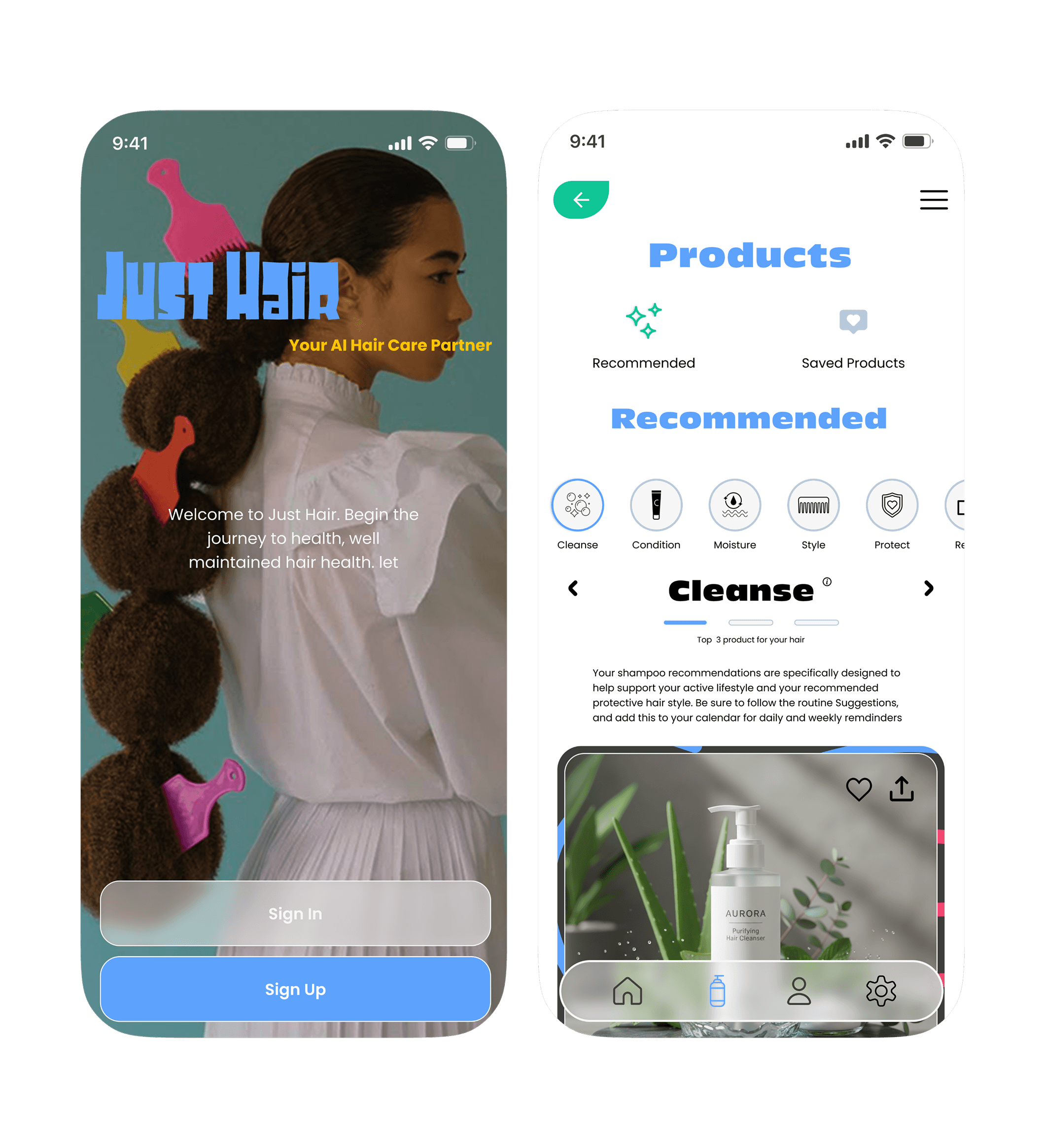
This project explores an AI-enabled mobile experience, focused on addressing gaps in women’s hair care education, product discovery, and routine building.
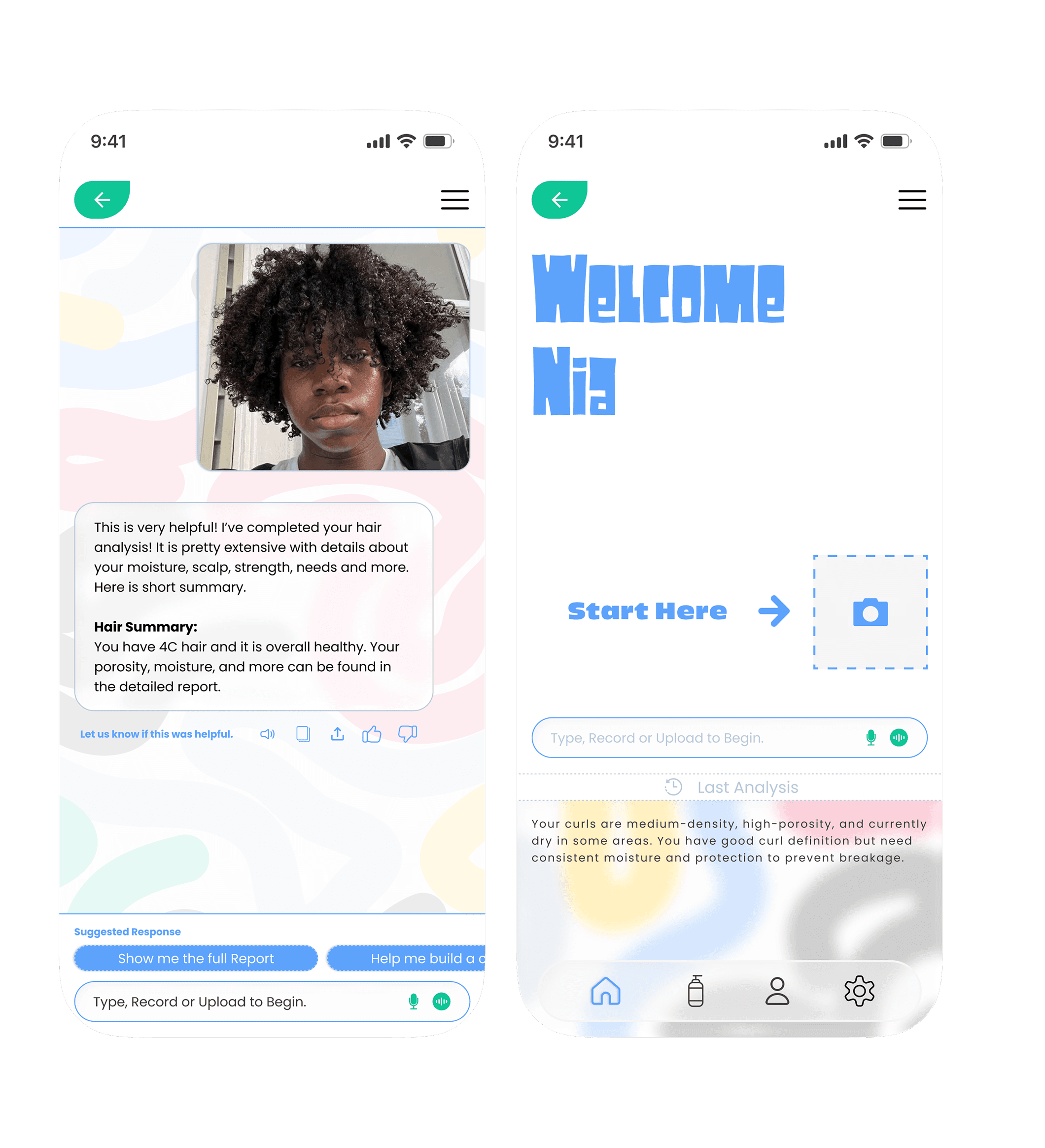
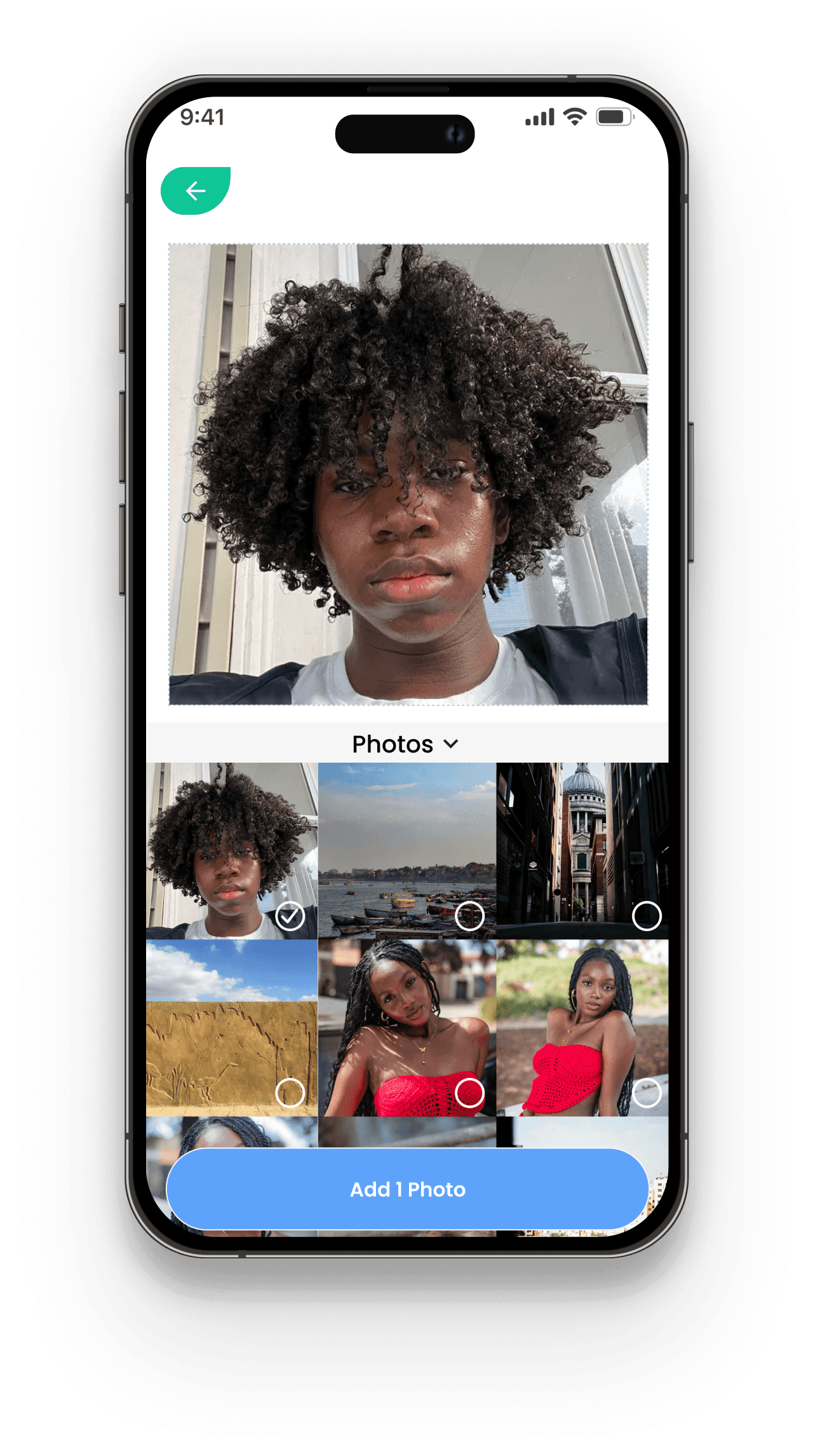
Using qualitative research and LLM experimentation, I designed an end-to-end application that allows users to upload a photo or video of their hair, receive personalized analysis, and build simple, sustainable routines tailored to their lifestyle.
Lead Designer
Role
Solo
Squad
7 weeks
Duration
The Problem
Despite the size and growth of the global hair care industry, women with textured hair—particularly Black women—struggle to confidently care for their hair in ways that fit their lifestyles.
Research revealed a consistent set of challenges across geographies and age groups:
Users spent disproportionately more on hair products due to trial-and-error discovery, often without reliable guidance
Finding trusted, skilled stylists—locally or while traveling—was difficult and inconsistent
Educational resources around hair health, curl patterns, and routines were fragmented or inaccessible
Many users described a decades-long learning curve to understand their own hair
Existing tools and services failed to account for differences in lifestyle, priorities, and context
At its core, the problem was not a lack of products or services—it was a lack of confidence and clarity.
The industry has historically placed the burden of expertise on the user, forcing generations of women to navigate complex, opaque systems without personalized support. This resulted in higher costs, wasted time, inconsistent outcomes, and diminished trust—persisting globally across users from early adulthood through later life.
The Solution
I designed an AI-powered mobile experience that helps users confidently care for their hair by replacing trial-and-error with personalized guidance.
Core Approach
Instead of asking users to become experts, the product acts as a personal hair care assistant—translating complex hair science into clear, actionable guidance.
Key Capabilities
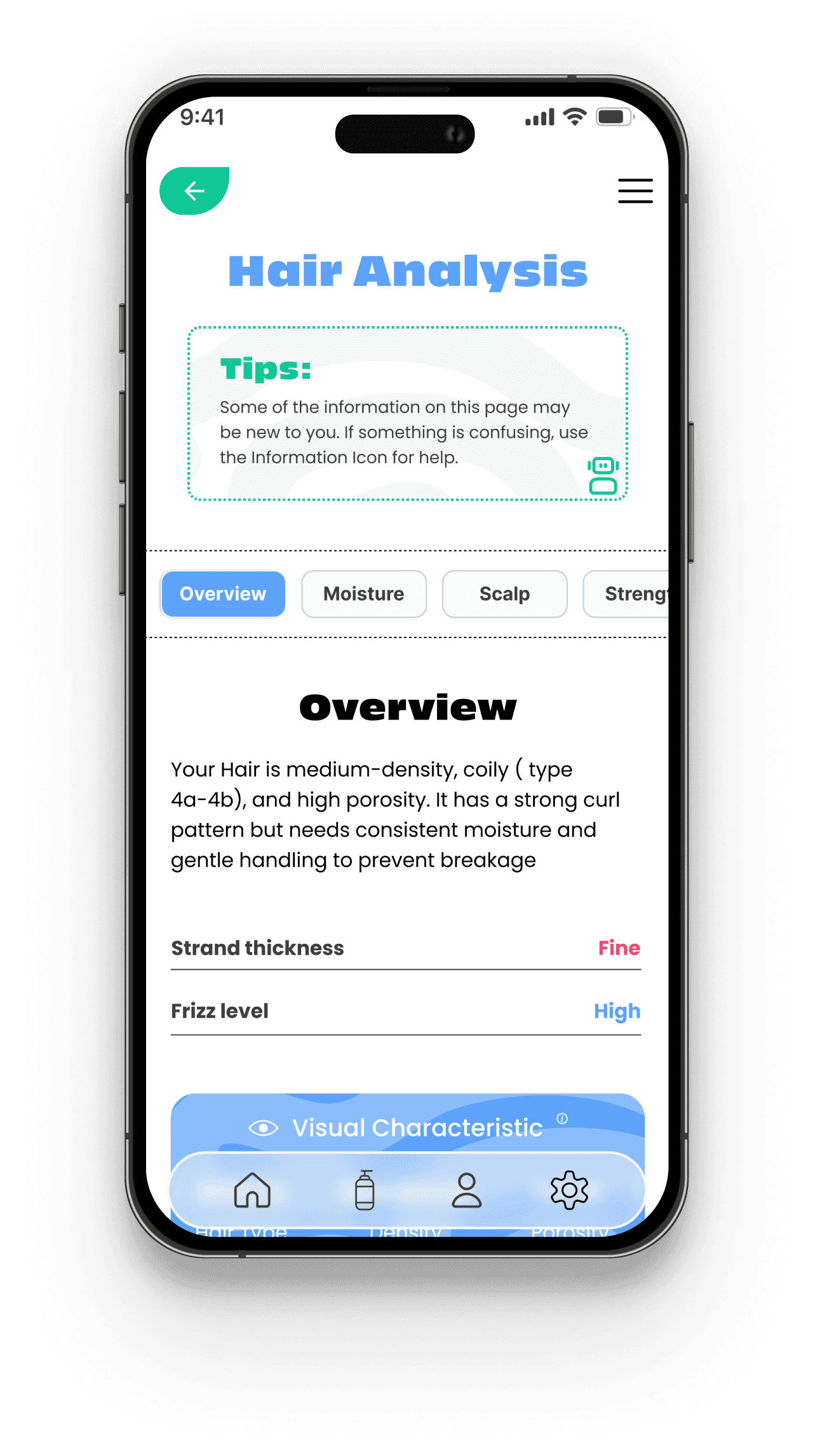
Photo and video-based hair and scalp analysis
AI-driven insights assessing hair health, curl pattern, texture, and scalp condition
Plain-language recommendations designed to build confidence, not overwhelm
Personalized routines with reminders to support consistency over time
Designed for Real Lifestyles
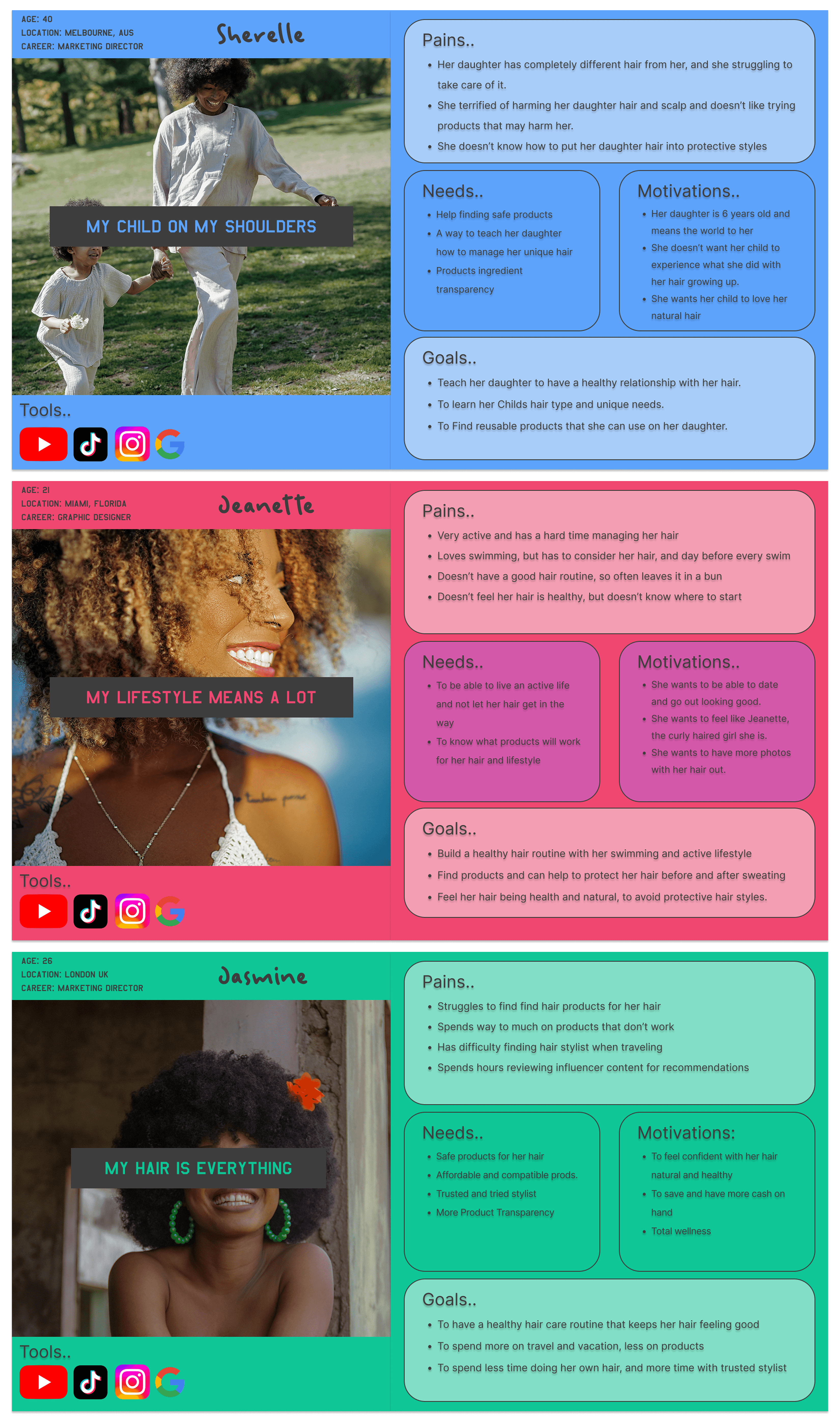
The experience was intentionally flexible to support distinct user needs:
High-investment users seeking smarter, more cost-efficient product decisions
Athletes needing low-effort, low-maintenance routines
Parents managing multiple hair types within one household
System-Level Thinking
Beyond individual recommendations, the product was designed to learn over time. By aggregating anonymized data across hair types, products, climates, and lifestyles, the system could identify global patterns—continuously improving recommendations and reducing friction for future users.
End-to-End Ownership
I designed the experience holistically—from onboarding and education to routines, reminders, and long-term engagement—ensuring the solution aligned user confidence with product value.
The Results
Delivered an end-to-end AI-driven product that helped users replace years of trial-and-error with clear, personalized guidance.
User Impact
Reduced dependence on costly experimentation by translating hair science into actionable routines
Helped users build confidence faster through education, reminders, and consistent care
Supported diverse lifestyles and life stages with adaptable, low-friction personalization
Product & Platform Impact
Designed a scalable personalization system capable of evolving with user data over time
Positioned hair care as part of a broader wellness ecosystem alongside skin, fitness, and health
Established a foundation for long-term learning across hair types, products, climates, and routines
Discovery
The Process of Learning and finding a path forward
From Product Gaps to a Trust & Education Problem
I initially explored whether AI could improve product discovery in textured hair care. Early research quickly revealed the problem was larger than access to products — it was a systemic lack of trust, education, and confidence.
Signals from the Market
Black women spend significantly more on hair care due to trial-and-error purchasing, often investing hundreds of dollars per month without reliable outcomes
Despite growth in natural hair care products, many users still struggle to find safe, effective options and qualified stylists
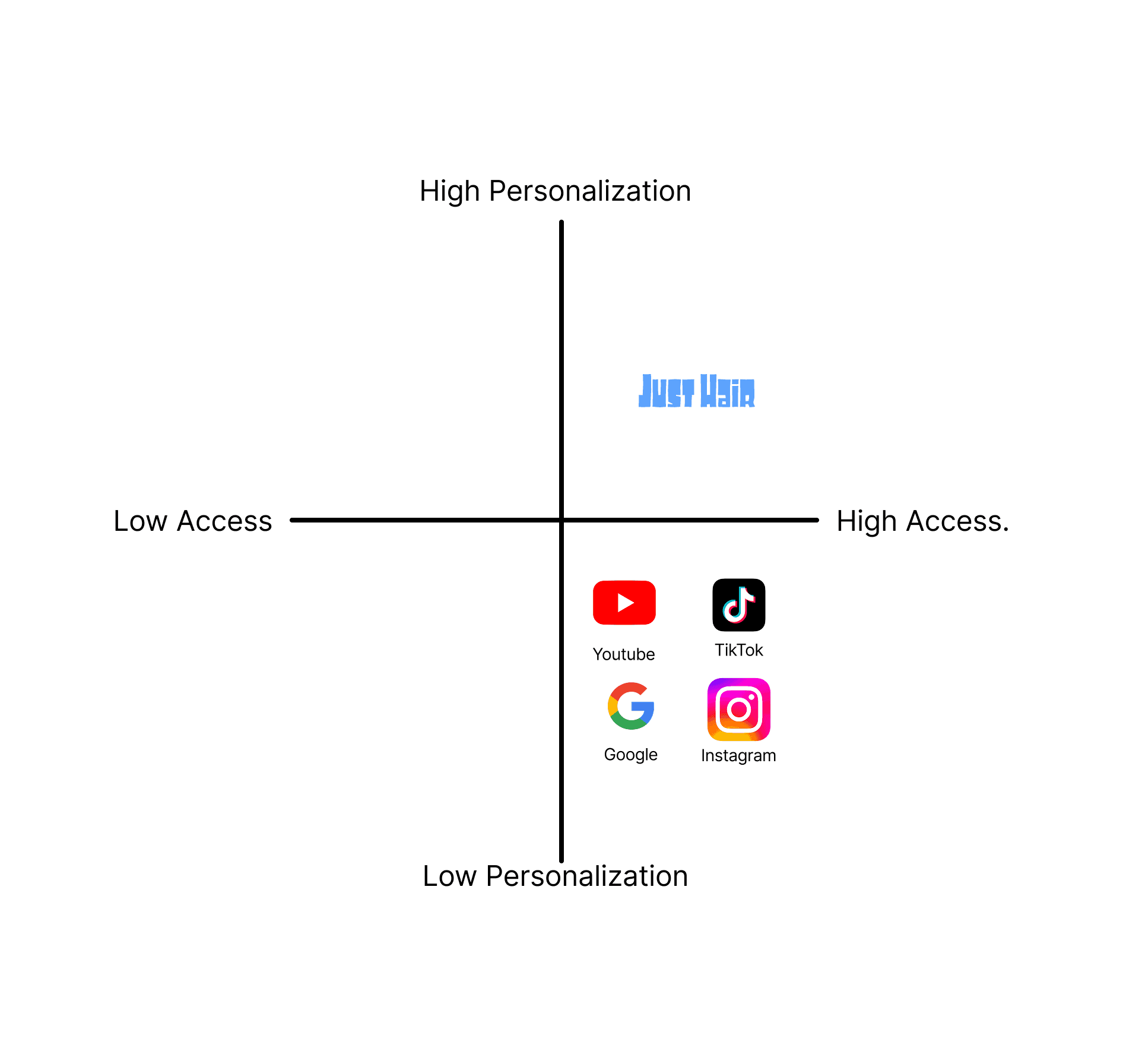
Existing apps focus on commerce or content, but fail to provide personalized guidance users can trust
These patterns suggested that more options weren’t the solution — better understanding was.
Insights from User Conversations
Interviews with women across ages, regions, and hair textures reinforced this shift:
Users described years — sometimes decades — spent learning their hair through costly experimentation
Many felt overwhelmed by conflicting advice and skeptical of one-size-fits-all recommendations
Trust was built through education, lived experience, and peer validation — not marketing claims
Key Insight
Hair care isn’t just a shopping problem. It’s an identity-driven, emotionally loaded learning journey — and users lack a reliable guide.
This reframed the opportunity from “help users buy better products” to “help users understand their hair and make confident decisions over time.”
Define
The Process of figuring out "What are we actually Solving?"
Framing the Right Problem to Solve
Discovery made it clear that the core issue wasn’t access to products — it was a lack of understanding. Users were making expensive decisions without confidence, relying on trial and error because they didn’t have a reliable way to learn what actually worked for their hair.
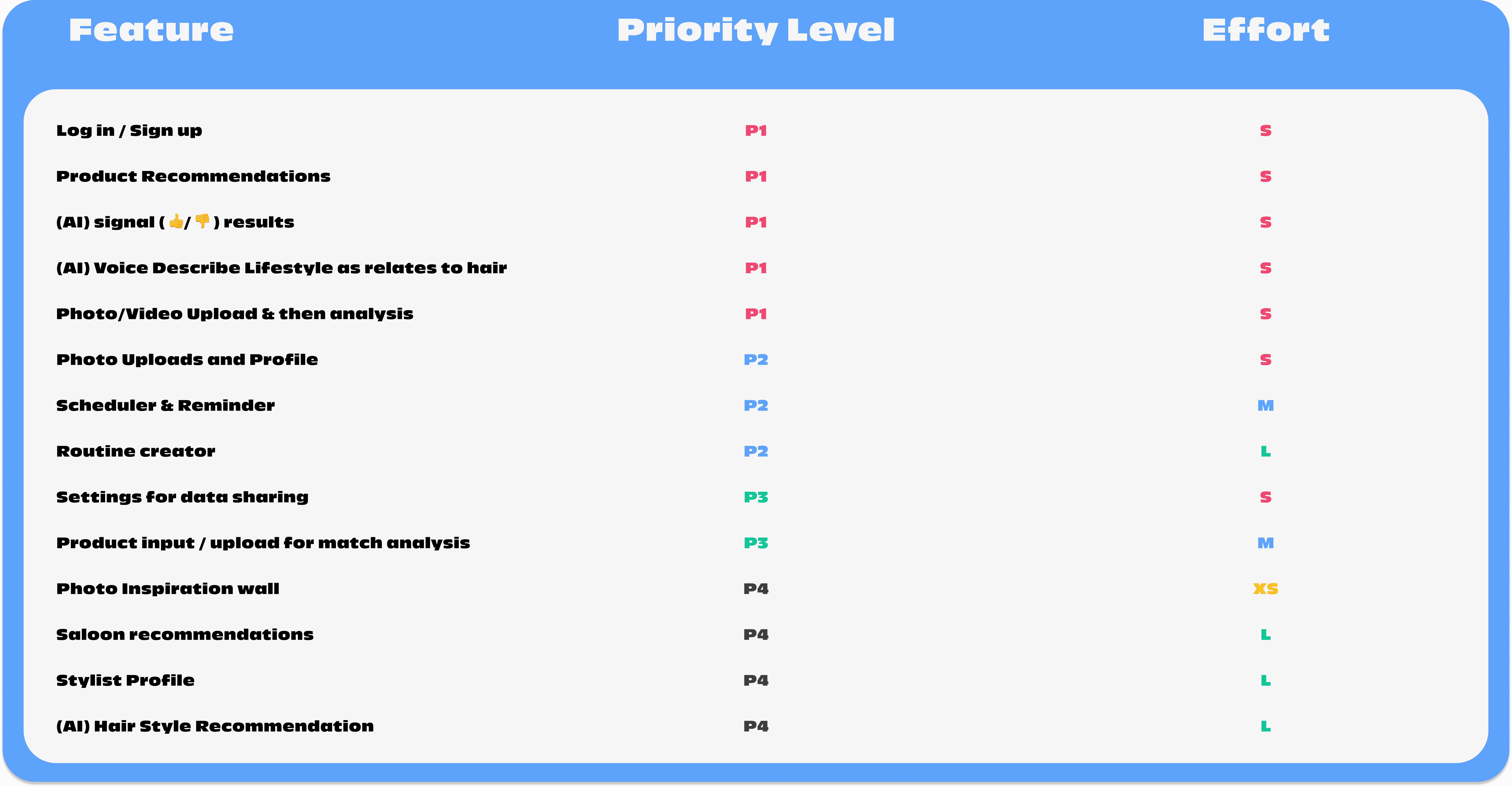
Rather than attempting to solve the entire hair care ecosystem at once, I focused the MVP on building confidence before commerce.
What We Chose to Prioritize
Education first — helping users understand their hair type, health, and needs in plain language
Personalized guidance — translating that understanding into routines and product recommendations tailored to the individual
Global accessibility — ensuring insights weren’t limited by geography, stylist access, or local product availability
What We Intentionally Deprioritized
Becoming a marketplace or e-commerce platform in the first iteration
Replacing stylists or expert care with automation alone
Overloading users with content before establishing trust and clarity
Defining Principle
If users could confidently understand their hair, better decisions would follow — across products, routines, and services.
This framing shaped every downstream decision, turning research insights into a focused, scalable foundation for an AI-driven experience.

Explore
Exploring all the ways in which we can solve this problem.
Turning Insight into Experience Direction
With the problem clearly framed around confidence and education, exploration focused on how users should experience learning about their hair — not just where features lived.
Experience Directions Considered
I explored multiple ways users could receive guidance:
Content-first education, similar to blogs or learning hubs
Product-first discovery, leading with recommendations and reviews
Insight-first guidance, where understanding hair came before decisions
While content-heavy approaches provided depth, they risked overwhelming users. Product-first flows recreated the same trial-and-error users were trying to escape.
Chosen Direction
I committed to an insight-first flow:
Onboarding builds context around the user’s hair, lifestyle, and goals
AI analysis translates inputs into clear, human explanations
Recommendations and routines follow understanding — not the other way around
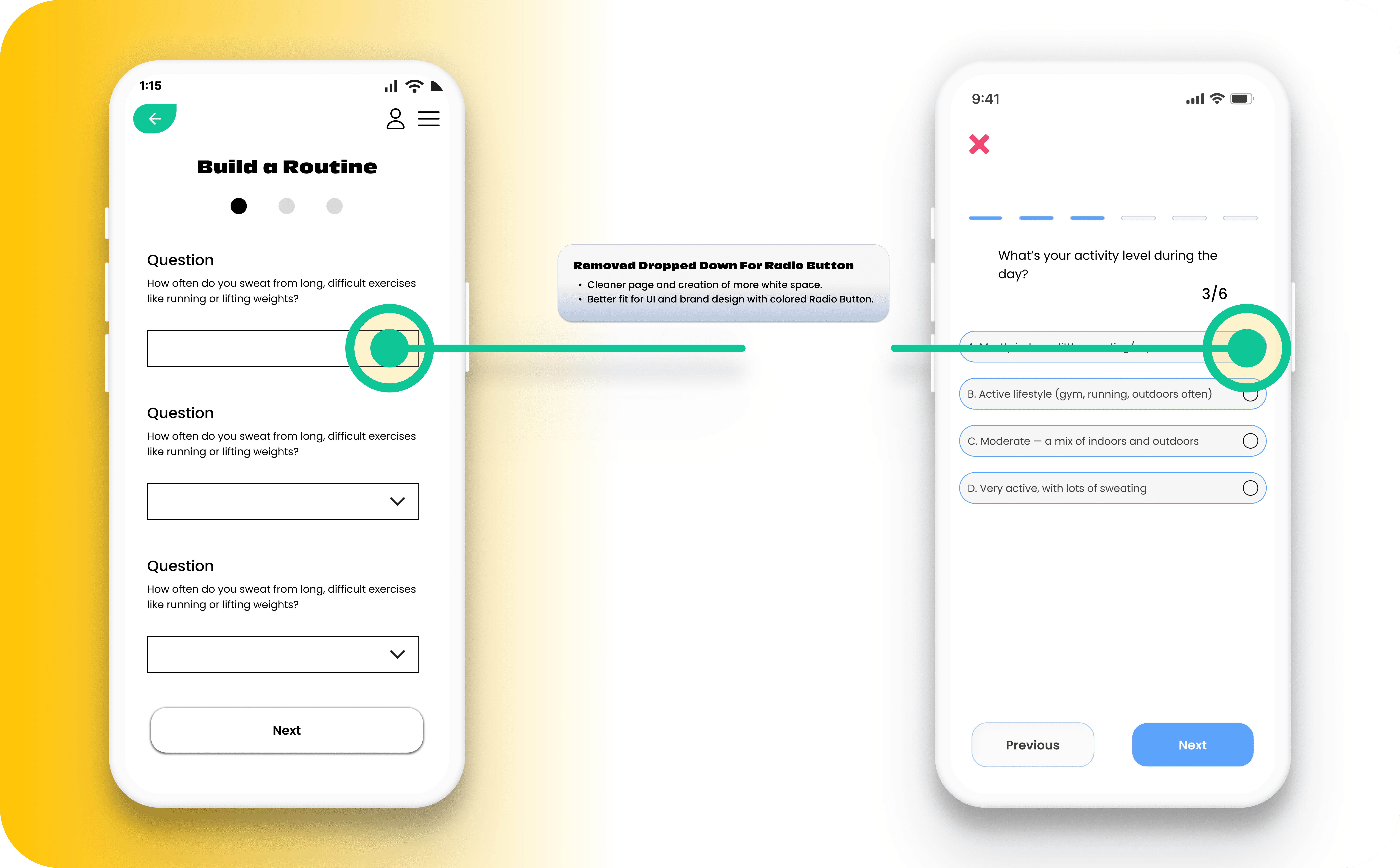
Low-Fidelity Exploration
Low-fidelity wireframes were used to:
Test hierarchy and pacing across the journey
Reduce friction between education and action
Ensure key information lived in a single, cohesive flow rather than fragmented screens
This exploration established the backbone of the experience — one that felt guided, supportive, and confidence-building before introducing complexity.
Design
Flows, IA and Wire Frames. Taking Lofi to HiFI Designs
Crafting a Confident, Trust-Forward Experience
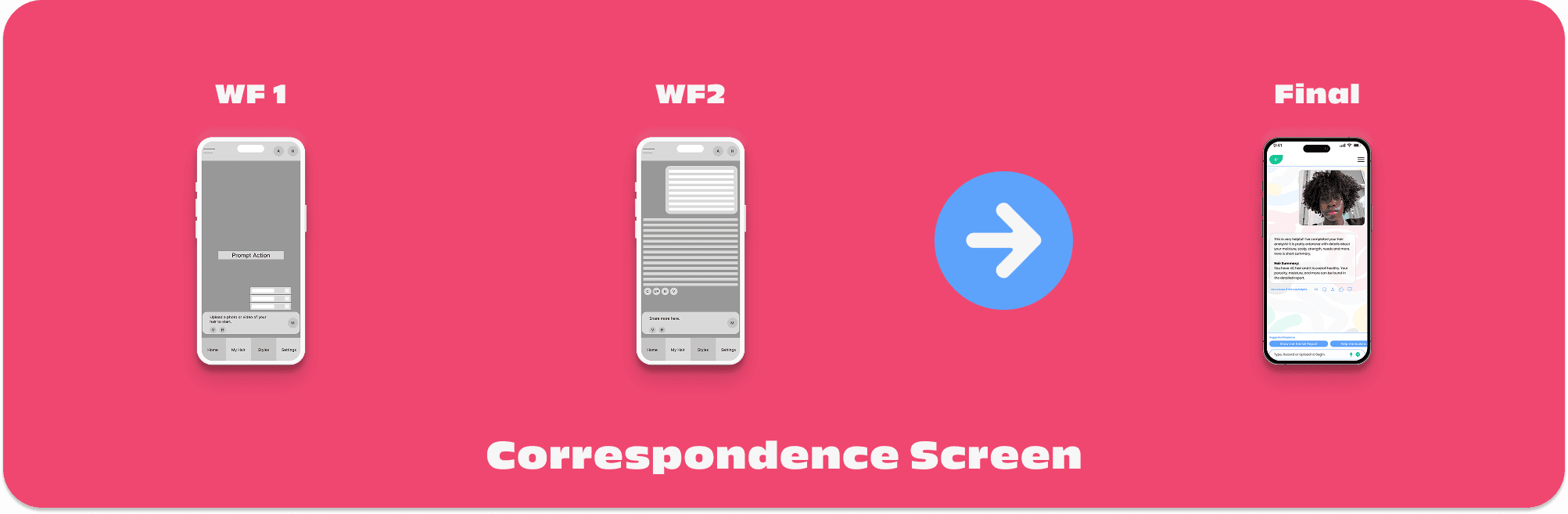
Design focused on translating AI-driven insight into an experience that felt clear, modern, and authoritative without being clinical. After validating low-fidelity wireframes, I iterated through mid-fidelity designs with continuous feedback loops to refine hierarchy, language, and interaction flow before moving into high-fidelity execution.
Design Principles
Confidence before action — insights were framed to inform and reassure before recommending changes
Progressive disclosure — complex information was revealed gradually to avoid cognitive overload
Neutral by default — the experience avoided gendered cues in favor of clarity, balance, and inclusivity
System & Visual Decisions
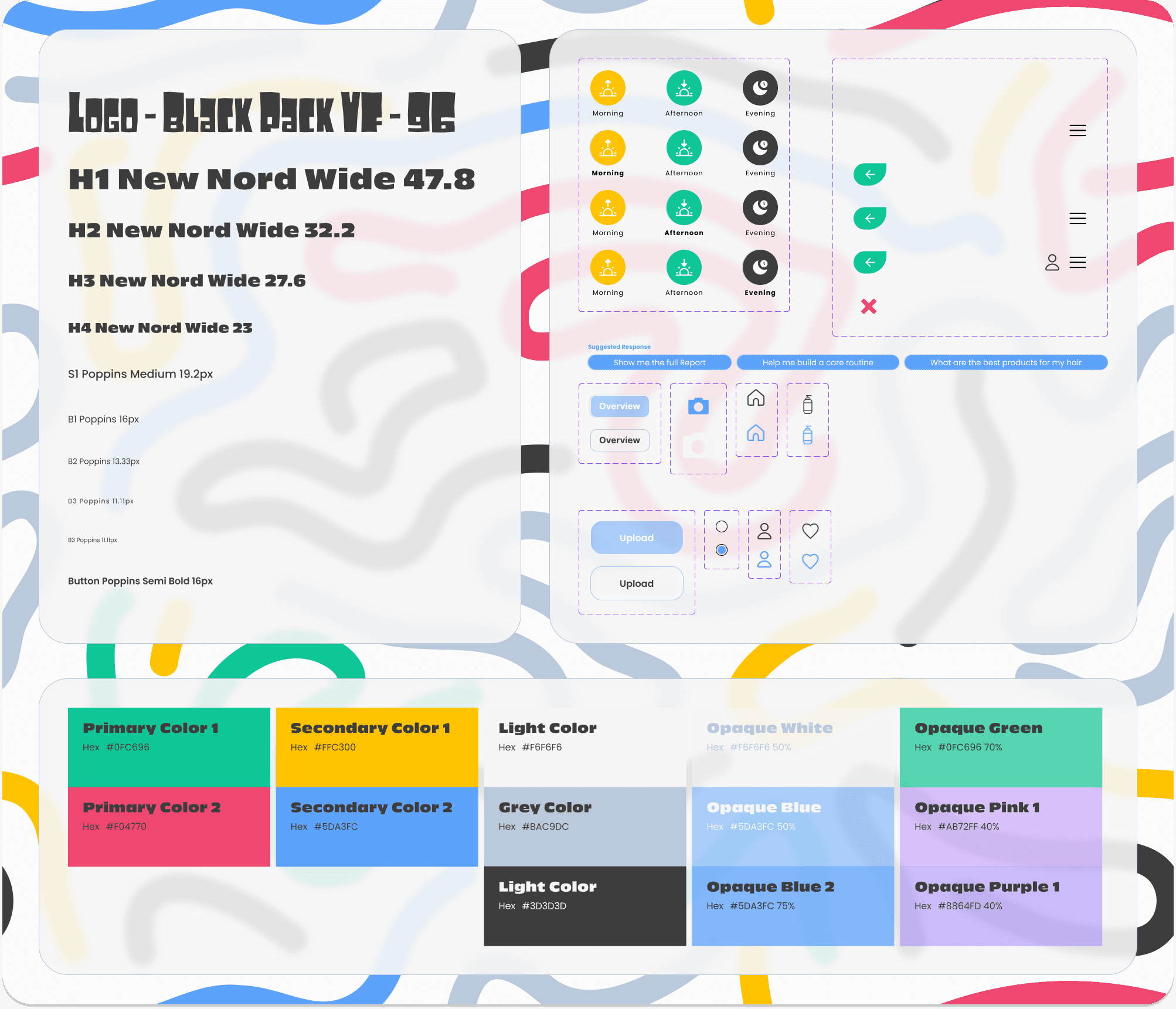
Built a lightweight design system to ensure consistency across analysis, routines, and recommendations
Standardized components (typography, color, buttons, iconography) to support scalability and future feature growth
Established hierarchy patterns that made insight scannable and decisions feel low-effort
Visual Direction
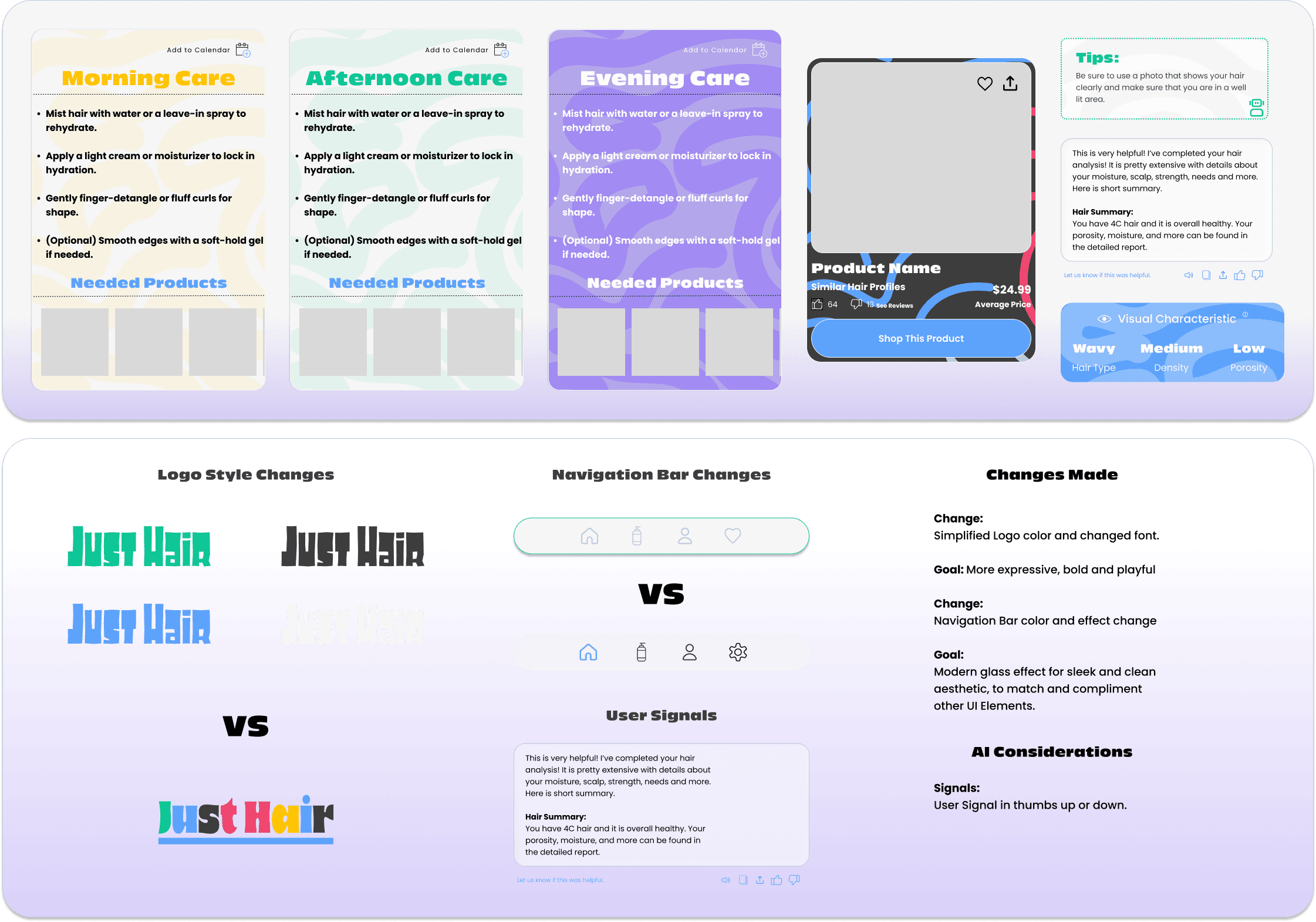
The visual language leaned modern, minimal, and platform-ready — using whites, translucent layers, and a restrained palette of opaque blues, soft pinks, and greens. Transparency and subtle depth cues were used to suggest intelligence and adaptability without visual noise.
The result was a gender-neutral, generation-friendly aesthetic that felt powerful, sleek, and credible — positioning the product as a trusted guide rather than a lifestyle brand.
Every design decision was evaluated against one question:
“Does this feel confident, modern, and easy to trust?”
Test
COnducting rounds of testing before hand offs
Validating Confidence, Clarity, and Flow
Testing focused on validating whether users could understand insights quickly, navigate without hesitation, and feel confident taking action.
Using usability testing in Maze, I gathered both quantitative signals and qualitative feedback to identify where friction still existed — particularly around hierarchy, navigation clarity, and pacing between insight and action.
What Testing Revealed
Users understood the AI insights, but hesitated when deciding what to do next
Certain layouts competed for attention, slowing decision-making
Small language and hierarchy changes had an outsized impact on confidence
What Changed
Refined navigation and card hierarchy to guide attention more clearly
Simplified layouts to reduce cognitive load during decision points
Adjusted copy to feel more supportive and less instructional
Outcome
After iteration, the experience felt intuitive, cohesive, and ready for real-world use — balancing scalability with a calm, empowering interaction model.
Reflection
No project is DONe. Reflect and plan what could be better and whats next.
Designing AI Is About Trust, Not Intelligence
This project reinforced that AI’s value isn’t in how much it knows — it’s in how confidently users can act on what it provides. Accuracy mattered, but clarity, tone, and pacing mattered more.
I learned that when designing AI-driven experiences, education must come before automation. Users need to understand why something is recommended before they’re willing to trust it — especially in emotionally charged, identity-driven spaces like hair care.
What I’d Do Next
If this product shipped, the next phase would focus on:
Feedback loops that allow users to confirm outcomes and improve recommendations over time
Longitudinal learning, tracking how routines perform across climates, seasons, and lifestyle changes
Trust signals, such as explainability, peer validation, and outcome transparency
How This Changed My Approach
This work shifted how I design with emerging technologies. I now prioritize:
Confidence over completeness
Systems that learn over one-off solutions
Human understanding as the foundation for scalable personalization
Case Study
Overview
Just Hair
End to End
This project explores an AI-enabled mobile experience, focused on addressing gaps in women’s hair care education, product discovery, and routine building.
Using qualitative research and LLM experimentation, I designed an end-to-end application that allows users to upload a photo or video of their hair, receive personalized analysis, and build simple, sustainable routines tailored to their lifestyle.
Lead Designer
Role
Solo
Squad
7 weeks
Duration
The Problem
Despite the size and growth of the global hair care industry, women with textured hair—particularly Black women—struggle to confidently care for their hair in ways that fit their lifestyles.
Research revealed a consistent set of challenges across geographies and age groups:
Users spent disproportionately more on hair products due to trial-and-error discovery, often without reliable guidance
Finding trusted, skilled stylists—locally or while traveling—was difficult and inconsistent
Educational resources around hair health, curl patterns, and routines were fragmented or inaccessible
Many users described a decades-long learning curve to understand their own hair
Existing tools and services failed to account for differences in lifestyle, priorities, and context
At its core, the problem was not a lack of products or services—it was a lack of confidence and clarity.
The industry has historically placed the burden of expertise on the user, forcing generations of women to navigate complex, opaque systems without personalized support. This resulted in higher costs, wasted time, inconsistent outcomes, and diminished trust—persisting globally across users from early adulthood through later life.
The Solution
I designed an AI-powered mobile experience that helps users confidently care for their hair by replacing trial-and-error with personalized guidance.
Core Approach
Instead of asking users to become experts, the product acts as a personal hair care assistant—translating complex hair science into clear, actionable guidance.
Key Capabilities
Photo and video-based hair and scalp analysis
AI-driven insights assessing hair health, curl pattern, texture, and scalp condition
Plain-language recommendations designed to build confidence, not overwhelm
Personalized routines with reminders to support consistency over time
Designed for Real Lifestyles
The experience was intentionally flexible to support distinct user needs:
High-investment users seeking smarter, more cost-efficient product decisions
Athletes needing low-effort, low-maintenance routines
Parents managing multiple hair types within one household
System-Level Thinking
Beyond individual recommendations, the product was designed to learn over time. By aggregating anonymized data across hair types, products, climates, and lifestyles, the system could identify global patterns—continuously improving recommendations and reducing friction for future users.
End-to-End Ownership
I designed the experience holistically—from onboarding and education to routines, reminders, and long-term engagement—ensuring the solution aligned user confidence with product value.
The Results
Delivered an end-to-end AI-driven product that helped users replace years of trial-and-error with clear, personalized guidance.
User Impact
Reduced dependence on costly experimentation by translating hair science into actionable routines
Helped users build confidence faster through education, reminders, and consistent care
Supported diverse lifestyles and life stages with adaptable, low-friction personalization
Product & Platform Impact
Designed a scalable personalization system capable of evolving with user data over time
Positioned hair care as part of a broader wellness ecosystem alongside skin, fitness, and health
Established a foundation for long-term learning across hair types, products, climates, and routines
Discovery
The Process of Learning and finding a path forward
From Product Gaps to a Trust & Education Problem
I initially explored whether AI could improve product discovery in textured hair care. Early research quickly revealed the problem was larger than access to products — it was a systemic lack of trust, education, and confidence.
Signals from the Market
Black women spend significantly more on hair care due to trial-and-error purchasing, often investing hundreds of dollars per month without reliable outcomes
Despite growth in natural hair care products, many users still struggle to find safe, effective options and qualified stylists
Existing apps focus on commerce or content, but fail to provide personalized guidance users can trust
These patterns suggested that more options weren’t the solution — better understanding was.
Insights from User Conversations
Interviews with women across ages, regions, and hair textures reinforced this shift:
Users described years — sometimes decades — spent learning their hair through costly experimentation
Many felt overwhelmed by conflicting advice and skeptical of one-size-fits-all recommendations
Trust was built through education, lived experience, and peer validation — not marketing claims
Key Insight
Hair care isn’t just a shopping problem. It’s an identity-driven, emotionally loaded learning journey — and users lack a reliable guide.
This reframed the opportunity from “help users buy better products” to “help users understand their hair and make confident decisions over time.”
Define
The Process of figuring out "What are we actually Solving?"
Framing the Right Problem to Solve
Discovery made it clear that the core issue wasn’t access to products — it was a lack of understanding. Users were making expensive decisions without confidence, relying on trial and error because they didn’t have a reliable way to learn what actually worked for their hair.
Rather than attempting to solve the entire hair care ecosystem at once, I focused the MVP on building confidence before commerce.
What We Chose to Prioritize
Education first — helping users understand their hair type, health, and needs in plain language
Personalized guidance — translating that understanding into routines and product recommendations tailored to the individual
Global accessibility — ensuring insights weren’t limited by geography, stylist access, or local product availability
What We Intentionally Deprioritized
Becoming a marketplace or e-commerce platform in the first iteration
Replacing stylists or expert care with automation alone
Overloading users with content before establishing trust and clarity
Defining Principle
If users could confidently understand their hair, better decisions would follow — across products, routines, and services.
This framing shaped every downstream decision, turning research insights into a focused, scalable foundation for an AI-driven experience.
Explore
Exploring all the ways in which we can solve this problem.
Turning Insight into Experience Direction
With the problem clearly framed around confidence and education, exploration focused on how users should experience learning about their hair — not just where features lived.
Experience Directions Considered
I explored multiple ways users could receive guidance:
Content-first education, similar to blogs or learning hubs
Product-first discovery, leading with recommendations and reviews
Insight-first guidance, where understanding hair came before decisions
While content-heavy approaches provided depth, they risked overwhelming users. Product-first flows recreated the same trial-and-error users were trying to escape.
Chosen Direction
I committed to an insight-first flow:
Onboarding builds context around the user’s hair, lifestyle, and goals
AI analysis translates inputs into clear, human explanations
Recommendations and routines follow understanding — not the other way around
Low-Fidelity Exploration
Low-fidelity wireframes were used to:
Test hierarchy and pacing across the journey
Reduce friction between education and action
Ensure key information lived in a single, cohesive flow rather than fragmented screens
This exploration established the backbone of the experience — one that felt guided, supportive, and confidence-building before introducing complexity.
Design
Flows, IA and Wire Frames. Taking Lofi to HiFI Designs
Crafting a Confident, Trust-Forward Experience
Design focused on translating AI-driven insight into an experience that felt clear, modern, and authoritative without being clinical. After validating low-fidelity wireframes, I iterated through mid-fidelity designs with continuous feedback loops to refine hierarchy, language, and interaction flow before moving into high-fidelity execution.
Design Principles
Confidence before action — insights were framed to inform and reassure before recommending changes
Progressive disclosure — complex information was revealed gradually to avoid cognitive overload
Neutral by default — the experience avoided gendered cues in favor of clarity, balance, and inclusivity
System & Visual Decisions
Built a lightweight design system to ensure consistency across analysis, routines, and recommendations
Standardized components (typography, color, buttons, iconography) to support scalability and future feature growth
Established hierarchy patterns that made insight scannable and decisions feel low-effort
Visual Direction
The visual language leaned modern, minimal, and platform-ready — using whites, translucent layers, and a restrained palette of opaque blues, soft pinks, and greens. Transparency and subtle depth cues were used to suggest intelligence and adaptability without visual noise.
The result was a gender-neutral, generation-friendly aesthetic that felt powerful, sleek, and credible — positioning the product as a trusted guide rather than a lifestyle brand.
Every design decision was evaluated against one question:
“Does this feel confident, modern, and easy to trust?”
Test
COnducting rounds of testing before hand offs
Validating Confidence, Clarity, and Flow
Testing focused on validating whether users could understand insights quickly, navigate without hesitation, and feel confident taking action.
Using usability testing in Maze, I gathered both quantitative signals and qualitative feedback to identify where friction still existed — particularly around hierarchy, navigation clarity, and pacing between insight and action.
What Testing Revealed
Users understood the AI insights, but hesitated when deciding what to do next
Certain layouts competed for attention, slowing decision-making
Small language and hierarchy changes had an outsized impact on confidence
What Changed
Refined navigation and card hierarchy to guide attention more clearly
Simplified layouts to reduce cognitive load during decision points
Adjusted copy to feel more supportive and less instructional
Outcome
After iteration, the experience felt intuitive, cohesive, and ready for real-world use — balancing scalability with a calm, empowering interaction model.
Reflection
No project is DONe. Reflect and plan what could be better and whats next.
Designing AI Is About Trust, Not Intelligence
This project reinforced that AI’s value isn’t in how much it knows — it’s in how confidently users can act on what it provides. Accuracy mattered, but clarity, tone, and pacing mattered more.
I learned that when designing AI-driven experiences, education must come before automation. Users need to understand why something is recommended before they’re willing to trust it — especially in emotionally charged, identity-driven spaces like hair care.
What I’d Do Next
If this product shipped, the next phase would focus on:
Feedback loops that allow users to confirm outcomes and improve recommendations over time
Longitudinal learning, tracking how routines perform across climates, seasons, and lifestyle changes
Trust signals, such as explainability, peer validation, and outcome transparency
How This Changed My Approach
This work shifted how I design with emerging technologies. I now prioritize:
Confidence over completeness
Systems that learn over one-off solutions
Human understanding as the foundation for scalable personalization
Case
Study
Overview
Just Hair
End to End
This project explores an AI-enabled mobile experience, focused on addressing gaps in women’s hair care education, product discovery, and routine building.
Using qualitative research and LLM experimentation, I designed an end-to-end application that allows users to upload a photo or video of their hair, receive personalized analysis, and build simple, sustainable routines tailored to their lifestyle.
Lead Designer
R0le
Solo
Squad
7 weeks
Duration
The Problem
Despite the size and growth of the global hair care industry, women with textured hair—particularly Black women—struggle to confidently care for their hair in ways that fit their lifestyles.
Research revealed a consistent set of challenges across geographies and age groups:
Users spent disproportionately more on hair products due to trial-and-error discovery, often without reliable guidance
Finding trusted, skilled stylists—locally or while traveling—was difficult and inconsistent
Educational resources around hair health, curl patterns, and routines were fragmented or inaccessible
Many users described a decades-long learning curve to understand their own hair
Existing tools and services failed to account for differences in lifestyle, priorities, and context
At its core, the problem was not a lack of products or services—it was a lack of confidence and clarity.
The industry has historically placed the burden of expertise on the user, forcing generations of women to navigate complex, opaque systems without personalized support. This resulted in higher costs, wasted time, inconsistent outcomes, and diminished trust—persisting globally across users from early adulthood through later life.
The Solution
I designed an AI-powered mobile experience that helps users confidently care for their hair by replacing trial-and-error with personalized guidance.
Core Approach
Instead of asking users to become experts, the product acts as a personal hair care assistant—translating complex hair science into clear, actionable guidance.
Key Capabilities
Photo and video-based hair and scalp analysis
AI-driven insights assessing hair health, curl pattern, texture, and scalp condition
Plain-language recommendations designed to build confidence, not overwhelm
Personalized routines with reminders to support consistency over time
Designed for Real Lifestyles
The experience was intentionally flexible to support distinct user needs:
High-investment users seeking smarter, more cost-efficient product decisions
Athletes needing low-effort, low-maintenance routines
Parents managing multiple hair types within one household
System-Level Thinking
Beyond individual recommendations, the product was designed to learn over time. By aggregating anonymized data across hair types, products, climates, and lifestyles, the system could identify global patterns—continuously improving recommendations and reducing friction for future users.
End-to-End Ownership
I designed the experience holistically—from onboarding and education to routines, reminders, and long-term engagement—ensuring the solution aligned user confidence with product value.
The Results
Delivered an end-to-end AI-driven product that helped users replace years of trial-and-error with clear, personalized guidance.
User Impact
Reduced dependence on costly experimentation by translating hair science into actionable routines
Helped users build confidence faster through education, reminders, and consistent care
Supported diverse lifestyles and life stages with adaptable, low-friction personalization
Product & Platform Impact
Designed a scalable personalization system capable of evolving with user data over time
Positioned hair care as part of a broader wellness ecosystem alongside skin, fitness, and health
Established a foundation for long-term learning across hair types, products, climates, and routines
Discovery
The Process of Learning and finding a path forward
From Product Gaps to a Trust & Education Problem
I initially explored whether AI could improve product discovery in textured hair care. Early research quickly revealed the problem was larger than access to products — it was a systemic lack of trust, education, and confidence.
Signals from the Market
Black women spend significantly more on hair care due to trial-and-error purchasing, often investing hundreds of dollars per month without reliable outcomes
Despite growth in natural hair care products, many users still struggle to find safe, effective options and qualified stylists
Existing apps focus on commerce or content, but fail to provide personalized guidance users can trust
These patterns suggested that more options weren’t the solution — better understanding was.
Insights from User Conversations
Interviews with women across ages, regions, and hair textures reinforced this shift:
Users described years — sometimes decades — spent learning their hair through costly experimentation
Many felt overwhelmed by conflicting advice and skeptical of one-size-fits-all recommendations
Trust was built through education, lived experience, and peer validation — not marketing claims
Key Insight
Hair care isn’t just a shopping problem. It’s an identity-driven, emotionally loaded learning journey — and users lack a reliable guide.
This reframed the opportunity from “help users buy better products” to “help users understand their hair and make confident decisions over time.”
Define
The Process of figuring out "What are we actually Solving?"
Framing the Right Problem to Solve
Discovery made it clear that the core issue wasn’t access to products — it was a lack of understanding. Users were making expensive decisions without confidence, relying on trial and error because they didn’t have a reliable way to learn what actually worked for their hair.
Rather than attempting to solve the entire hair care ecosystem at once, I focused the MVP on building confidence before commerce.
What We Chose to Prioritize
Education first — helping users understand their hair type, health, and needs in plain language
Personalized guidance — translating that understanding into routines and product recommendations tailored to the individual
Global accessibility — ensuring insights weren’t limited by geography, stylist access, or local product availability
What We Intentionally Deprioritized
Becoming a marketplace or e-commerce platform in the first iteration
Replacing stylists or expert care with automation alone
Overloading users with content before establishing trust and clarity
Defining Principle
If users could confidently understand their hair, better decisions would follow — across products, routines, and services.
This framing shaped every downstream decision, turning research insights into a focused, scalable foundation for an AI-driven experience.
Explore
Exploring all the ways in which we can solve this problem.
Turning Insight into Experience Direction
With the problem clearly framed around confidence and education, exploration focused on how users should experience learning about their hair — not just where features lived.
Experience Directions Considered
I explored multiple ways users could receive guidance:
Content-first education, similar to blogs or learning hubs
Product-first discovery, leading with recommendations and reviews
Insight-first guidance, where understanding hair came before decisions
While content-heavy approaches provided depth, they risked overwhelming users. Product-first flows recreated the same trial-and-error users were trying to escape.
Chosen Direction
I committed to an insight-first flow:
Onboarding builds context around the user’s hair, lifestyle, and goals
AI analysis translates inputs into clear, human explanations
Recommendations and routines follow understanding — not the other way around
Low-Fidelity Exploration
Low-fidelity wireframes were used to:
Test hierarchy and pacing across the journey
Reduce friction between education and action
Ensure key information lived in a single, cohesive flow rather than fragmented screens
This exploration established the backbone of the experience — one that felt guided, supportive, and confidence-building before introducing complexity.
Design
Flows, IA and Wire Frames. Taking Lofi to HiFI Designs
Crafting a Confident, Trust-Forward Experience
Design focused on translating AI-driven insight into an experience that felt clear, modern, and authoritative without being clinical. After validating low-fidelity wireframes, I iterated through mid-fidelity designs with continuous feedback loops to refine hierarchy, language, and interaction flow before moving into high-fidelity execution.
Design Principles
Confidence before action — insights were framed to inform and reassure before recommending changes
Progressive disclosure — complex information was revealed gradually to avoid cognitive overload
Neutral by default — the experience avoided gendered cues in favor of clarity, balance, and inclusivity
System & Visual Decisions
Built a lightweight design system to ensure consistency across analysis, routines, and recommendations
Standardized components (typography, color, buttons, iconography) to support scalability and future feature growth
Established hierarchy patterns that made insight scannable and decisions feel low-effort
Visual Direction
The visual language leaned modern, minimal, and platform-ready — using whites, translucent layers, and a restrained palette of opaque blues, soft pinks, and greens. Transparency and subtle depth cues were used to suggest intelligence and adaptability without visual noise.
The result was a gender-neutral, generation-friendly aesthetic that felt powerful, sleek, and credible — positioning the product as a trusted guide rather than a lifestyle brand.
Every design decision was evaluated against one question:
“Does this feel confident, modern, and easy to trust?”
Test
COnducting rounds of testing before hand offs
Validating Confidence, Clarity, and Flow
Testing focused on validating whether users could understand insights quickly, navigate without hesitation, and feel confident taking action.
Using usability testing in Maze, I gathered both quantitative signals and qualitative feedback to identify where friction still existed — particularly around hierarchy, navigation clarity, and pacing between insight and action.
What Testing Revealed
Users understood the AI insights, but hesitated when deciding what to do next
Certain layouts competed for attention, slowing decision-making
Small language and hierarchy changes had an outsized impact on confidence
What Changed
Refined navigation and card hierarchy to guide attention more clearly
Simplified layouts to reduce cognitive load during decision points
Adjusted copy to feel more supportive and less instructional
Outcome
After iteration, the experience felt intuitive, cohesive, and ready for real-world use — balancing scalability with a calm, empowering interaction model.
Reflection
No project is DONe. Reflect and plan what could be better and whats next.
Designing AI Is About Trust, Not Intelligence
This project reinforced that AI’s value isn’t in how much it knows — it’s in how confidently users can act on what it provides. Accuracy mattered, but clarity, tone, and pacing mattered more.
I learned that when designing AI-driven experiences, education must come before automation. Users need to understand why something is recommended before they’re willing to trust it — especially in emotionally charged, identity-driven spaces like hair care.
What I’d Do Next
If this product shipped, the next phase would focus on:
Feedback loops that allow users to confirm outcomes and improve recommendations over time
Longitudinal learning, tracking how routines perform across climates, seasons, and lifestyle changes
Trust signals, such as explainability, peer validation, and outcome transparency
How This Changed My Approach
This work shifted how I design with emerging technologies. I now prioritize:
Confidence over completeness
Systems that learn over one-off solutions
Human understanding as the foundation for scalable personalization