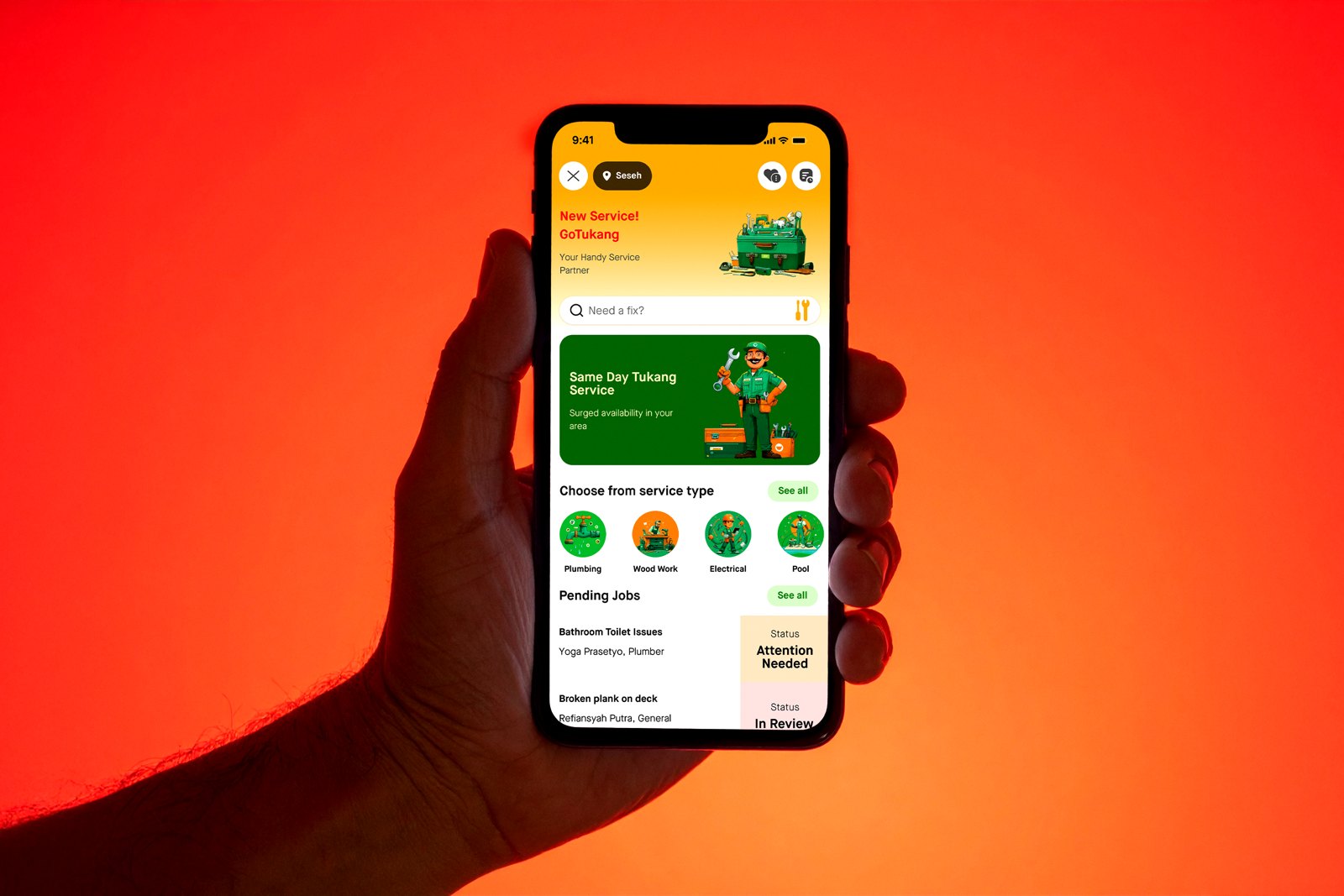
GoTukang
A concept for booking trusted handymen inside Gojek, so business owners in Bali can stop relying on “I know a guy.”
- Status
- Concept, tested hi-fi prototype
- Context
- Solo project: add a feature to an existing app. Not affiliated with Gojek.
- My role
- Product lead and designer: research, prioritization, design and testing
- Timeline
- July to September 2025
- Segment
- Small business and property owners in Bali
- Research
- 3 in-person interviews, competitive SWOT and a four-market analysis
- Tested with
- 4 rounds of lo-fi testing; 7 participants in Maze
- North star
- Books again within 60 days
- Stack
- Figma, FigJam, Maze, Notion, Midjourney
1. Background
The brief was to add a feature to an existing app without breaking its brand. I live in Bali, and every repair I saw ran on a personal network: a tukang (handyman) you know, reached by text or call. I picked Gojek, Indonesia’s leading super app for rides, food and payments, and asked whether it could own this job.
Gojek had tried before. Its GoService partnership brought Pinhome’s cleaning and home services into the app in 2021, and that integration ended on February 28, 2022 (Warta Ekonomi, 2022). The demand was real; a partner-run model was the risk.
2. Project overview
Vision. Make finding and booking a reliable tukang as easy and trustworthy as ordering a Gojek ride.
The market. Indonesia has 65.5 million micro, small and medium businesses. They employ about 97% of the workforce and produce 61.9% of GDP (Antara, July 2025). Gojek’s parent, GoTo, is growing at scale: group core GTV rose 43% year over year to Rp89.8 trillion in Q2 2025, and On-Demand Services GTV grew 9% to Rp16.4 trillion (GoTo, Q2 2025). That means a large base of businesses that need repairs, and an app many already open every day.
Problem statement. For business and home owners in Indonesia, finding skilled labor for maintenance is hard. Word of mouth is still the main way to find a tukang, and it brings a chain of problems: no transparent pricing, unreliable scheduling, language barriers and no way to find someone new.
3. Ideation overview
Scope. A solo project: I made the product calls and tested them with users.
- 3 in-person interviews with Bali business and property owners who regularly hire tukangs
- A four-market comparison (Indonesia, Thailand, the Philippines, Singapore) that ranked Indonesia first on business count and labor supply
- A SWOT analysis of Sejasa, Ayasan and Pinhome, the main home-service players
- Affinity mapping, then problem statements, POVs and How Might We questions
- An audit of Gojek’s existing flows (GoRide, GoFood, GoSend, GoPay) to reuse its patterns
| Player | Focus | Gap GoTukang fills |
|---|---|---|
| Sejasa | Handyman and renovation marketplace | Web-first; quality varies by provider |
| Ayasan | Domestic staff (maids, drivers, carers) | Little depth in trades |
| Pinhome | App-based home services | Mostly big cities; no super-app reach since leaving Gojek |
None of the people I interviewed knew any of these apps existed. Reach, not features, was the gap.
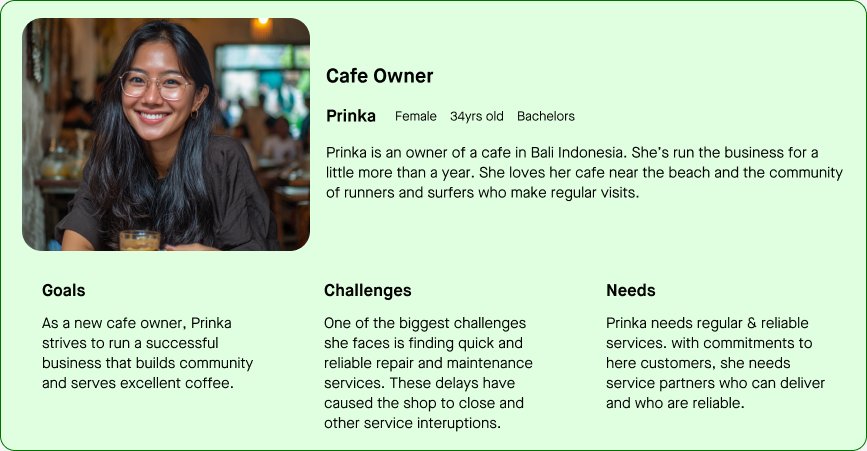
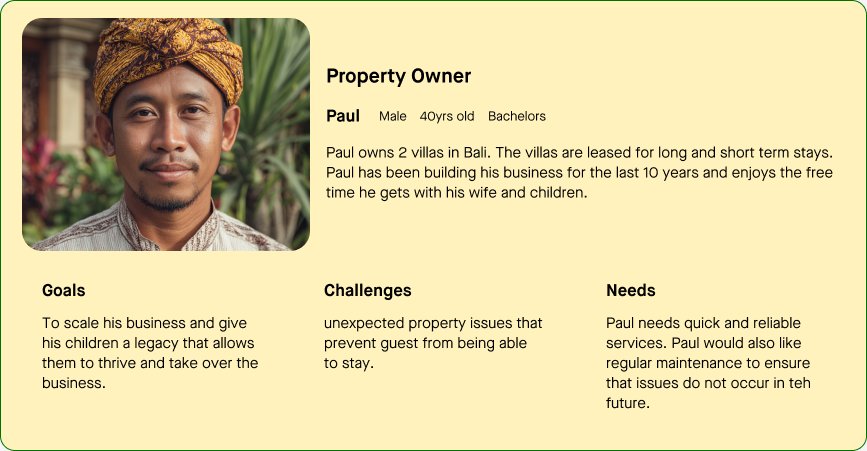
Target customer. Two personas came out of the research:
| Persona | Who they are | Key goal | Key pain |
|---|---|---|---|
| Prinka | 34, runs a café near the beach in Bali | A business that builds community and serves great coffee | Slow, unreliable repairs have forced the café to close |
| Paul | 40, owns two villas leased for long and short stays | Scale the business into a legacy for his children | Surprise property issues stop guests from staying |
4. Customer segmentation
We prioritized small business owners, the Prinka segment. A shop needs a tukang often and loses money the day something breaks, so the need is frequent and the cost of a no-show is real.
| Segment | Impact | Urgency | Size of market | Total |
|---|---|---|---|---|
| Small business owners (cafés, shops) | 5 | 5 | 4 | 14 |
| Property and villa owners and managers | 5 | 4 | 3 | 12 |
| Households | 3 | 2 | 5 | 10 |
Scored 1–5, retrospectively from research findings.
Property owners like Paul scored close behind and share the same flow. Households are the biggest group but need help a few times a year and have more patience, so they come later.
5. Customer pain point
We prioritized finding a reliable, trustworthy tukang. Every other pain follows from it.
| Pain point | Impact | Urgency | Size | Total |
|---|---|---|---|---|
| Finding a reliable, trustworthy tukang | 5 | 5 | 5 | 15 |
| No-shows and unreliable scheduling | 5 | 4 | 4 | 13 |
| No transparent pricing | 4 | 3 | 4 | 11 |
| Language barrier | 3 | 3 | 3 | 9 |
| Findability: no listings, only referrals | 3 | 3 | 3 | 9 |
Scored 1–5, retrospectively from research findings.
Participants described the same loop: ask a friend, wait, and hope. Some tukangs didn’t show up, others lacked professionalism or missed the brief. Reliability scored second, but you can’t schedule someone reliable until you can find and judge them.
6. Prioritized solution
We chose search and tukang profiles with reviews and badges, so a business owner can judge a tukang in seconds instead of asking around.
| Proposed solution | Ease (5 = easy) | Eng. effort (5 = easy) | Effectiveness | Total |
|---|---|---|---|---|
| Search + tukang profiles with reviews and badges (On Time, Bilingual) | 4 | 4 | 5 | 13 |
| Job request with scope, budget and photos; invite several tukangs | 4 | 3 | 5 | 12 |
| Scheduling | 4 | 3 | 4 | 11 |
| Chat and Q&A with the tukang | 4 | 4 | 3 | 11 |
| Saved tukangs and referrals | 4 | 4 | 2 | 10 |
| In-app payment | 3 | 2 | 2 | 7 |
| QR code scan to book | 3 | 3 | 1 | 7 |
| Large projects and contractor accounts | 2 | 2 | 2 | 6 |
Scored retrospectively; priorities come from my feature backlog (P1–P3).
Profiles answer the top pain directly and reuse patterns Gojek users already know. The job request came with them, because a profile only helps if you can then ask that person for help.
Key product decisions
| Decision | I chose | Over | Why |
|---|---|---|---|
| Trust | Ratings, reviews and job history | Referrals | Trust has to live in the product |
| Reliability | Badges: On Time, Bilingual | Long reviews | Judge a tukang in seconds |
| Requests | Structured job: issue type, photos, schedule | Free-text messages | Better proposals, less back-and-forth |
| Look and feel | Gojek’s existing patterns, like GoCar scheduling | New UI | Inside a super app, new patterns are a cost |
What we cut, and why
| Cut | Moved to | Reason |
|---|---|---|
| In-app payment | Later phase | The trades still run largely on cash; forcing digital payment adds friction on both sides |
| QR code scan to book | Removed | Testers said it was nice to have, but the audience could struggle with it |
| Saved tukangs and tukang referrals | P2 | Saved tukangs were tested in lo-fi; both matter once a network exists, not first |
| Large-project bidding and contractor accounts | P3 | A different product for multi-trade jobs |
7. Develop MVP
The MVP is one loop inside Gojek: search a problem → compare tukang profiles → create a job → invite tukangs → track proposals and schedule, with chat before you commit and a review after the job.
North star: businesses that book again within 60 days. A first booking can be curiosity; a second one means the tukang showed up and did the work. In a two-sided marketplace I’d watch supply just as closely: jobs with no proposals, and tukang no-shows.
| Stage | Metric | Signal |
|---|---|---|
| Request | Job posted with issue, photos and schedule | Real |
| Match | Job gets 2+ proposals | Real |
| Complete | Tukang arrives on time | Real |
| Repeat | Books again within 60 days | North star |
User stories and acceptance criteria
| # | User story | Acceptance criteria |
|---|---|---|
| 1 | As a business owner, I want to search by problem and area, so that I find tukangs who can fix it near me. | Search by service type and location. Results and categories follow Gojek’s search layout. |
| 2 | As a business owner, I want to see a tukang’s reviews, badges and services, so that I can trust them before I ask. | Profile shows rating, review count, badges and services, with a path to all reviews. Save or share the profile. |
| 3 | As a business owner, I want to create a job and invite several tukangs to it, so that I get a fast, fair response. | Choose an existing job or create one with name, issue type and photos. Invite more than one tukang to the same job. |
| 4 | As a business owner, I want to give my available times, so that a tukang can accept quickly. | Scheduling mirrors GoCar: open availability for the day, the week or custom dates and times. |
| 5 | As a business owner, I want to track each job’s status and contact the tukang, so that I know who is coming and when. | Jobs page with Pending, Accepted and Past. Message, call or request a change from the job. |
The test plan’s bar: 100% task success, 0% errors.
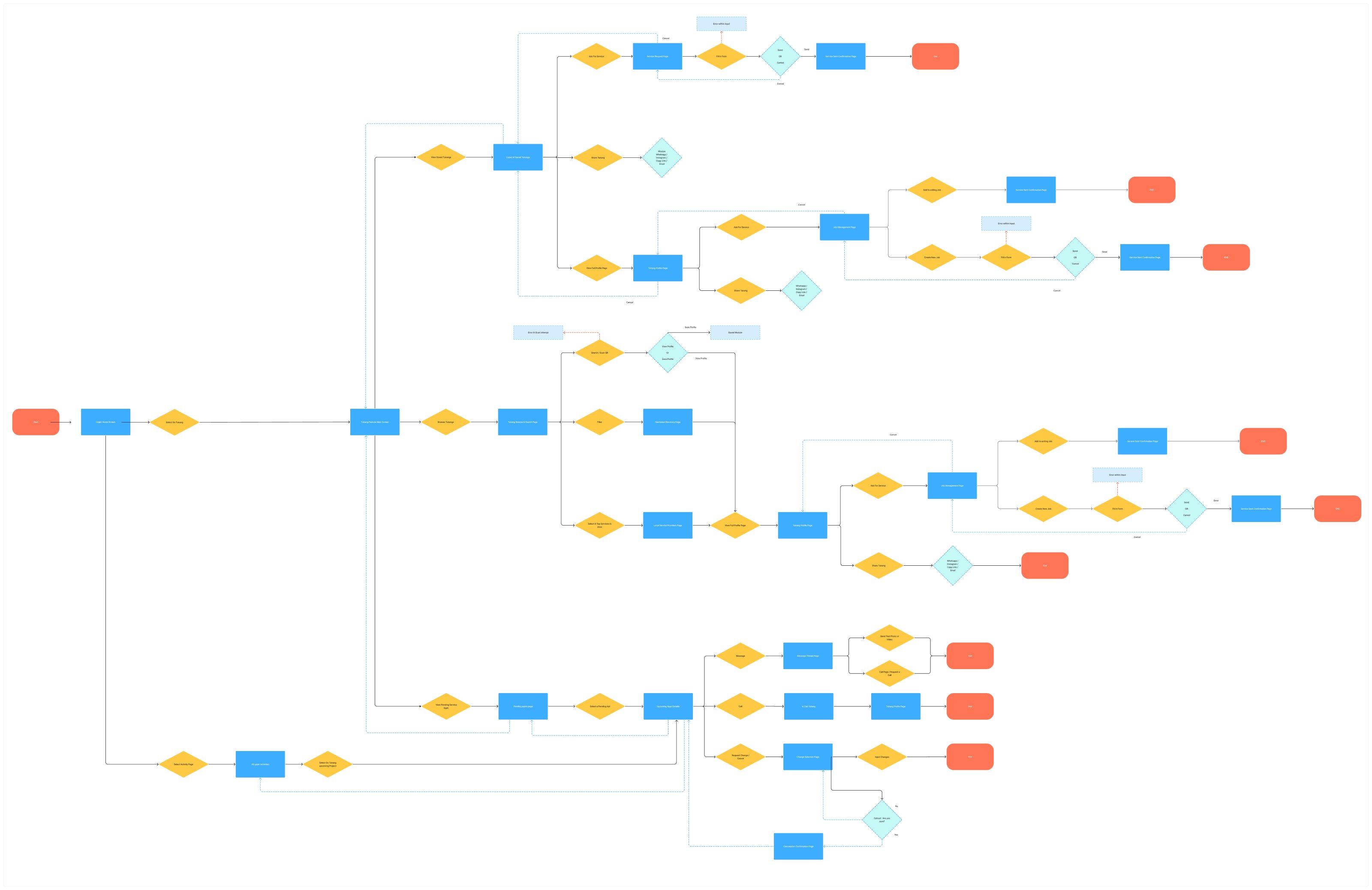
User flow
Every path from Gojek’s home screen: search and browse, saved tukangs, pending jobs and changes to a booking. Select the flow to open it full size.
8. Launch plan
GoTukang hasn’t launched; this is how it would go to market.
- First market: small businesses and villa owners in Bali, where the research happened and where referrals still decide who gets hired.
- Supply first: recruit tukangs through the referral networks they already use, so jobs get proposals from day one.
- Promotion: an entry on Gojek’s home screen and cross-promotion to GoFood merchants, who are already small businesses on the platform.
| Phase | What ships | Gate to move on |
|---|---|---|
| Pilot (Bali) | Search, profiles and badges, job requests and invites, scheduling, chat, reviews | Most jobs get 2+ proposals |
| Expand | More cities and trades, saved tukangs, tukang referrals | Repeat bookings hold |
| Scale | Contractor accounts, large projects, GoPay payment | Commission covers acquisition |
How it will make money
Long term, a commission on each completed job. The pilot earns no commission by design, because I cut in-app payment: its job is to build a reliable network and repeat demand. Commission starts once GoPay is common in the trades.
9. Customer feedback and iterations
Four rounds of lo-fi testing reshaped the flows before any visual design. Over seven days, testers reviewed three flows: book from saved tukangs, search for a plumber and schedule, and message or change a booking.
| What we saw | What I changed |
|---|---|
| People needed to send one job to several tukangs | Added a job selection or creation step to the request flow |
| Upcoming appointments didn’t reflect that tukangs must accept first | Replaced them with a Jobs page: Pending, Accepted, Past |
| The scheduling screen felt unfamiliar | Rebuilt it to mirror GoCar scheduling, with open-availability options |
| The QR scan was nice to have but a barrier for this audience | Removed it |
| Search sections all looked the same | Rebuilt the layout to match Gojek’s search pages |
| The large profile photo took space but added little | Shrank it and added badges, services and reviews |
| Saving tukangs to groups was confusing | Added a heart to save or unsave, plus quick actions on the saved list |
Then an unmoderated Maze test of the hi-fi “search and request a tukang” flow with 7 participants: 100% task success, and testers rated it 5 out of 5. Four small changes followed:
- Images that fit Gojek’s brand, generated with Midjourney
- Missing UI states: calendar pickers, dropdowns and keyboard input
- Clearer button text where people hesitated
- The request split into two distinct steps
Gojek has no public design system, so I rebuilt the fonts, colors, icons and components from screenshots to keep the feature native.
Appendix: the full feature backlog
All 8 features from my feature map, ranked P1 to P3.
| Priority | Feature | Outcome |
|---|---|---|
| P1 | Specialty tukang search | In prototype |
| P1 | Schedule a tukang service | In prototype |
| P1 | Chat and Q&A before booking | In prototype |
| P1 | Tukang reviews | In prototype |
| P2 | Save tukangs for future jobs | Tested in lo-fi; deferred |
| P2 | Tukang referral | Deferred |
| P3 | Large-project bidding | Deferred |
| P3 | General contractor and tukang manager accounts | Deferred |