Prepare
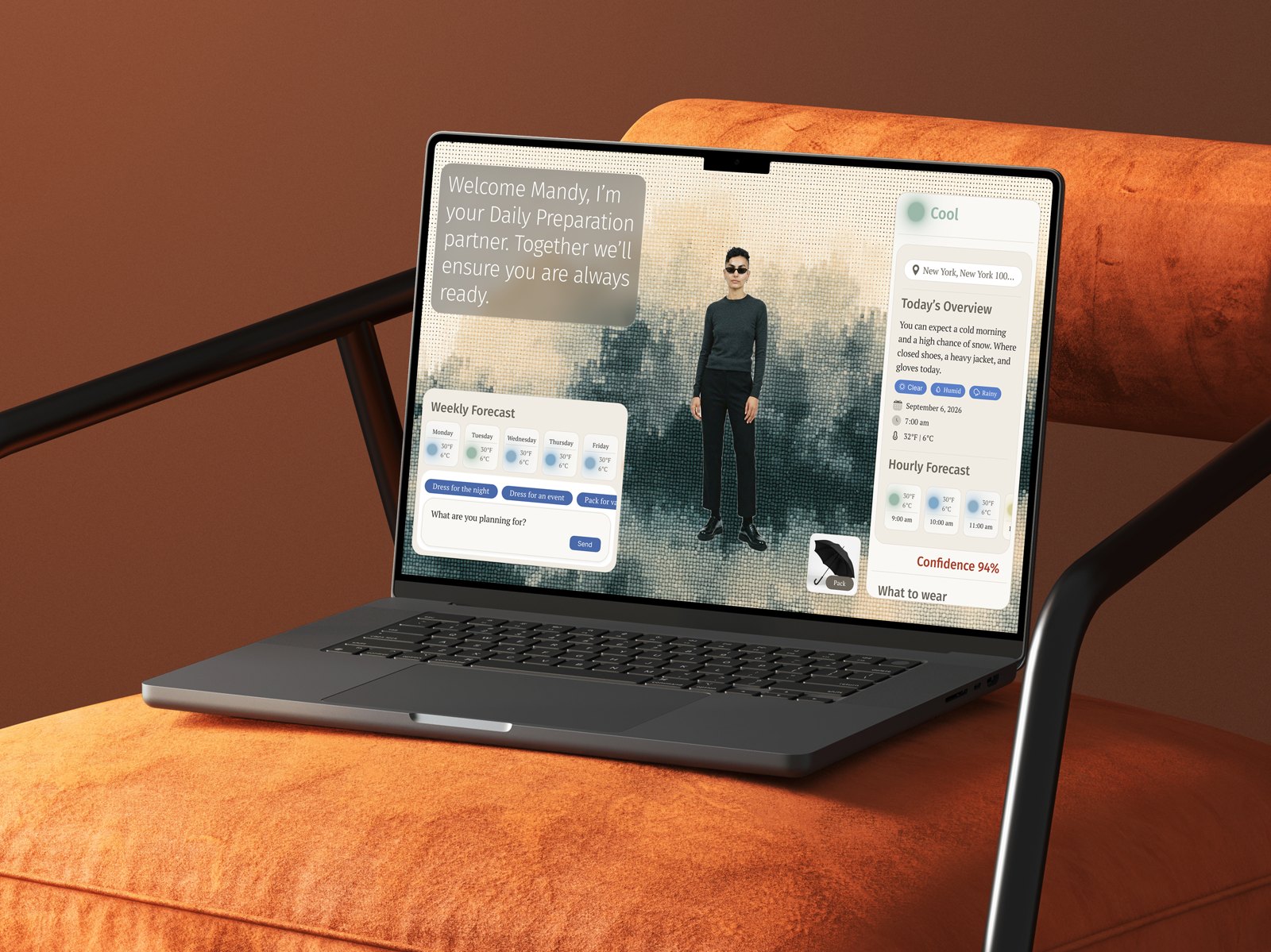
A weather app that answers the question people actually open it for: what do I wear and what do I pack today?
- Status
- Shipped v0.1
- My role
- Product lead, designer and builder
- Platform
- Mobile web
- Segment
- Urban professionals first, travelers second
- Traction
- ~100 site visitors; 20 research participants using it daily
- North star
- Daily return rate
- Stack
- React, TypeScript, Tailwind, Gemini Flash, Open-Meteo, Google Cloud Run
- Links
- Live app · Figma · Repo
1. The problem and who had it
Weather apps are built as data dashboards, but nobody checks the weather to study meteorology. Every morning, people do the same mental math: 68°F, 85% humidity and 18 mph gusts means a light jacket? An umbrella? Both?
Someone close to me asked for exactly this: an app that just tells them what to wear. That's when it clicked that this is an accessibility problem, not a convenience feature. Some people simply need help deciding what to wear.
How I validated it
Before building, I talked to many people about how they dress for the weather. Almost everyone described the same friction and had ideas for fixing it, which told me the problem was common, not personal.
2. Segment and business case
Prepare is for anyone who checks the weather, but I prioritized urban professionals. City weather changes what they wear across work, evening plans and the weekend. They check the forecast at a predictable moment, which makes the habit easy to design for. Travelers come second: packing is the same decision stretched over days.
The category is crowded and free, so the case rests on owning the decision layer, a daily habit, and very low running costs.
| Monetization path | How it pays | Why it fits |
|---|---|---|
| Premium personalization | Subscription for personal modes and briefings | Deepens a habit people already have |
| Wardrobe integration | Recommendations from your own closet | High switching cost once a closet is catalogued |
| Commerce in Pack | Affiliate links on recommended gear | Recommendations are purchase-intent moments |
3. The decisions: what I chose and what I cut
The biggest call: AI writes the words, but rules make the recommendations. Letting a language model decide what to wear is fast to build but unsafe: it can suggest a t-shirt in a snowstorm. Every clothing and packing decision comes from a rules engine; Gemini only adds the voice and answers follow-up questions.
| Decision | I chose | Over | Why |
|---|---|---|---|
| Who decides what to wear | A rules engine | The language model | No made-up advice; logic I can test |
| Speed vs. richness | Instant fallback copy, AI copy swaps in | Waiting for the model | A slow model never blocks the morning |
| Chat scope | Today's forecast only | Open-ended chat | On-job, cheaper, harder to misuse |
| Uncertainty | A confidence score | Hiding it | Honesty on borderline days builds trust |
What I cut from v0.1
- Most weather data points. Showing more data well takes careful design, and it isn't what people came for.
- Pack items beyond the umbrella. Rain is the most obvious, highest-stakes call. The umbrella is even suppressed when wind would break it.
- Custom avatar and styling. Too heavy for v0.1, and the core value didn't depend on it.
- Richer assistant replies: no images, products or multiple-choice answers yet.
4. How I designed and built it
I designed it in Figma and built it myself, so every decision above could be tested in a working app within days instead of handed off in a spec.
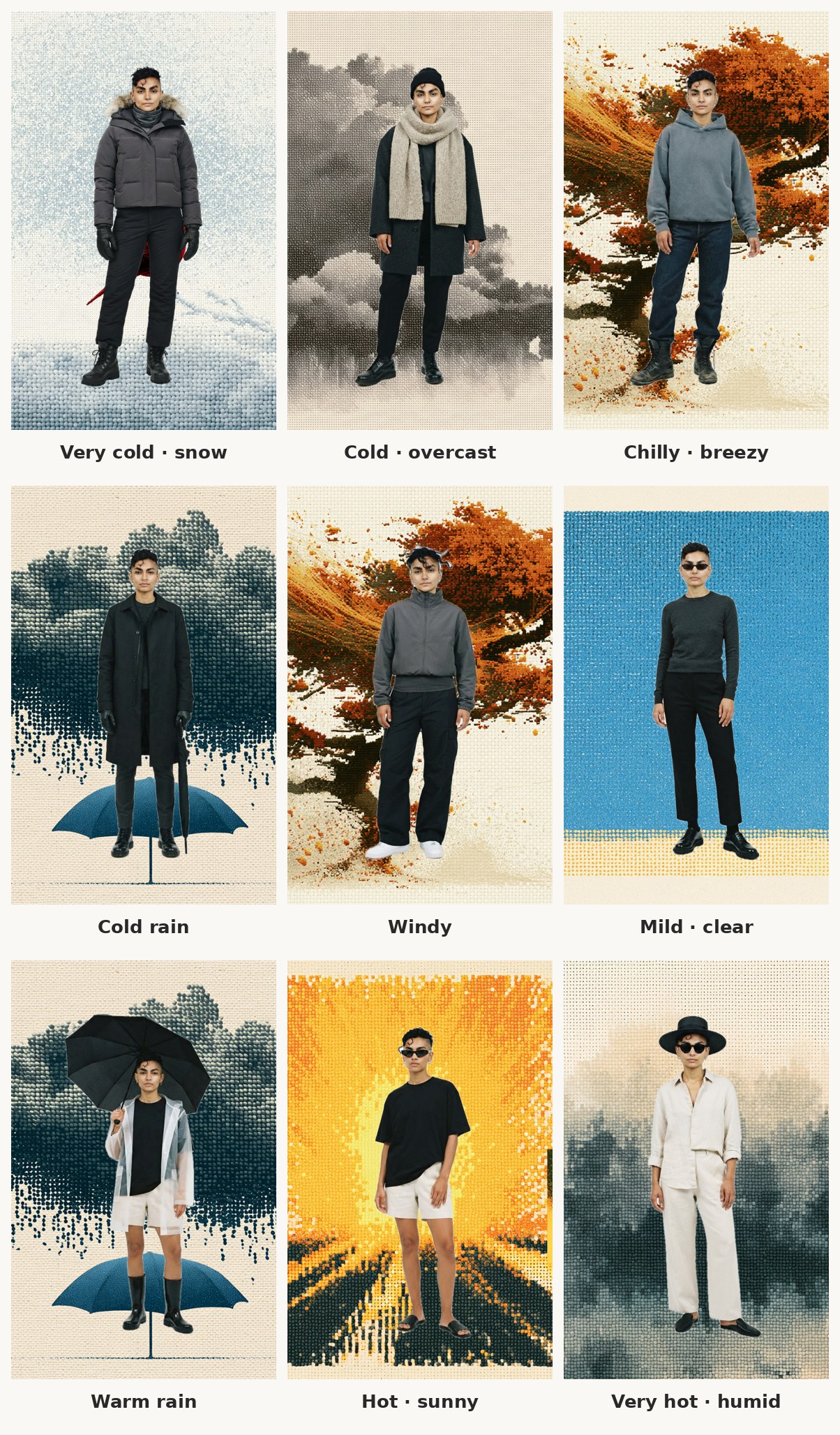
Rules decide; AI only writes the words. If the model is slow, fallback copy appears instantly.
Design and build details
- Decision first, data second. Wear and Pack lead the screen; forecast detail sits below.
- An editorial voice: serif headlines over a clean sans, like a morning paper.
- Mobile first, with fluid layouts that scale up.
- Build: React, TypeScript and Tailwind; 23 custom icons; deployed to Google Cloud Run on every push.
5. Outcome and how I measure success
v0.1 is live with ~100 site visitors. I recruited 20 research participants to use it daily; because they were recruited, the next test is whether strangers come back on their own.
The metric that matters is whether people come back tomorrow morning.
| Stage | Metric | Signal |
|---|---|---|
| Arrive | Visits, location granted | Vanity on its own |
| Activate | Saw the Wear card in under a second | Real |
| Trust | Recommendation followed | Real |
| Habit | Next-morning return, 4+ days a week | North star |
| Expand | Shared with a friend | Real |
6. Growth plan and roadmap
The roadmap follows the habit loop: get people in, make the answer trustworthy, then give them a reason to come back without thinking.
| Phase | What ships | Gate to the next phase |
|---|---|---|
| v0.1 Shipped | Rules engine, wear recommendations, umbrella call, AI copy, travel assistant | 20 participants using it daily |
| v0.2 | Sign-up, avatar, custom pack lists, deeper weather data | Daily return holds with strangers |
| v0.3 | Travel and shopping, calendar integrations, AI that learns your routine | Retention proven before monetizing |