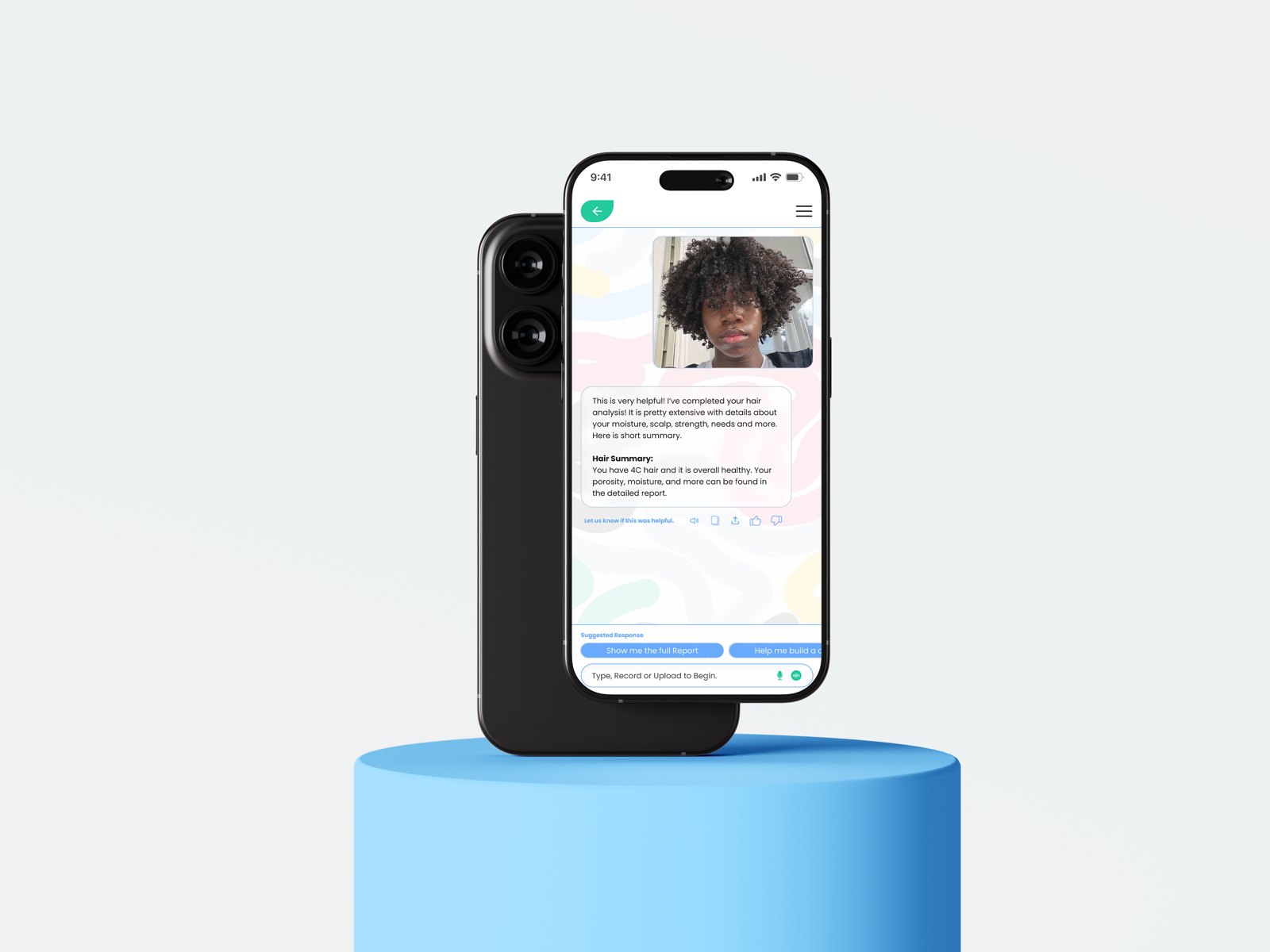
Just Hair
An AI hair-care assistant for women with textured hair: it explains your hair before it recommends anything, so years of trial and error become a routine you can trust.
- Status
- Concept, tested hi-fi prototype
- Context
- Solo project, ELVTR product design program
- My role
- Product and UX, end to end: research, prioritization, design and testing
- Timeline
- 6 weeks
- Segment
- High-spending professionals with textured hair
- Research
- 6 interviews, U.S. and Indonesia, ages 20s to 40s
- Tested with
- 6 participants (mid-fi) and 7 unmoderated Maze testers
- North star
- Routine followed for 3+ weeks
- Stack
- Figma, Maze, Notion; LLM feasibility in Lovable
1. Background
Just Hair is my concept project from the ELVTR product design program. I chose it because textured-hair care is a deep, global problem that the industry underserves, and because large language models can finally read a photo and explain what they see in plain language. I owned every stage, and tested the LLM connection for feasibility in Lovable.
2. Project overview
Vision. Help women with textured hair understand their own hair first, then care for it with confidence and spend less getting there.
The market. Black consumers spent $6.6 billion on beauty in 2021, yet are 1.6 times more likely than White consumers to be dissatisfied with hair care products, and only 13% say it’s easy to find products that meet their needs at mass retailers (McKinsey, 2022). In 2017 they accounted for $54 million of the $63 million spent on ethnic hair and beauty products (NielsenIQ, 2018). High spend, low satisfaction: the gap is guidance, not supply.
Problem statement. Most people with textured hair don’t fully understand their own hair, and often take a decade or more to learn it. They rely on reviews, influencers and costly trial and error, so the industry puts the burden of expertise on the customer.
3. Ideation overview
Scope. A solo project: I made the product calls and tested them with users.
- 6 interviews over Zoom and phone: 2 with tightly textured hair, 3 medium textured, 1 straight, across the U.S. and Indonesia, ages 20s to 40s
- Secondary research on the hair-care market and on what LLMs can reliably analyze
- A competitive scan of curl quizzes and product lines participants already used (Prose, Cantu, Shea Moisture)
- Affinity mapping into six themes, then problem statements, POVs and How Might We questions
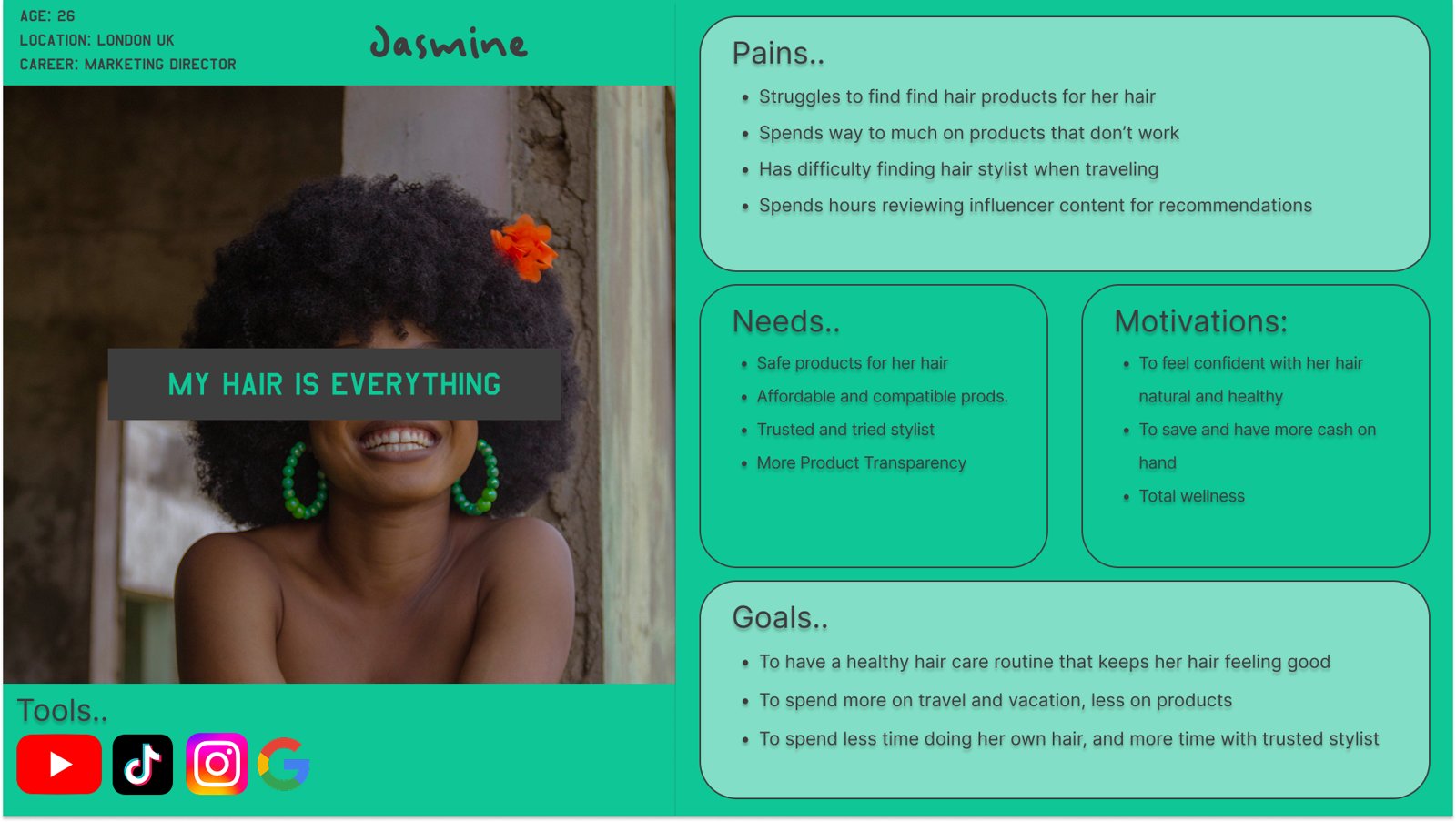
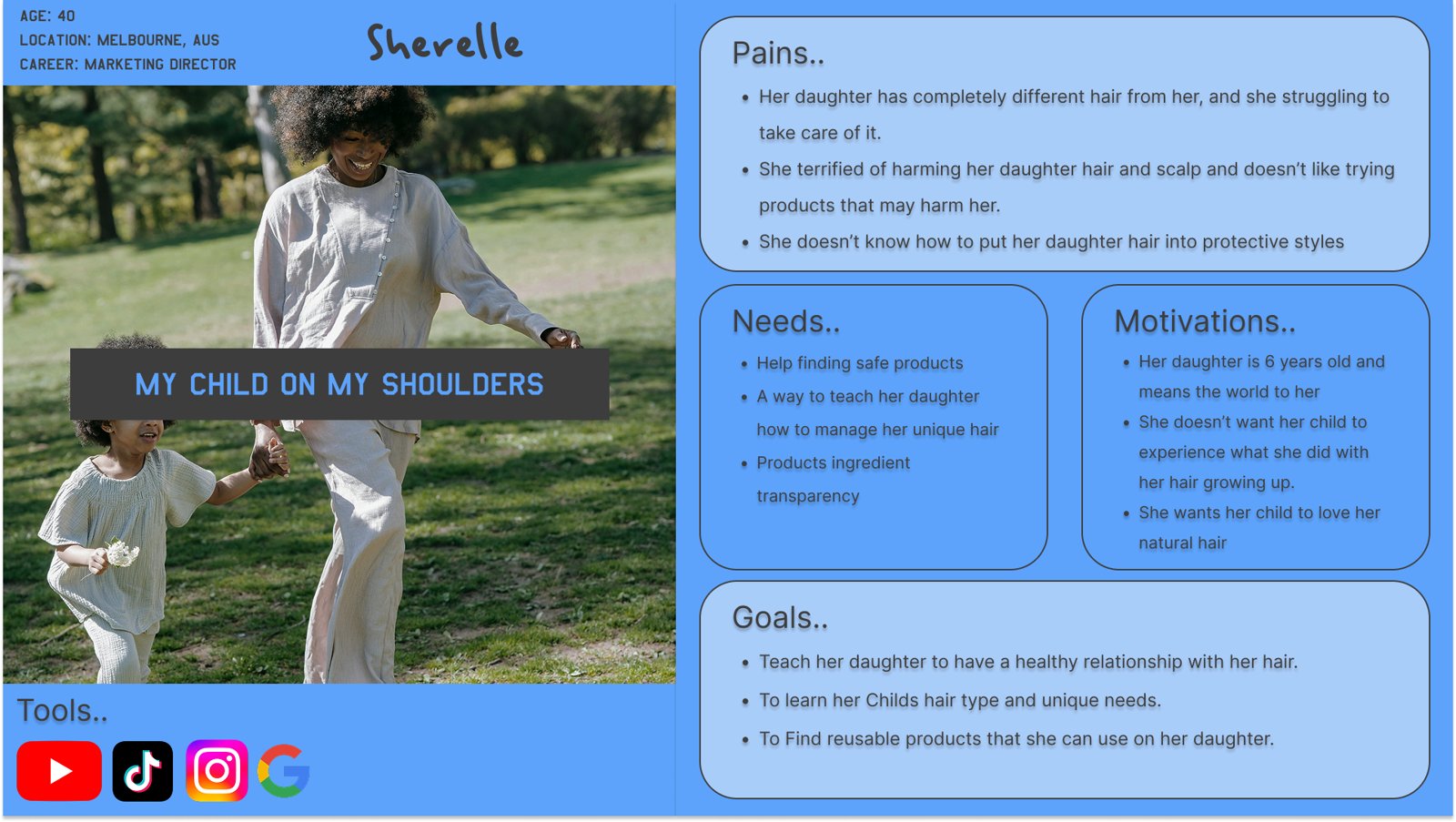
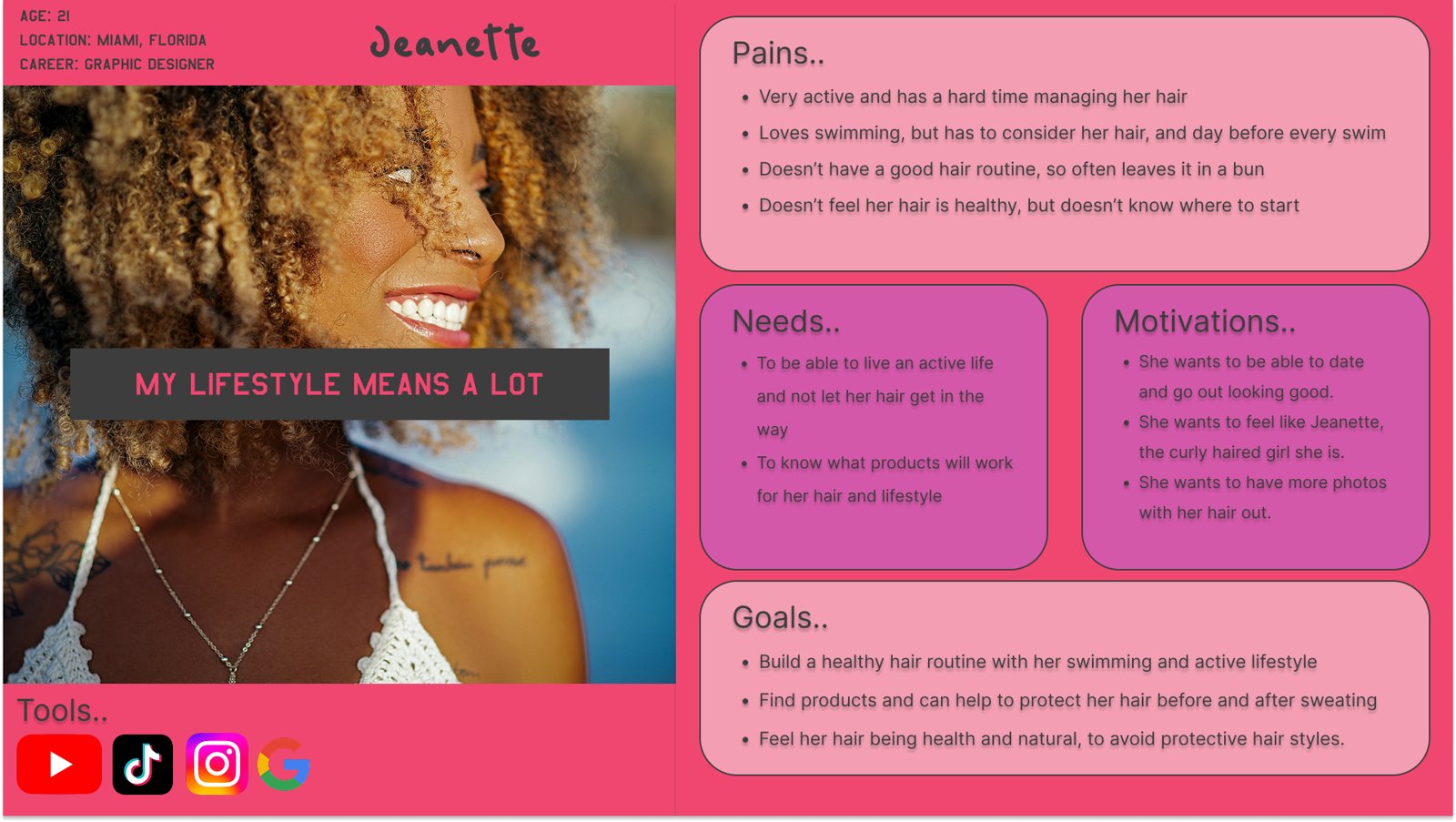
Target customer. Three personas came out of the research:
| Persona | Who she is | Key goal | Key pain |
|---|---|---|---|
| Jasmine | 26, London, marketing director who travels | A healthy routine and less money wasted on products | Spends too much on products that don’t work; hard to find stylists abroad |
| Sherelle | 40, Melbourne, mother of a 6-year-old | Teach her daughter to love and care for her hair | Her daughter’s hair is different from hers; afraid of harmful products |
| Jeanette | 21, Miami, swimmer with an active life | A routine that survives sweat and pool days | No routine, so her hair usually ends up in a bun |
4. Customer segmentation
We prioritized high-spending professionals with textured hair, the Jasmine segment. Their spend is the business case: redirect it to the right products and the product earns trust and a path to revenue.
| Segment | Impact | Urgency | Size of market | Total |
|---|---|---|---|---|
| High-spending professionals with textured hair | 5 | 4 | 4 | 13 |
| Parents caring for a child’s textured hair | 4 | 4 | 3 | 11 |
| Active, lifestyle-driven young women | 3 | 3 | 3 | 9 |
Scored 1–5, retrospectively from research findings.
Parents scored close behind and stay in the roadmap as household profiles; the same analysis and routines serve them once the core works for one person.
5. Customer pain point
We prioritized not understanding my own hair, the root cause behind years of trial and error.
| Pain point | Impact | Urgency | Size | Total |
|---|---|---|---|---|
| Not understanding my own hair, so years of trial and error | 5 | 5 | 5 | 15 |
| Finding products that fit my hair, climate and lifestyle | 5 | 4 | 4 | 13 |
| Trusting ingredients are safe | 4 | 3 | 4 | 11 |
| Finding a stylist who knows textured hair | 4 | 3 | 3 | 10 |
| Buying products locally or abroad | 3 | 3 | 2 | 8 |
Scored 1–5, retrospectively from research findings.
Every interview told the same story: “A lot of Googling, a lot of YouTube,” products bought and abandoned, and routines that broke when life or climate changed (“In Bali, I wash every day”). Product fit scored second, but recommending products to someone who doesn’t understand her hair only restarts the cycle, so understanding came first.
6. Prioritized solution
We chose photo analysis with a plain-language hair report, fed by a short lifestyle questionnaire.
| Proposed solution | Ease (5 = easy) | Eng. effort (5 = easy) | Effectiveness | Total |
|---|---|---|---|---|
| Photo analysis + plain-language hair report | 4 | 4 | 5 | 13 |
| Lifestyle questionnaire, by voice or text | 4 | 4 | 4 | 12 |
| Product recommendations from the profile | 4 | 4 | 3 | 11 |
| Routine builder with reminders | 3 | 2 | 5 | 10 |
| Stylist profiles and salon recommendations | 2 | 2 | 3 | 7 |
| AI hairstyle recommendation | 2 | 2 | 2 | 6 |
Effort mapped from my feature backlog’s sizing (S = 4, M = 3, L = 2); scored retrospectively.
The analysis answers the top pain directly and was small to build on an existing multimodal model. The questionnaire and recommendations came with it, because a routine that ignores real life fails.
Key product decisions
| Decision | I chose | Over | Why |
|---|---|---|---|
| Core experience | A guided flow | A search bar or feed | Win on clarity, not on volume of content |
| Understanding the user | Photo analysis plus lifestyle questions | Hair type alone | Routines fail when they ignore real life |
| AI’s role | Explain the why in plain language | Just output a routine | Trust comes before automation |
| Feedback | Thumbs up or down on every result | No feedback loop | Users get control; the model learns |
What we cut, and why
| Cut | Moved to | Reason |
|---|---|---|
| Stylist profiles and salon recommendations | P4 | Real need, but a marketplace is a separate product; it needs trust and supply first |
| AI hairstyle recommendation | P4 | Styling isn’t the root pain; high effort |
| Photo inspiration wall | P4 | Engagement feature with no link to understanding |
| Product scan for match analysis | P3 | Valuable, but depends on a product database that doesn’t exist yet |
7. Develop MVP
The MVP is one loop: photo → plain-language report → lifestyle questions → routine and matched products → reminders and rescans, with a thumbs up or down on every answer.
North star: routines followed for three or more weeks. An analysis is a one-time novelty; weeks of routine change hair and earn trust.
| Stage | Metric | Signal |
|---|---|---|
| Try | Photo uploaded | Vanity on its own |
| Understand | Report read, questionnaire done | Real |
| Commit | Routine started, reminders on | Real |
| Habit | Routine followed 3+ weeks | North star |
User stories and acceptance criteria
| # | User story | Acceptance criteria |
|---|---|---|
| 1 | As a woman with textured hair, I want to take or upload a photo and get an analysis, so that I finally understand what my hair needs. | Camera or gallery upload, with tips on the confirm screen. The report explains results in plain language. Thumbs up or down on every result. |
| 2 | As a user, I want to describe my lifestyle by voice or text, so that advice fits my climate and routine. | Voice or text input. The assistant asks follow-up questions and offers suggested replies. |
| 3 | As a user, I want products matched to my profile, so that I stop paying for trial and error. | Each recommendation shows why it fits my profile. Save or shop from the list. Sponsored items labeled. |
| 4 | As a user, I want to turn my report into a routine and add it to my calendar, so that I actually stick to it. | An intro screen sets expectations. The routine is generated from my answers. Add to calendar in one step, with a confirmation. |
| 5 | As a returning user, I want reminders and rescans, so that I can see my hair change over time. | Wash-day and treatment reminders. Rescan at any time from home. |
The test plan’s bar: complete each task with no errors.
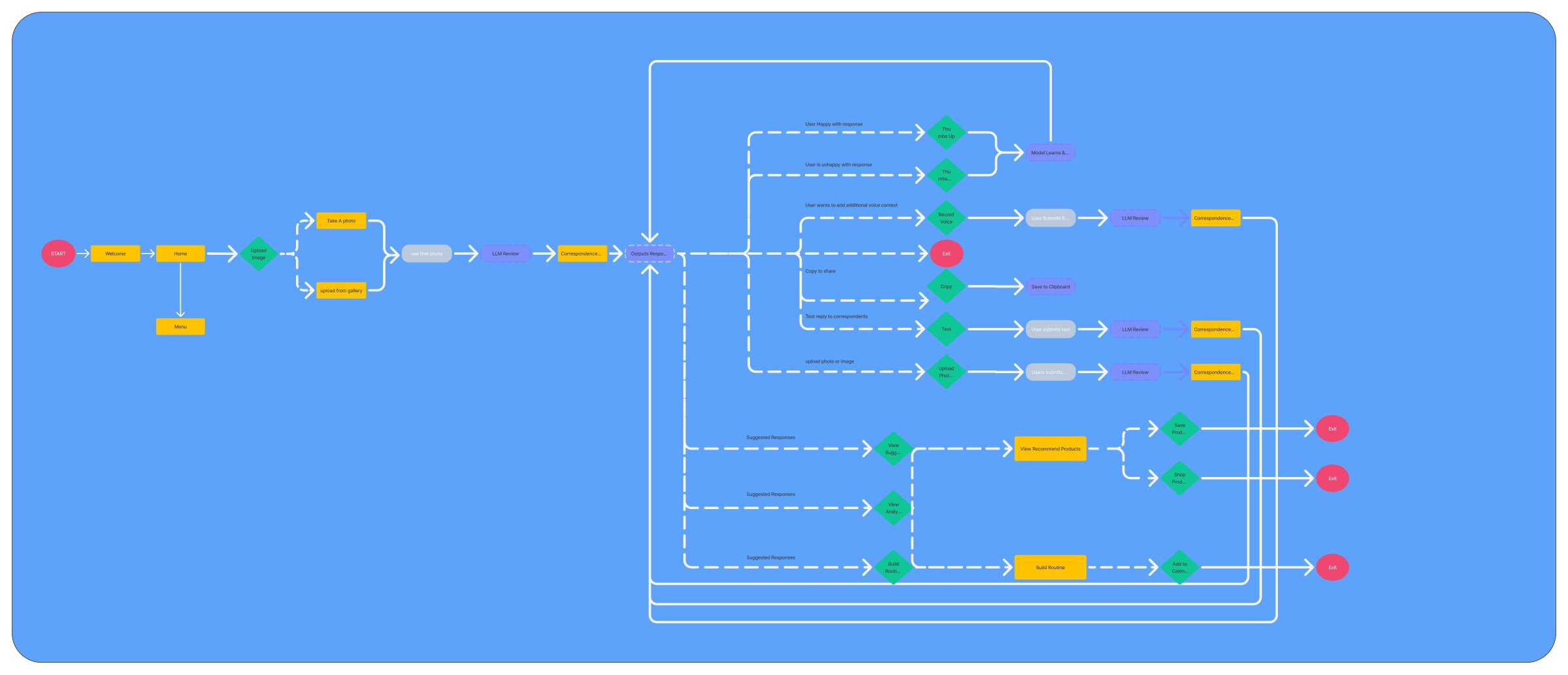
User flows
The task flow is the happy path; the user flow shows every branch after the first report. Select a flow to open it full size.

8. Launch plan
Just Hair hasn’t launched; this is how it will go to market. An iOS version is in definition.
- First market: high-spending professionals with textured hair in the U.S., starting with the research participants and a waitlist.
- Promotion: natural-hair creators and communities on YouTube and social, where research showed women already go to learn.
- AI approach: ground an existing model in a curated hair-care knowledge base instead of training one. It ships fast, stays grounded in vetted hair science and updates without retraining. Fine-tuning comes once real thumbs up and down signals exist.
| Phase | What ships | Gate to move on |
|---|---|---|
| Beta | Analysis, questionnaire, routines, recommendations, feedback signals | Over 60% of users rate results; analysis rated accurate over 95% of the time |
| v2 | Product scan anywhere, progress tracking, household profiles, fine-tuned model | Routines followed 3+ weeks |
| v3 | Stylist marketplace, climate and travel adjustments | Recommendation revenue proven |
How it will make money
| Path | How it pays | Why it fits |
|---|---|---|
| Product recommendations | Affiliate revenue or brand partners | Users already spend; these are purchase-intent moments |
| Premium routines | Subscription for tracking and household profiles | Value grows the longer someone uses it |
| Stylist marketplace | Booking fee for vetted stylists | Solves the trust problem research surfaced |
The risk to manage: affiliate money can bias recommendations, so they will stay tied to the hair profile, with sponsorship labeled.
Privacy, built in from day one
- Explicit consent before any data improves the AI
- Entries anonymized: names, location and photo metadata stripped
- A clear “don’t train on my data” option
- A plain-English explanation of how data helps the user
9. Customer feedback and iterations
Two rounds of testing shaped the final design. First a mid-fi test with the six research participants across three flows: complete a hair analysis, create a routine and find products.
| What we saw | What I changed |
|---|---|
| The “swipe no” button made people hesitate | Clarified the choice |
| Suggested replies sped people through the analysis | Kept and expanded them |
| The back arrow and back button confused people | Replaced with a Cancel button |
| The photo-upload check lacked context | Added a title, tips and guidance |
| People wanted more guidance | Added an intro before the routine questions and a congratulations step that leads to add-to-calendar |
Then an unmoderated Maze test of the routine flow, with no help: 17 people started and 7 finished.
| Result | Score |
|---|---|
| Completed the routine flow | 85% |
| Said the hair report was what they needed | 86% |
| Rated its value to them 4 out of 5 | 57% |
| Found navigation “somewhat intuitive” | 57% |
Testers liked the routine questions and the clean layout but found the light-blue buttons looked disabled and the background too busy. The nine changes that followed: a stronger call-to-action color, outlines instead of background scribbles, more photos, guide text, simpler copy for all levels of English, a stronger blur behind pop-ups, clearer checkboxes and better contrast.
Appendix: the full feature backlog
All 14 features, ranked P1 to P4 with effort sizes.
| Priority | Feature | Effort | Outcome |
|---|---|---|---|
| P1 | Log in and sign up | S | In prototype |
| P1 | Photo or video upload and AI analysis | S | In prototype |
| P1 | Product recommendations | S | In prototype |
| P1 | AI lifestyle questionnaire by voice | S | In prototype |
| P1 | Thumbs up or down signals on results | S | In prototype |
| P2 | Photo uploads and profile | S | In prototype |
| P2 | Routine creator | L | In prototype (promoted) |
| P2 | Scheduler and reminders | M | In prototype |
| P3 | Product scan for match analysis | M | Deferred |
| P3 | Data-sharing settings | S | Planned for launch |
| P4 | Stylist profiles | L | Cut |
| P4 | Salon recommendations | L | Cut |
| P4 | AI hairstyle recommendation | L | Cut |
| P4 | Photo inspiration wall | XS | Cut |